





Walk
A well-kept Roman secret
Mérida, Spain
Walk
A well-kept Roman secret
Mérida, Spain
6.5 km
Distance
2h40
Durée
19
Audios
Loop
Parcours
Shutterstock
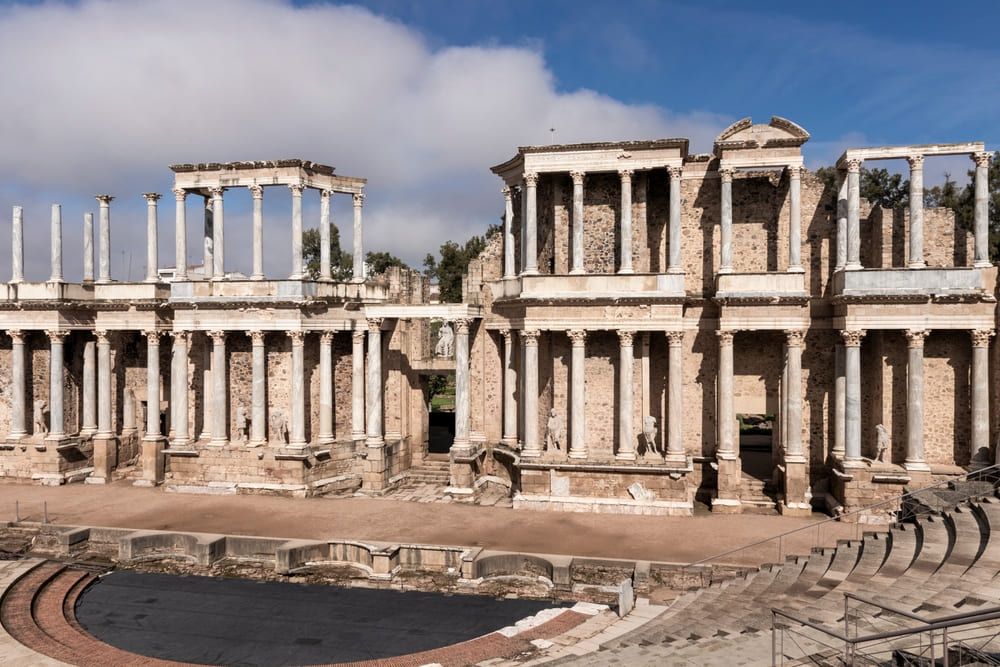
The Roman theatre of Mérida is the most important archaeological ensemble of the town, the site not to be missed, formed of the theatre and the amphitheatre of the ancient Augusta Emerita. The Mérida audio-guided tour stops here to evoke this masterpiece of the first century before our era, whose magnificent columned stage still hosts today a great festival of classical theatre.
You arrive now at the most important archaeological ensemble of Mérida. If you had to visit only one site, it would be this one. Alas, you do not see much from the outside; the best is to take an entry to go and discover the ruins of the theatre and the amphitheatre of the ancient Augusta Emerita. And if you plan to visit other monuments of the archaeological ensemble of Mérida, opt rather for a combined entry, that gives access to all the sites of the town. The complex that you have here was built at the end of the first century before our era, when Augusta Emerita was already the capital of the province of Lusitania. The theatre, the jewel of the site, was offered to the town by Marcus Agrippa, the faithful right-hand man of the emperor Augustus. It could host nearly six thousand spectators in its tiers in a hemicycle, leaning against a hill for reasons of acoustics and stability. But its marvel is the stage, the frons scaenae, a splendid back wall adorned with two storeys of marble columns, statues and pediments, reconstituted and magnificently preserved, that forms one of the finest images of Roman archaeology. Next to it stands the amphitheatre, where the combats of gladiators and the hunts took place, that could also host thousands of spectators. Still today, each summer, the theatre comes to life again during a great international festival of classical theatre, reconnecting with its vocation two thousand years later. An ancient theatre and a wonder of Mérida, the Roman theatre is a fine stop of the discovery of the town.
Here you discover the major archaeological ensemble of Mérida, the theatre and the amphitheatre of Augusta Emerita, built at the end of the first century before our era; the theatre, offered by Marcus Agrippa, could host nearly six thousand spectators and keeps its splendid stage with two storeys of marble columns, while the neighbouring amphitheatre hosted combats of gladiators and hunts. The Roman theatre is the wonder of Mérida. It is a fine stop, to be explored on foot.
The Roman theatre and the amphitheatre lie in the heart of Mérida, reachable on foot. The site follows its own days and opening hours, variable, and entry is subject to a fee, often offered in a combined formula giving access to all the monuments of the town. Each summer, the theatre hosts a festival of classical theatre. It is best to enquire before coming.
Because it is the major archaeological ensemble of the town and one of the finest preserved Roman theatres: built at the end of the first century before our era and offered by Marcus Agrippa, it could host nearly six thousand spectators and keeps its splendid stage with two storeys of marble columns; it hosts each summer a great festival of classical theatre, near the amphitheatre.
In the heart of Mérida, in Extremadura, in Spain.
Aucun avis pour le moment
