





Walk
The city of sea and freedom
Cadiz, Spain
Walk
The city of sea and freedom
Cadiz, Spain
5.4 km
Distance
2h30
Durée
25
Audios
Loop
Parcours
Shutterstock
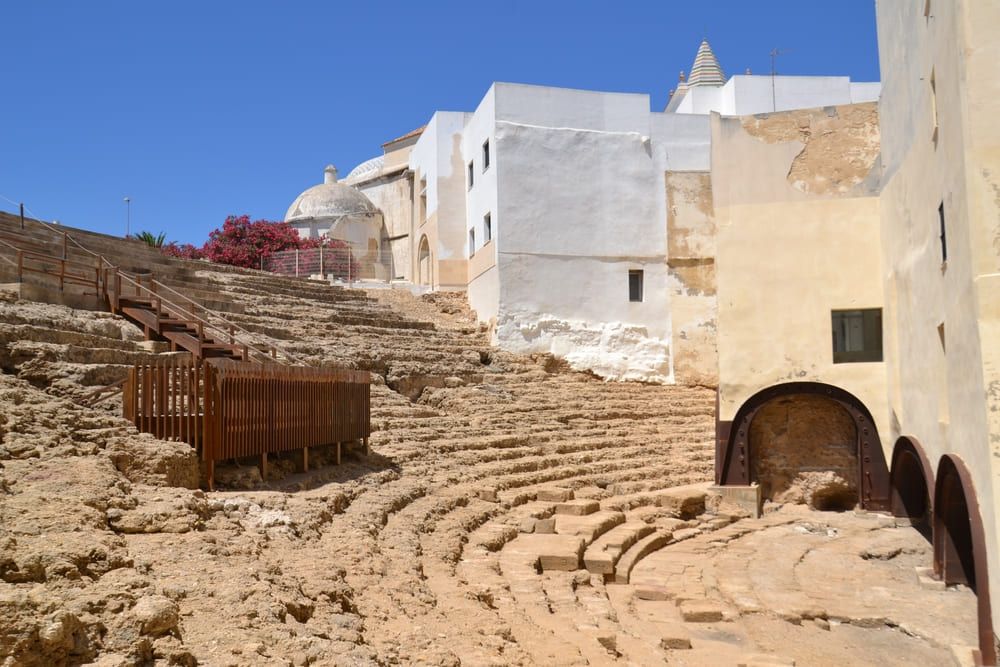
The Roman theatre of Cadix is one of the oldest of all Hispania, rediscovered by chance in 1980 under the houses of the El Pópulo district. The Cadix audio-guided tour stops here to evoke this building of the first century before our era, willed by the powerful Balbo family, that could host more than ten thousand spectators in the time of ancient Rome.
Behind these railings lie the vestiges of the Roman theatre of Cadix, one of the oldest of all Hispania. It was rediscovered in 1980, almost by chance, under the houses of the old district of El Pópulo. This theatre dates from the first century before our era and owes its existence to the Balbo family, Gaditans of Phoenician origin become Roman citizens and close to Julius Caesar. Their idea was ambitious: to create a Neápolis, a new town endowed with great public buildings, including this theatre that could host more than ten thousand spectators, an enormous figure for a town five times smaller. Built on the hillside, it followed the codes of Roman theatres: the working classes seated at the top, the more well-off citizens in the middle, and the elites right at the bottom, just at the edge of the orchestra and the stage, formerly decorated with columns, statues and mobile sets. Over the centuries, the theatre was abandoned then reused: stones were taken from it, its galleries were transformed into warehouses, and a medieval fortress was even built over it. Today, several buildings still rest on its buried tiers, and a centre of interpretation allows to understand the scale of this exceptional monument, witness of the grandeur of Cadix in Antiquity. An ancient theatre and a buried treasure, the Roman theatre is a fine stop of the discovery of Cadix.
Here you discover one of the oldest Roman theatres of Hispania, rediscovered by chance in 1980 under the houses of El Pópulo; built in the first century before our era by the Romanised Phoenician Balbo family, close to Julius Caesar, it could host more than ten thousand spectators and was, over the centuries, transformed into a quarry, a warehouse and even surmounted by a medieval fortress. The Roman theatre is an ancient treasure of Cadix. It is a fine stop, to be explored on foot.
The Roman theatre lies in the El Pópulo district, in the heart of the old town of Cadix, reachable on foot. The site and its centre of interpretation can be visited according to the hours in force, which vary; entry is generally free. It is best to enquire before coming. You discover it during a walk in old Cadix.
The Balbo family, Gaditans of Phoenician origin become Roman citizens and close to Julius Caesar, who wanted to create a new town, a Neápolis, endowed with great buildings; built in the first century before our era, this theatre, one of the oldest of Hispania, could host more than ten thousand spectators and was rediscovered by chance in 1980 under the El Pópulo district.
In the El Pópulo district, in the heart of the old town of Cadix, in Spain.
Aucun avis pour le moment
