





Walk
A well-kept Roman secret
Mérida, Spain
Walk
A well-kept Roman secret
Mérida, Spain
6.5 km
Distance
2h40
Durée
19
Audios
Loop
Parcours
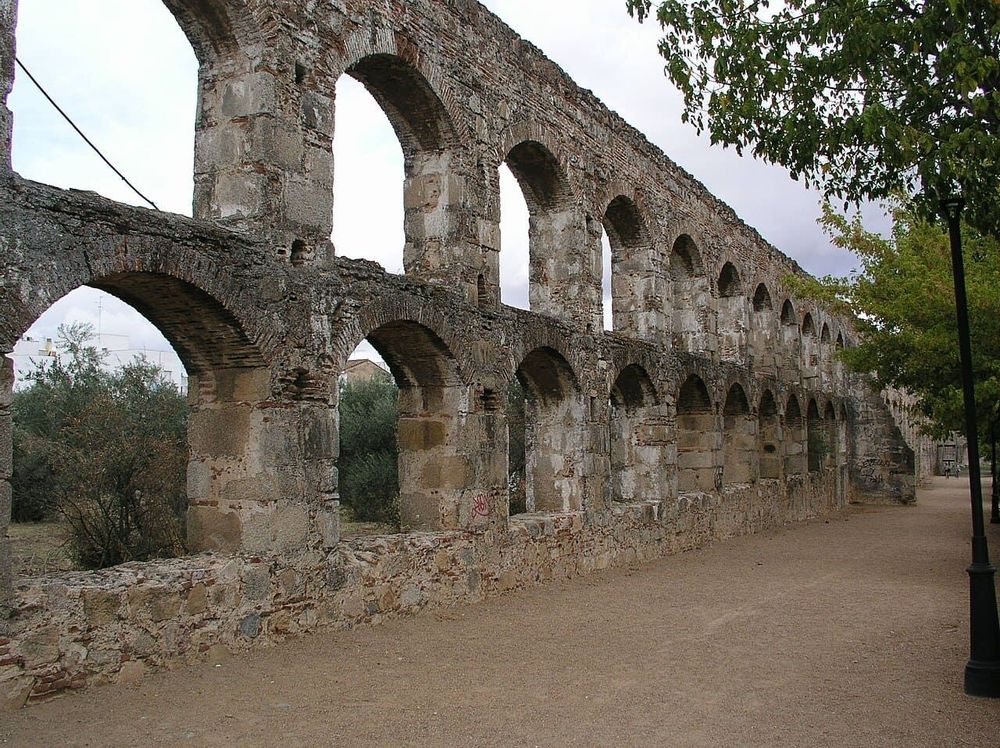
©Xauxa CC BY-SA 2.5. <https://creativecommons.org/licenses/by-sa/2.5/deed.fr>via Wikipedia Commons
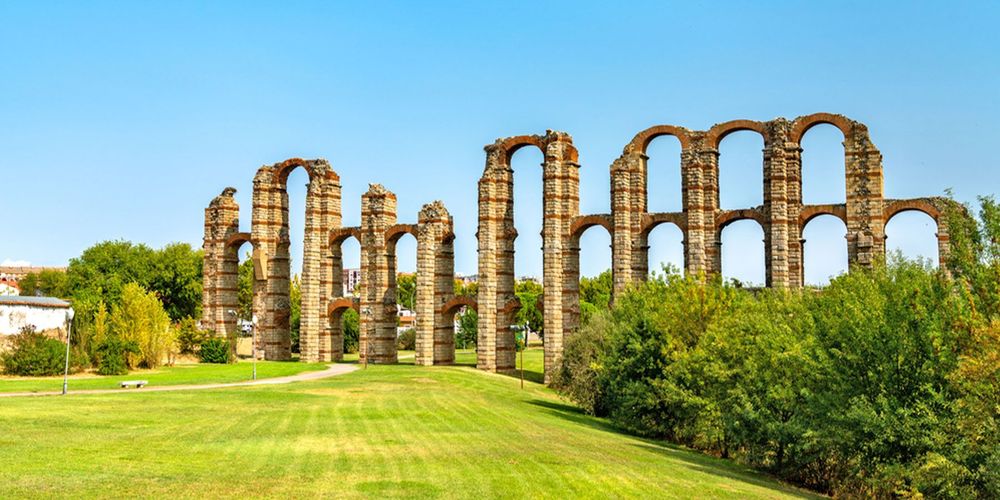
The aqueduct of San Lázaro is one of the two great aqueducts that supplied with water the ancient Augusta Emerita, of which high superimposed arches subsist. The Mérida audio-guided tour stops here to evoke this Roman work, completed in the Renaissance, witness of the ingenious hydraulic system that supplied the town with water from its reservoirs and its springs.
Here you are now in front of the aqueduct of San Lázaro, the aqueduct of Saint Lazarus. It takes its name from a former neighbouring hermitage, today demolished, that was dedicated to it. It is one of the two great aqueducts that supplied the town with water, with the impressive Aqueduct of the Miracles. For an ancient town like Augusta Emerita, the supply of water was an essential question, the very condition of the expansion and the comfort of a great Roman capital. The Romans had therefore deployed a hydraulic system of great ingenuity: several reservoirs and dams were created in the surroundings, natural springs were captured and channelled, and the water was conveyed towards the town, where it was stored in water towers before being redistributed throughout the town by a network of pipes, feeding fountains, baths and houses. The aqueduct of San Lázaro is part of this system. Of the original Roman work subsist some pillars and arches; next to it stands a more recent aqueduct, of Renaissance style, built in the sixteenth century to replace it by reusing the same route, and preserved almost intact. You can also see vestiges of this network elsewhere in the town. With its high arcades in the greenery, the aqueduct of San Lázaro testifies, like so many other monuments, to the hydraulic genius of Rome. An ancient aqueduct and a memory of water, the aqueduct of San Lázaro is a fine stop of the discovery of Mérida.
Here you discover one of the two great aqueducts that supplied with water the ancient Augusta Emerita, named after a former hermitage dedicated to Saint Lazarus; of the Roman work subsist pillars and arches, next to a Renaissance aqueduct of the sixteenth century that replaced it, witnesses of the ingenious Roman hydraulic system of reservoirs, captured springs and pipes. The aqueduct of San Lázaro is a witness of the hydraulic genius of Mérida. It is a fine stop, to be explored on foot.
The aqueduct of San Lázaro lies to the north of the centre of Mérida, reachable on foot. It is an open-air site, freely accessible and visible. You discover it during a walk to the north of the town, between the Roman vestiges and the greenery.
One of the two great aqueducts that supplied with water the ancient Augusta Emerita, named after a former hermitage dedicated to Saint Lazarus; of the Roman work subsist pillars and arches, next to a Renaissance aqueduct of the sixteenth century that replaced it, witnesses of the Roman hydraulic system of reservoirs, captured springs and pipes.
To the north of the centre of Mérida, in Spain.
Aucun avis pour le moment
