





Walk
Isle of Kings
Palma de Mallorca, Spain
Walk
Isle of Kings
Palma de Mallorca, Spain
5 km
Distance
2h00
Durée
26
Audios
Loop
Parcours
Shutterstock
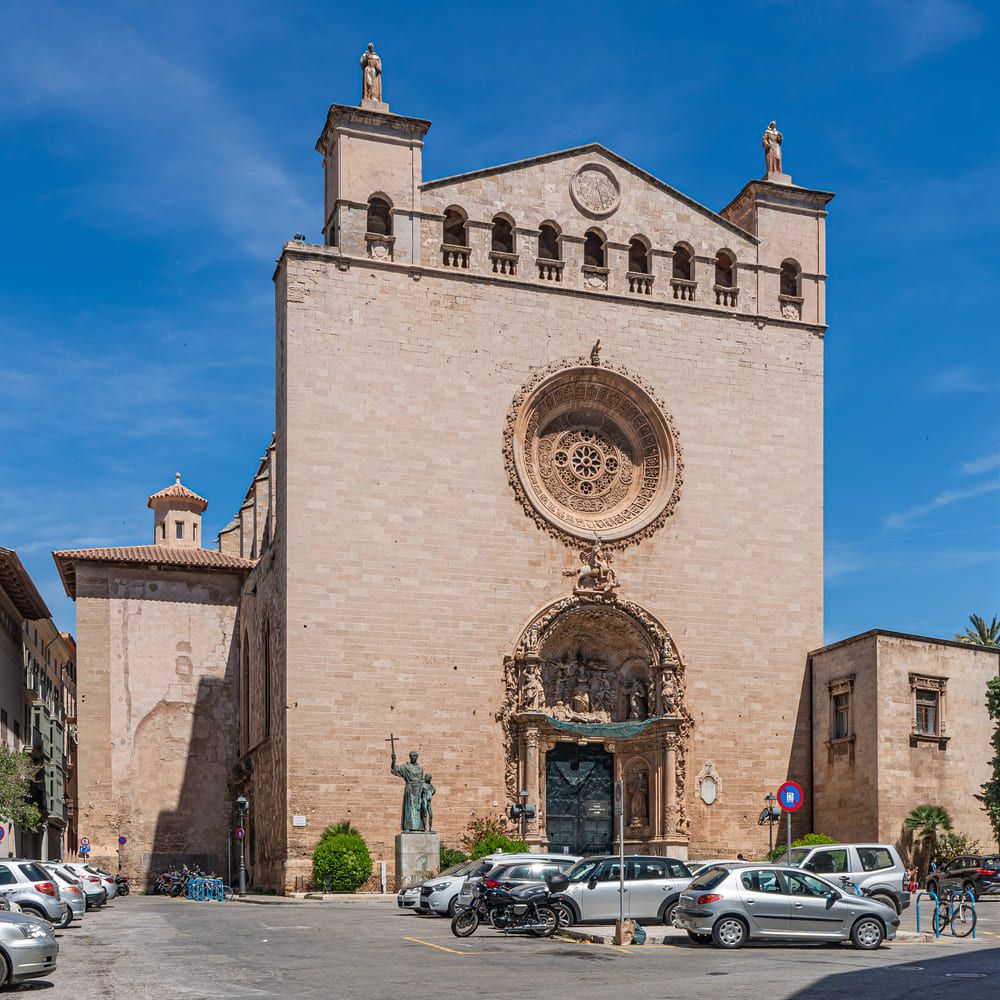
The Church of Saint Francis, the basilica of Sant Francesc, is one of the most important religious ensembles of Palma, famous for its magnificent Gothic cloister. The Palma audio-guided tour stops here, with respect, to evoke this Franciscan sanctuary, a jewel of the old town.
The Church of Saint Francis, the basilica of Sant Francesc, is one of the main religious buildings of Palma, founded by the Franciscans after the Christian conquest of the island. Its construction, begun in the thirteenth century, extended over several centuries, giving it a majestic character, between Gothic and baroque. Its main façade, adorned with a fine baroque portal and a great rose window, gives onto a square where a statue stands. Inside, the vast church shelters the tomb of Ramon Llull, the great Majorcan philosopher, theologian and writer of the Middle Ages, one of the most important figures of the history of the island. But the treasure of the ensemble is its magnificent Gothic cloister, one of the finest of Spain: its galleries with slender columns, its elegant arches and its peaceful garden planted with orange trees compose a haven of serenity and beauty. A major sanctuary and a jewel of the Gothic, the Church of Saint Francis is discovered with respect.
You admire, with respect, one of the main religious buildings of Palma, a Franciscan basilica built from the thirteenth century between Gothic and baroque, with a fine façade adorned with a baroque portal and a rose window, sheltering the tomb of the Majorcan philosopher Ramon Llull, and above all its magnificent Gothic cloister with slender columns and orange-tree garden, one of the finest of Spain. The Church of Saint Francis is a jewel of Palma. It is a stop to be discovered with respect.
The Church of Saint Francis lies in the heart of the old town of Palma, reachable on foot. A place of worship, it can be visited with respect for services; access to the church and the cloister follows its own hours and conditions, which vary. It is best to check them before coming and to respect the sacred character of the place.
Its magnificent Gothic cloister with slender columns and orange-tree garden, one of the finest of Spain; this Franciscan basilica built from the thirteenth century also shelters the tomb of Ramon Llull, great Majorcan philosopher and writer of the Middle Ages.
In the heart of the old town of Palma de Mallorca, in Spain.
Aucun avis pour le moment
