





Walk
A well-kept Roman secret
Mérida, Spain
Walk
A well-kept Roman secret
Mérida, Spain
6.5 km
Distance
2h40
Durée
19
Audios
Loop
Parcours
Shutterstock
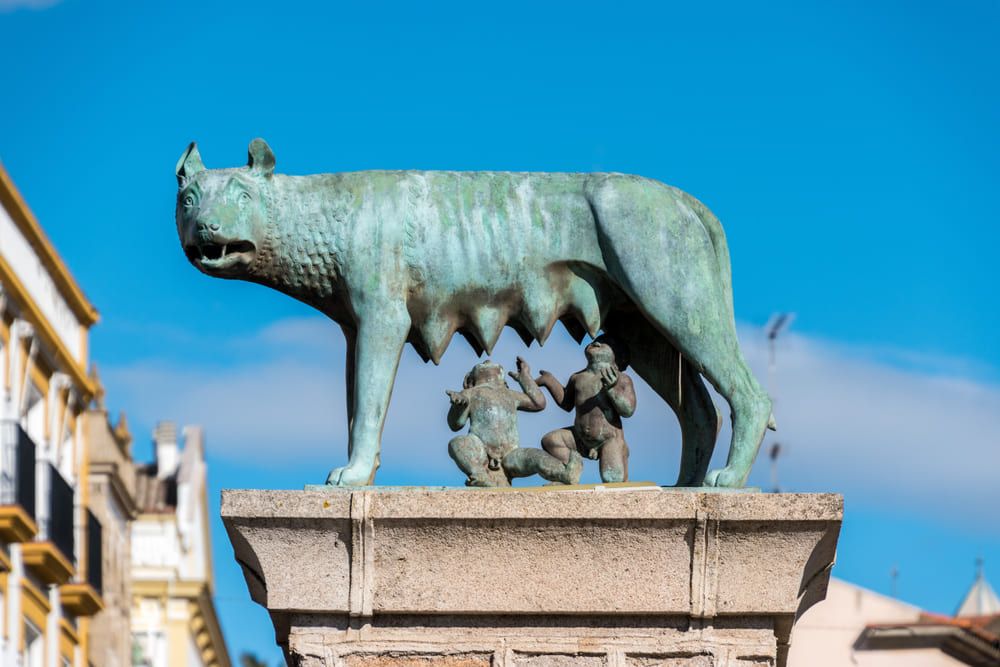
The Capitoline Wolf is a bronze statue offered by Rome to Mérida in 1997, that represents the she-wolf suckling Romulus and Remus, mythical founders of Rome. The Mérida audio-guided tour stops here to evoke this symbol of the Roman heritage of the town, standing near the Alcazaba, a copy of the famous Capitoline wolf.
In the centre of the roundabout, on the Place of Rome near the Alcazaba, stands the statue of the Capitoline Wolf, offered by the city of Rome to Mérida in 1997. The original, an antique bronze, is kept in the Capitoline museums, in Rome, since 1471, but there are numerous replicas across the world, from Paris to Buenos Aires through Chicago, Tokyo and a hundred other towns. This gift to Mérida is no accident: it celebrates the Roman past of Augusta Emerita, one of the most brilliant towns of the Empire, and the deep link that unites the town to Rome. The sculpture represents the she-wolf suckling the twins Romulus and Remus, at the origin of the myth of the foundation of Rome. According to legend, the priestess Rhea Silvia, daughter of King Numitor, was made a mother by the god Mars and gave birth to these twins. When Numitor was overthrown by his brother, the latter had the infants thrown into the Tiber; but the basket that carried them ran aground, and a she-wolf gathered them and suckled them, before a shepherd raised them. Become adults, they founded Rome, but a quarrel opposed the brothers and Romulus killed Remus, becoming the first king of the town to which he gave his name. This founding image recalls, in the heart of Mérida, the Roman roots of the town. A symbolic statue and a nod to Rome, the Capitoline Wolf is a fine stop of the discovery of Mérida.
You admire the bronze statue of the she-wolf suckling Romulus and Remus, offered by Rome to Mérida in 1997 and standing near the Alcazaba; a copy of the famous Capitoline wolf kept in Rome, it celebrates the Roman past of Augusta Emerita and recalls, through the myth of the twins gathered by the she-wolf, the roots of the town in the legendary foundation of Rome. The Capitoline Wolf is a Roman symbol of Mérida. It is a fine stop, to be explored on foot.
The Capitoline Wolf lies on a roundabout, Place of Rome, near the Alcazaba and the Roman bridge, in Mérida, reachable on foot. It is an open-air statue, freely visible. You discover it during a walk between the Alcazaba and the centre.
The she-wolf suckling the twins Romulus and Remus, at the origin of the myth of the foundation of Rome; this bronze statue, a copy of the famous Capitoline wolf, was offered by Rome to Mérida in 1997 to celebrate the Roman past of Augusta Emerita and the link of the town with Rome, and stands near the Alcazaba.
On a roundabout, Place of Rome, near the Alcazaba and the Roman bridge, in Mérida, in Spain.
Aucun avis pour le moment
