





Walk
A well-kept Roman secret
Mérida, Spain
Walk
A well-kept Roman secret
Mérida, Spain
6.5 km
Distance
2h40
Durée
19
Audios
Loop
Parcours
Shutterstock
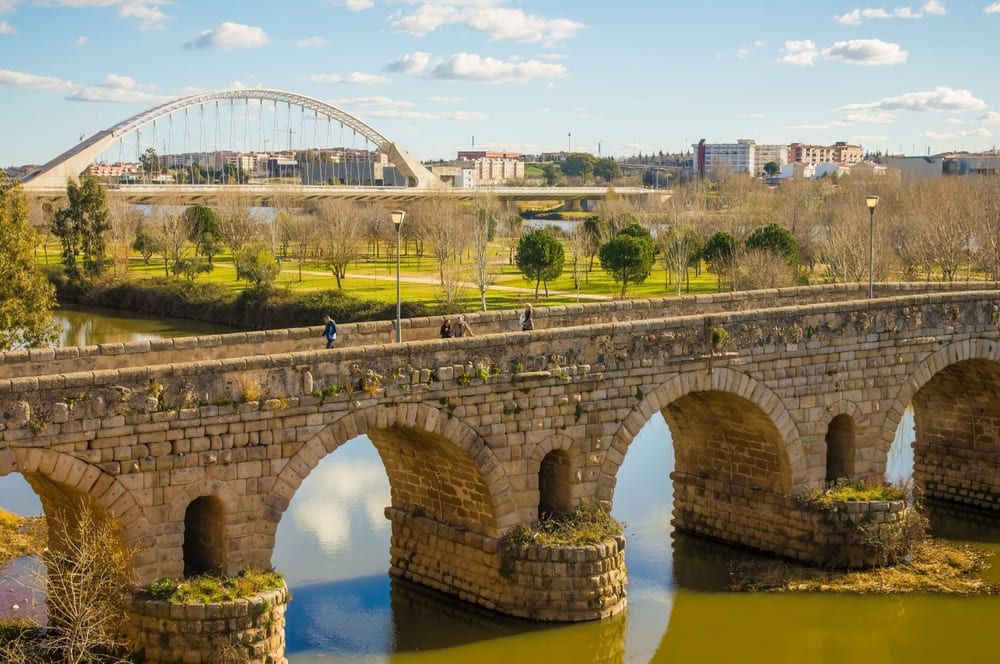
The Roman bridge of Mérida is one of the longest bridges of Antiquity, that crosses the Guadiana over nearly eight hundred metres, the first construction of the town of Augusta Emerita. The Mérida audio-guided tour stops here to evoke this work of the first century before our era, that made the town the great crossroads of the west of the Iberian peninsula.
You are now on the Roman bridge of Mérida, one of the longest bridges of Antiquity. Under the Roman Empire, it crossed the river Guadiana in two sections, separated by a terreplein in the middle of the river, forming like a pause in the heart of the waters. It is the very first construction of the town of Augusta Emerita, raised in the first century before our era, at the same time as the foundation of the town. Thanks to it, the town became the most important centre of the communication network of the west of the Iberian peninsula: capital of the province of Lusitania on the one hand, but also a privileged passage point of the Guadiana thanks to this immense stone bridge, then brand new. Today about eight hundred metres long and counting numerous arches, it testifies to the mastery of the Roman engineers, whose works have crossed two thousand years. Several times restored over the centuries, notably after floods of the river, it has kept the essential of its ancient structure. Long taken by the famous Via de la Plata, the great Roman road linking the south to the north of Hispania, it was the umbilical cord of the town. Today reserved for pedestrians, it offers a magnificent promenade above the Guadiana, with a fine view over the Alcazaba that guarded it. An ancient bridge and a cradle of the town, the Roman bridge of Mérida is a fine stop of the discovery of the town.
Here you discover one of the longest bridges of Antiquity, about eight hundred metres long, that crosses the Guadiana and was the very first construction of Augusta Emerita, in the first century before our era; it made the town the great crossroads of the west of the peninsula, on the Via de la Plata, and offers today, reserved for pedestrians, a fine promenade and a view over the Alcazaba. The Roman bridge is the cradle of Mérida. It is a fine stop, to be explored on foot.
The Roman bridge of Mérida crosses the Guadiana at the foot of the Alcazaba, near the Plaza de España, reachable on foot. It is an open-air work freely accessible, today reserved for pedestrians, particularly fine at sunset. You walk along it during a stroll at the edge of the river.
Because it is one of the longest bridges of Antiquity, about eight hundred metres long, and the very first construction of Augusta Emerita, raised in the first century before our era; by crossing the Guadiana, it made the town the great crossroads of the west of the peninsula, on the Via de la Plata, and it offers today, reserved for pedestrians, a fine promenade above the river.
On the Guadiana, at the foot of the Alcazaba, near the Plaza de España, in Mérida, in Spain.
Aucun avis pour le moment
