





Walk
A well-kept Roman secret
Mérida, Spain
Walk
A well-kept Roman secret
Mérida, Spain
6.5 km
Distance
2h40
Durée
19
Audios
Loop
Parcours
Shutterstock
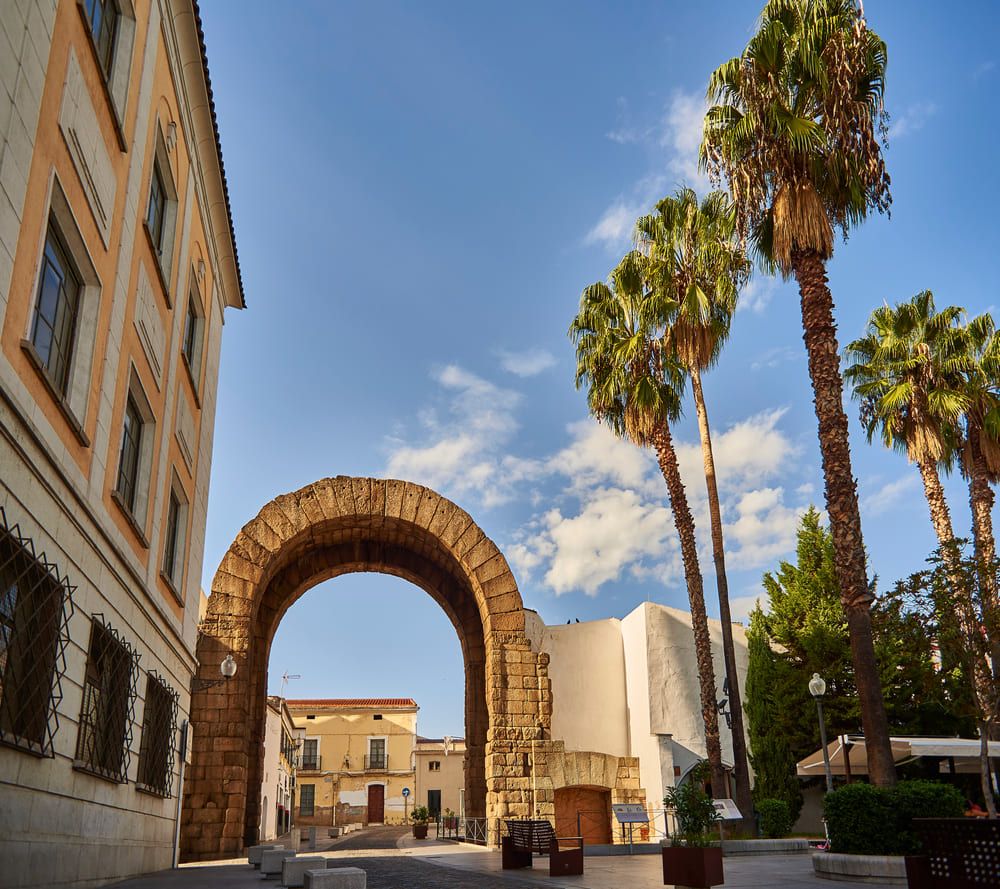
The Arch of Trajan is a monumental Roman arch of the first century, about fifteen metres high, standing in the heart of the historic centre of Mérida. The Mérida audio-guided tour stops here to evoke this imposing granite gateway, that formerly led to a space consecrated to the imperial cult, despite a name that has no proven link with the emperor Trajan.
If you lived in Augusta Emerita in the time of the Romans, you would take this arch that stands in front of you to access a space consecrated to the imperial cult. This cult, new under the Empire, was a form of religion that henceforth considered the emperors and certain members of their family as gods, and rendered them an official cult throughout the Empire. We call this monument the Arch of Trajan, although no information allows to link it to this emperor in particular; it is a traditional name, inherited from an era when it was wrongly held to be a triumphal arch. What we know is that it was built under the reign of the emperor Tiberius, in the first half of the first century. It is a round arch about fifteen metres high, measured from the base of the pillars, even if today its two metres of foundations are buried under the level of the street, that has risen over the centuries. It corresponded to the central span of a great monumental gateway, giving access to a sacred zone. Stripped today of its original marble covering, it reveals the robustness of its granite heart, that allowed it to cross two thousand years. Standing in the middle of a street of the historic centre, it testifies, like so many monuments of Mérida, to the grandeur of Augusta Emerita. A monumental arch and a gateway of the imperial cult, the Arch of Trajan is a fine stop of the discovery of Mérida.
Here you discover an imposing round Roman arch about fifteen metres high, built under the emperor Tiberius in the first half of the first century, that led to a space consecrated to the imperial cult; its name of Arch of Trajan is traditional and without proven link with this emperor, and the arch, stripped of its original marble, reveals its robust granite heart in the middle of a street of the historic centre. The Arch of Trajan is a Roman monument of Mérida. It is a fine stop, to be explored on foot.
The Arch of Trajan lies on Trajano street, in the heart of the historic centre of Mérida, reachable on foot. It is an open-air monument, freely accessible and visible from the street. You discover it during a walk in the monumental centre.
It is a traditional name, without proven link with the emperor Trajan, inherited from an era when it was wrongly held to be a triumphal arch; in reality, this round arch of about fifteen metres was built under the emperor Tiberius in the first half of the first century, and led to a space consecrated to the imperial cult.
On Trajano street, in the heart of the historic centre of Mérida, in Spain.
Aucun avis pour le moment
