





Walk
A City Worth Its Weight in Gold
Zurich, Switzerland
Walk
A City Worth Its Weight in Gold
Zurich, Switzerland
4.3 km
Distance
1h45
Durée
21
Audios
Loop
Parcours
Shutterstock
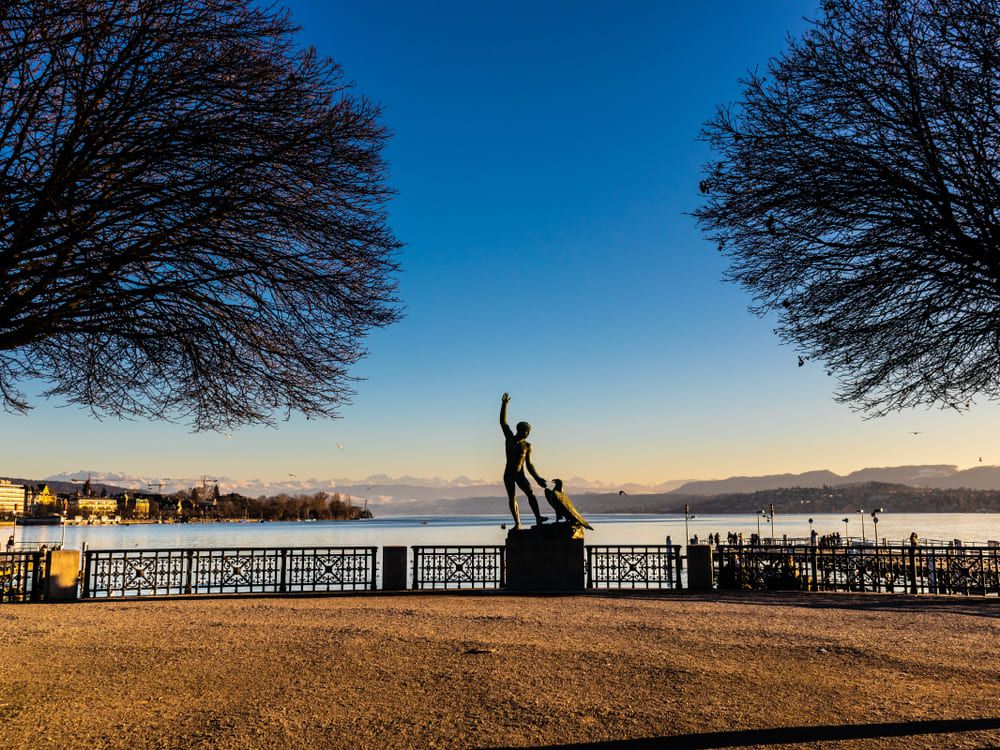
The bronze statue of Ganymede, entitled 'Abduction to Olympus', sits facing the lake on the Bürkliplatz since 1952 and has become the emblem of this square of Zurich. The Zurich audio-guided tour stops here to evoke this work of the sculptor Hermann Hubacher, inspired by Greek mythology, and the particular context in which it was offered to the city.
The bronze sculpture you see in front of you, representing a young man with his arm raised and accompanied by an eagle, is the statue of Ganymede. It sits facing the lake, on the popular Bürkliplatz, since 1952, and is today its emblem. It is an art historian who, in 1942, decided to give to Zurich a male figure, because at that time the city counted especially female representations. The artist Hermann Hubacher thus delivered this work, entitled 'Abduction to Olympus', that shows the young shepherd Ganymede alongside Zeus metamorphosed into an eagle, ready to carry him off to Mount Olympus. Homer describes Ganymede as the most beautiful of mortals and tells how he joined the immortals in the kingdom of the gods to serve Zeus as cupbearer. Behind this Greek mythology, that has nothing Swiss about it, can be read a reflection on the ideal of male beauty, to be placed in the context of its era. Elegant and serene, the statue contemplates the lake and the Alps, and constitutes a meeting point appreciated by the people of Zurich as by visitors. With its silhouette stretched towards the sky, it brings a poetic and mythological touch to the promenade of the lake. A bronze sculpture and an emblem of the square, the statue of Ganymede is a fine stop of the discovery of Zurich.
Here you discover a bronze statue representing the young shepherd Ganymede and Zeus metamorphosed into an eagle, entitled 'Abduction to Olympus', a work of the sculptor Hermann Hubacher installed in 1952 facing the lake, on the Bürkliplatz of which it has become the emblem; inspired by Greek mythology, it evokes the ideal of male beauty. The statue of Ganymede is a meeting point of Zurich. It is a fine stop, to be explored on foot.
The statue of Ganymede stands on the Bürkliplatz, facing the lake of Zurich, at the end of the old town, reachable on foot or by tram. It is a work in free access in the public space, that also offers a fine view over the lake and the Alps. You discover it during a walk by the water.
It represents the young shepherd Ganymede, described by Homer as the most beautiful of mortals, alongside Zeus metamorphosed into an eagle, ready to carry him off to Mount Olympus; entitled 'Abduction to Olympus', this work of the sculptor Hermann Hubacher was offered to the city and installed in 1952 on the Bürkliplatz, of which it is the emblem, in echo of the ideal of male beauty.
On the Bürkliplatz, facing the lake of Zurich, in Switzerland.
Aucun avis pour le moment
