






Walk
The cultural soul of Switzerland
Basel, Switzerland
Walk
The cultural soul of Switzerland
Basel, Switzerland
3.2 km
Distance
1h30
Durée
25
Audios
Loop
Parcours
Shutterstock
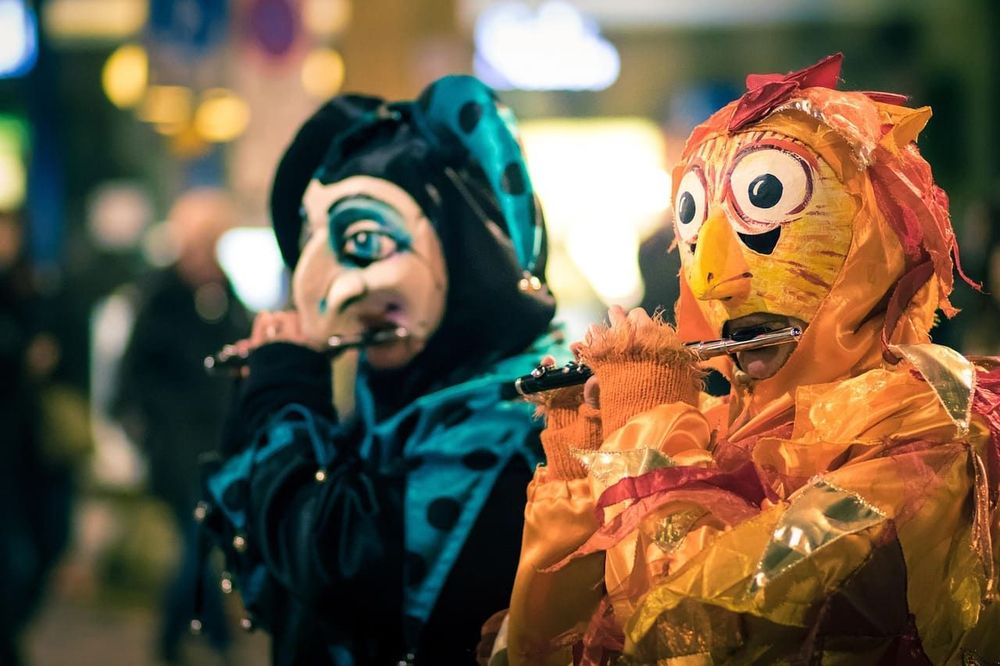
The Basel audio-guided tour has you discover one of the living treasures of the city: the Fasnacht, the Basel carnival, an event so renowned that it is inscribed on the intangible cultural heritage of UNESCO.
The Fasnacht has its origins in the Middle Ages, when people celebrated just before Lent. After the Protestant Reformation, many carnivals disappeared, but that of Basel survived by adopting a unique particularity: it begins on the Monday following Ash Wednesday, at four o'clock in the morning precisely. At that moment, all the lights of the centre go out and thousands of costumed participants invade the streets, lit by hand-painted lanterns, to the sound of fifes and drums. It is the famous Morgenstreich. For three days, the city lives to the rhythm of the parades, the Guggenmusik bands and the Schnitzelbängg, small satirical shows.
More than a festival, the Fasnacht is a tradition deeply anchored in the life of the inhabitants, transmitted from generation to generation, which transforms the atmosphere of Basel each winter. Painted lanterns, costumes, fifes and drums make it a unique spectacle. Even outside the carnival period, one perceives its imprint throughout the city, notably through the works and places that draw inspiration from it.
The Basel carnival, the Fasnacht, takes place each year in the centre of the city, from the Monday following Ash Wednesday, and lasts three days. The festivities are experienced freely in the streets; the Morgenstreich begins at four o'clock in the morning. The precise dates vary each year according to the Easter calendar.
The opening moment of the carnival: at four o'clock in the morning, the lights of the centre go out and the participants parade with painted lanterns, to the sound of fifes and drums.
For its value as a living tradition, deeply anchored in the life of the people of Basel and transmitted from generation to generation.
Aucun avis pour le moment
