



Walk
The Bear Pit
Bern, Switzerland
Walk
The Bear Pit
Bern, Switzerland
4.5 km
Distance
1h50
Durée
24
Audios
Loop
Parcours
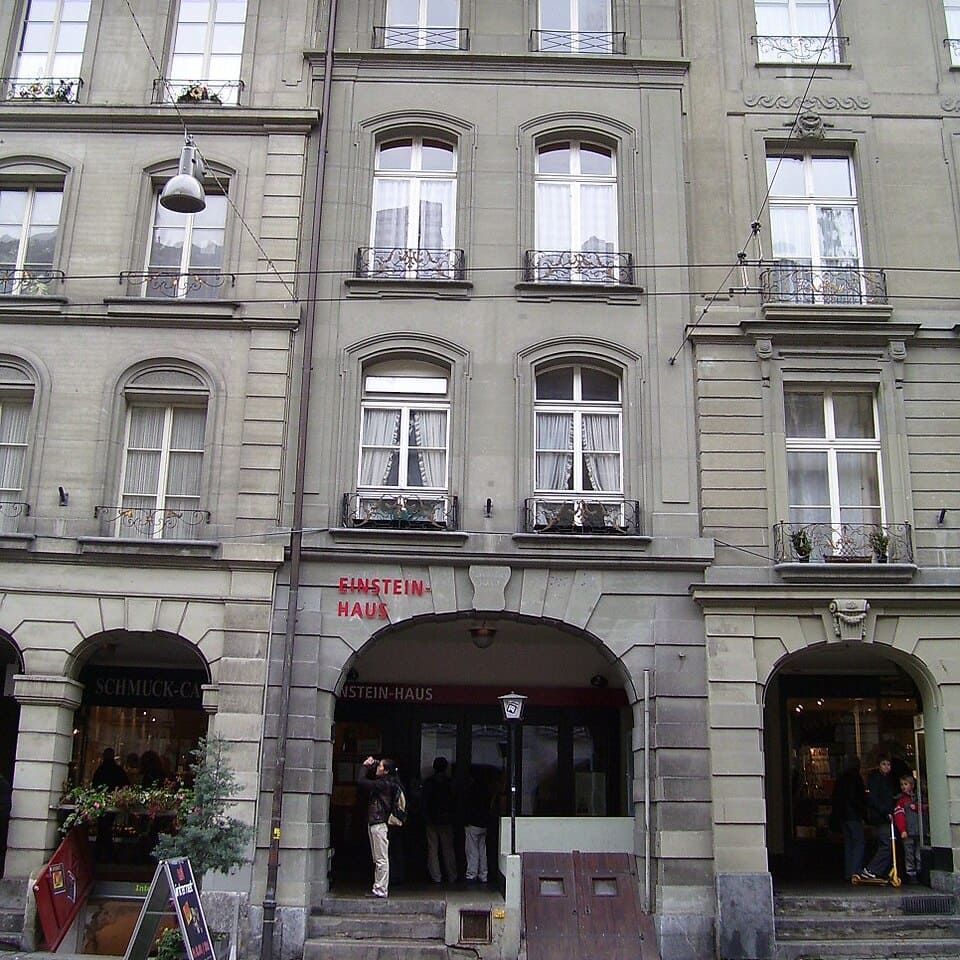
©Dsmntl - CC BY-SA 3.0 <https://creativecommons.org/licenses/by-sa/3.0/deed.fr>via Wikipedia Commons
A stop on the Berne audio-guided tour, the Einstein House is the apartment where the famous physicist lived. Born in Germany, Albert Einstein came to Switzerland at sixteen, joined the Federal Polytechnic School of Zurich, where he met Mileva Maric, whom he married in 1903.
Einstein and his wife settled in Berne between 1902 and 1909. It was in this apartment that he developed his theory of special relativity, immortalised by the famous equation linking energy to mass and the square of the speed of light. This period coincides with 1905, the annus mirabilis, the miraculous year that marked the peak of his career.
The apartment, turned into a museum, is reconstructed as it was in Einstein's time, with its furniture and period objects. A moving dive into the daily life of the scientist at the time he revolutionised physics, on the Kramgasse.
The Einstein House is at Kramgasse 49, in Berne's old town. Opening days, hours and prices should be checked depending on the season with the museum.
His theory of special relativity, during the miraculous year of 1905.
From 1902 to 1909, in the apartment on the Kramgasse.
Aucun avis pour le moment