





Walk
The cultural soul of Switzerland
Basel, Switzerland
Walk
The cultural soul of Switzerland
Basel, Switzerland
3.2 km
Distance
1h30
Durée
25
Audios
Loop
Parcours
Shutterstock
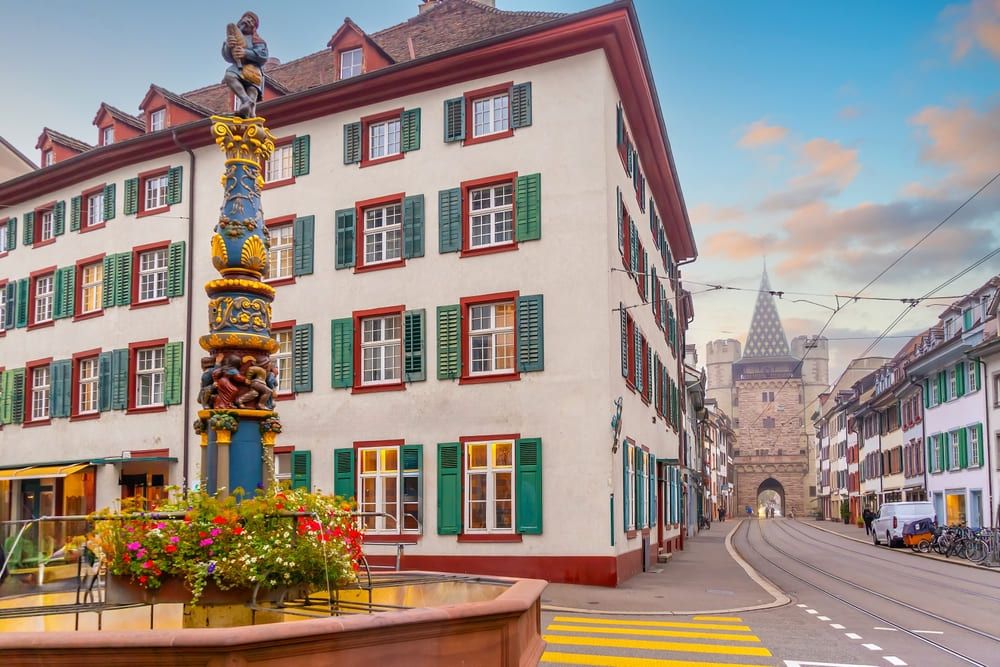
The Basel audio-guided tour has you observe the Holbein fountain, a fine example of Renaissance art in Basel, dating from the middle of the sixteenth century.
The fountain seen today is a copy installed in the nineteenth century, the original being kept at the Historical Museum to be protected. It owes its name to the carved figures that take up famous images of the Renaissance: the peasants dancing around the column are inspired by an engraving made in 1523 by Hans Holbein the Younger, a major painter who lived a long time in Basel, while the bagpipe player at the top takes up the posture of a figure drawn by Albrecht Dürer.
Around the column, the dance scenes bring movement and give the whole a lively character that contrasts with the solidity of the stone. As everywhere in Basel, the fountains have long played an essential role in daily life and remain supplied with drinkable water. The Holbein fountain is one of the hundreds that the city has, and one of the richest in artistic references.
The Holbein fountain is in the old town of Basel. It can be contemplated freely at all hours and on the level; its water is drinkable. The original is kept at the Historical Museum of the city.
Because its dancing peasants are inspired by a 1523 engraving by Hans Holbein the Younger, a painter who lived a long time in Basel.
No, it is a copy installed in the nineteenth century; the original is kept at the Historical Museum to protect it.
Aucun avis pour le moment
