





Walk
The cultural soul of Switzerland
Basel, Switzerland
Walk
The cultural soul of Switzerland
Basel, Switzerland
3.2 km
Distance
1h30
Durée
25
Audios
Loop
Parcours
Shutterstock
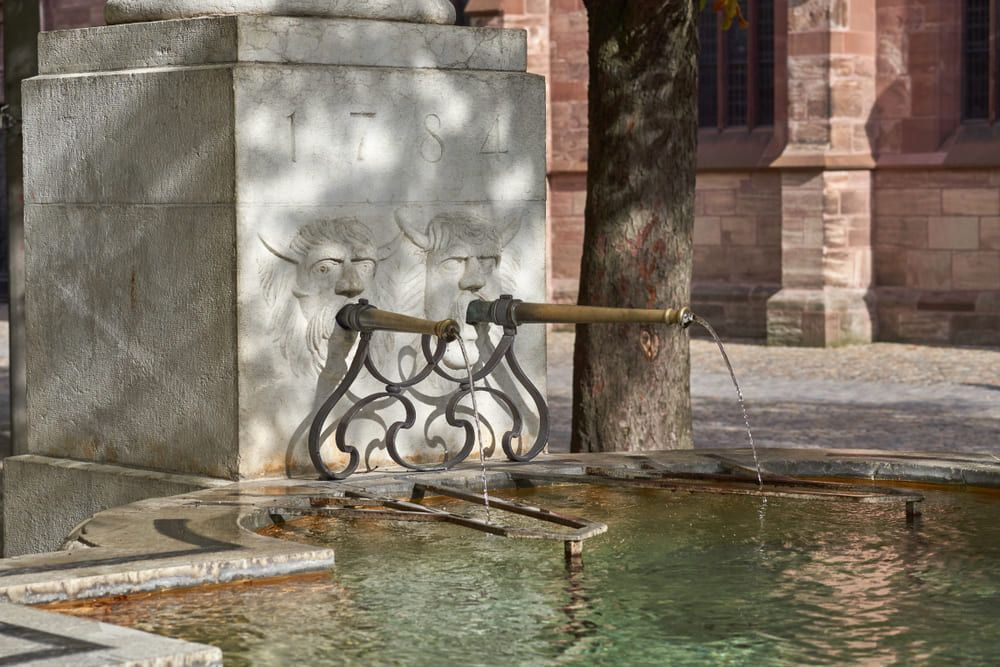
The Basel audio-guided tour stops you, just beside the cathedral, before the elegant Pisoni fountain. A witness to a long tradition, it marks a spot where water has flowed for centuries.
The fountain was made in 1784 by the Italian architect Paolo Antonio Pisoni, to replace an older fountain that had become too damaged, and brought into service the following year. The one seen today is a faithful copy installed in 1937 to preserve the original. It is a remarkable example of a "Zopfbrunnen", a "braid" fountain, a style that appeared at the end of the eighteenth century during the transition from rococo to a more sober classicism. One observes elegant lines, balanced ornaments and two carved heads inspired by stylised creatures of the period.
The fountain charms with the harmony of its lines, its basin and its carved heads, a stone's throw from the cathedral. Still in service, its water is drinkable and flows permanently, making it a pleasant place to pause. It is a fine example of the art of fountains, so present in the urban landscape of Basel.
The Pisoni fountain is just beside the cathedral, on the Münsterplatz, in Basel. It can be contemplated freely at all hours and on the level; its water is drinkable and flows continuously.
The Italian architect Paolo Antonio Pisoni, in 1784; the present fountain is a faithful copy installed in 1937.
A "braid" fountain, a style of the end of the eighteenth century marking the transition from rococo to a more sober and balanced classicism.
Aucun avis pour le moment
