





Walk
Beyond the Picture Perfect Image
San Diego, États-Unis
Walk
Beyond the Picture Perfect Image
San Diego, États-Unis
7 km
Distance
2h50
Durée
24
Audios
Loop
Parcours
Shutterstock
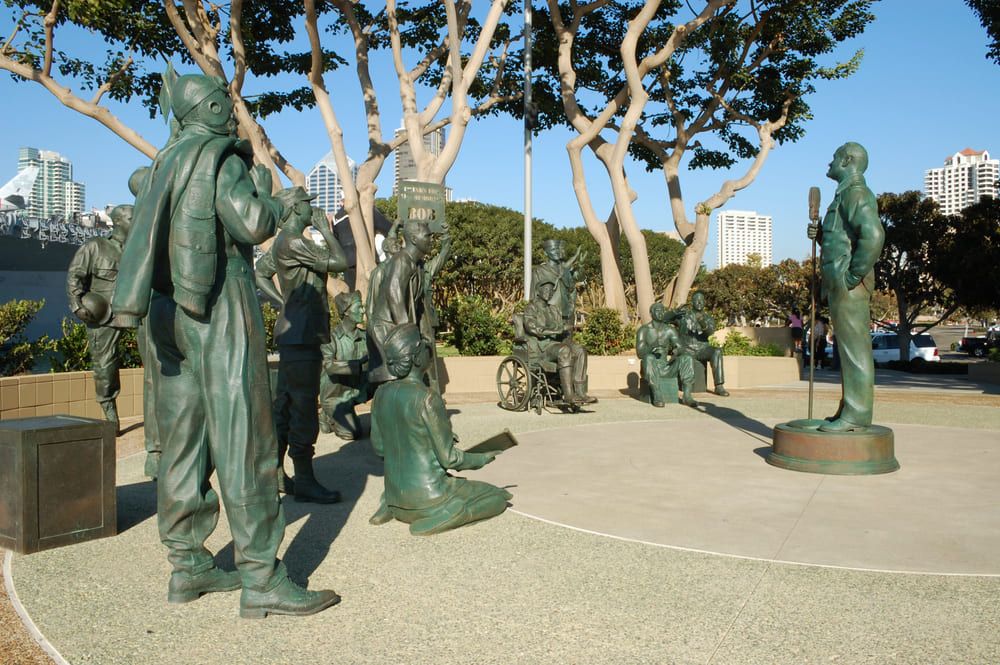
It’s impossible to miss the enormous ship in front of you. But before we get to it, let’s start with something less obvious and take a look at the monuments on this waterfront plaza. To your right, at the top of the steps, you’ll find A National Salute to Bob Hope and the Military.
Rather than focusing on a single figure, this monument was designed to include the visitor, inviting you to walk through the scene as if you were part of the audience. At the center stands Bob Hope, one of the most beloved entertainers of the twentieth century. Beginning in World War II, Bob Hope spent more than fifty years visiting military bases and conflict zones around the world to entertain American service members.
From Europe and the Pacific to Korea, Vietnam, and the Persian Gulf, he became a familiar and welcome presence for generations of troops. Surrounding Bob Hope are fifteen bronze figures representing soldiers, sailors, airmen, and members of the different branches of the U.S. military.
Take a closer look at their uniforms. They represent different eras of American military history, from World War II and the Korean War to Vietnam and the Cold War. Together, they offer a visual journey through the nation's military past.
Continue a little farther, and you'll come to a towering sculpture that stands more than 25 feet, or 7.5 meters, tall, commonly known as The Kissing Statue. It was inspired by the famous photograph of a sailor kissing a nurse at the end of World War II. Imagine the scene: It is 5:51 p.m.
in Times Square on August 14, 1945, when Americans learn that Japan has surrendered. Nearly two million people flood the streets of New York to celebrate the end of the war. Captured in an instant by photographer Alfred Eisenstaedt, the image quickly became one of the defining symbols of victory and the return of peace.
For many years, people imagined it as the perfect romantic moment—a sailor reunited with his sweetheart in the excitement of the celebration. But the real story is more complicated. For decades, no one knew the identities of the couple.
Researchers eventually identified them as George Mendonsa and Greta Zimmer Friedman, who were complete strangers to one another. Years later, Greta explained that the kiss had taken her by surprise and was not something she had expected. She simply accepted it in the excitement of the moment.
Today, that revelation gives this iconic image a more nuanced meaning.
Aucun avis pour le moment
