





Walk
Beyond the Picture Perfect Image
San Diego, États-Unis
Walk
Beyond the Picture Perfect Image
San Diego, États-Unis
7 km
Distance
2h50
Durée
24
Audios
Loop
Parcours
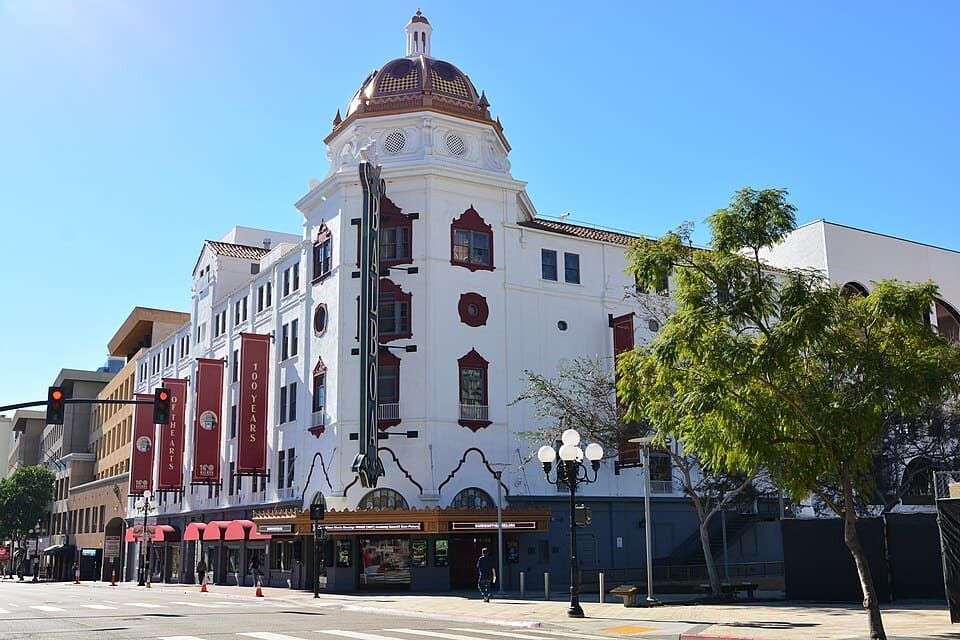
©Joe Mabel, CC BY-SA 4.0 httpscreativecommons.orglicensesby-sa4.0, via Wikimedia Commons
As the large vertical sign makes clear, you have arrived at the Balboa Theatre. It opened in March 1924, at a time when San Diego was growing rapidly and eager to compete with America’s major cities. The Balboa was designed as a grand entertainment palace, combining movies, vaudeville, and popular shows under one roof.
Architect William Wheeler completed the building for around $800,000—an enormous sum at the time. Its interior perfectly reflects the 1920s taste for elegant, spectacular theaters, with lavish decoration, ornamental plasterwork, and a large decorative dome above the seating area. Should you have the chance to step inside, it is well worth a look.
One highlight is the theater organ, which was reinstalled here in 2009. In the early days of cinema, films were accompanied live by an organist. The Balboa’s original organ disappeared in 1929, but a 1920s Wonder Morton organ was later restored, bringing back some of the theater’s former charm.
During the Balboa’s centennial celebrations in 2024, it was even used to accompany silent-film screenings, just as an organ would have done a century earlier. Silent movies were enormously popular in their day, but the theater went through many different chapters in the years that followed. After housing sailors before they left for service in World War II, the Balboa entered a long period of decline, like many of America’s grand theaters.
It narrowly escaped demolition several times before closing for nearly 20 years. A major restoration costing more than $26 million eventually brought it back to life, and the theater reopened in 2008. You may be wondering where its name comes from.
And no, it has nothing to do with the silver-screen giant Rocky Balboa. The theater was named after Vasco Núñez de Balboa, the Spanish explorer regarded as the first European to see the Pacific Ocean. The name Balboa appears throughout San Diego and has become an important symbol of the city’s Spanish heritage—most famously at Balboa Park, which is an absolute must-see.
Aucun avis pour le moment
