





Walk
A town built on legends
Cody, United States
Walk
A town built on legends
Cody, United States
3.2 km
Distance
1h20
Durée
16
Audios
Loop
Parcours
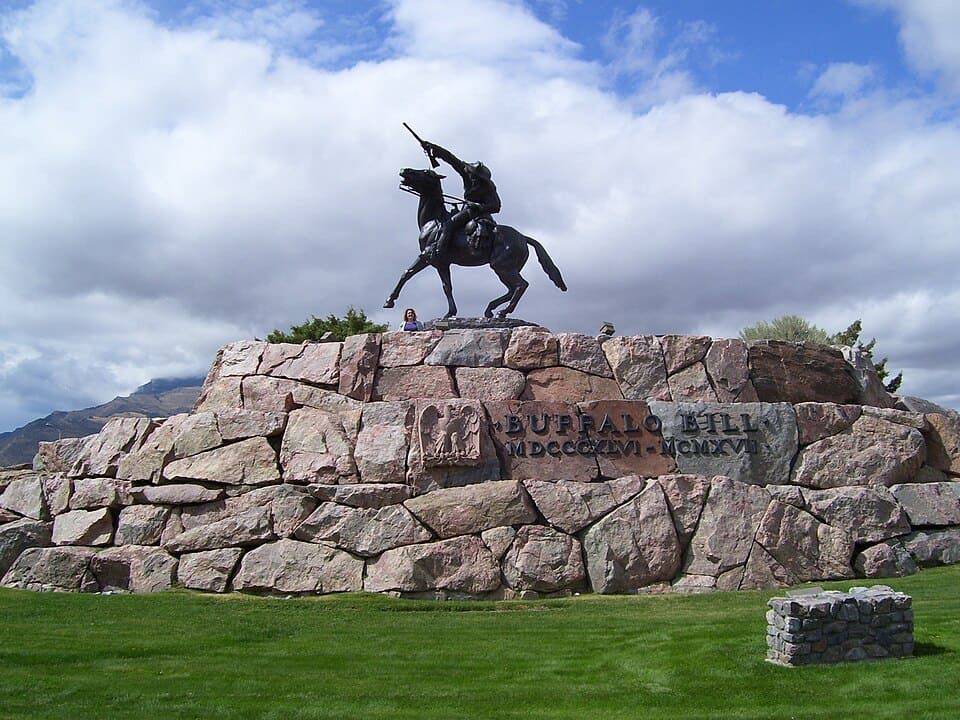
©UserSwampyank CC BY-SA 3.0 <https://creativecommons.org/licenses/by-sa/3.0/deed.fr>via Wikipedia Commons
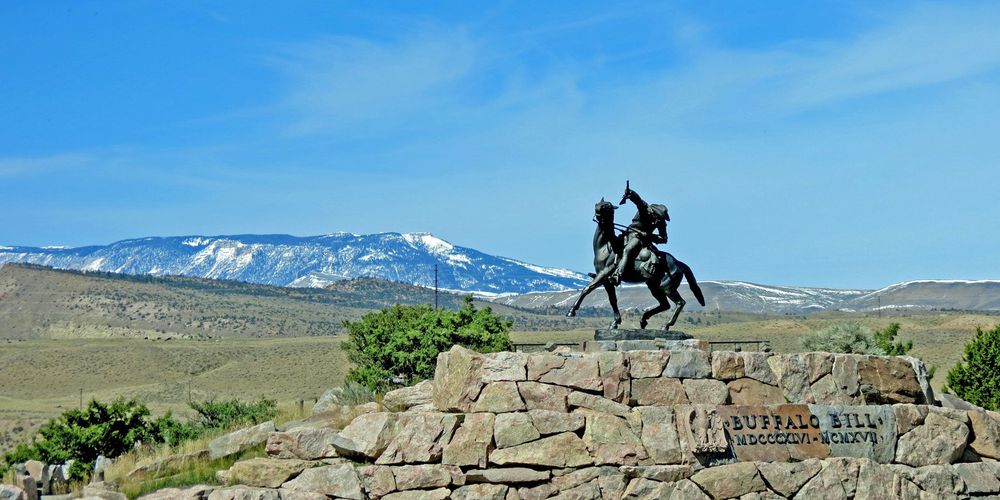
If you look to your left, you’ll see the statue of Buffalo Bill Cody depicted as a scout for the U.S. Army, set on its pedestal—feel free to step a little closer to take in the details. Titled The Scout, it shows Cody on horseback, scanning the landscape and signaling for the troops to follow.
Back in the 19th-century American West, a scout’s role was to explore the terrain, spot potential dangers, guide soldiers, and find the best routes through regions that were still largely unfamiliar. It was a crucial job during military campaigns across the Great Plains, and Buffalo Bill himself took on that role, guiding army columns, knowing the trails, water sources, and terrain, and often acting as a go-between with local populations. He’s even said to have ridden more than 550 kilometers in less than 60 hours.
The statue you see here is made of bronze and stands nearly four meters tall. It was unveiled on July 4, 1924, at the end of Sheridan Avenue, directly across from what is now the Buffalo Bill Center of the West. The artist was Gertrude Vanderbilt Whitney, a New York sculptor and patron from the Vanderbilt family.
The project began after Buffalo Bill’s death in 1917, when his niece, Mary Jester Allen, wanted to create a monument in his honor in the town he founded. Whitney became personally involved and funded most of the project herself, at a cost of around fifty thousand dollars at the time. Creating the statue wasn’t entirely straightforward.
Early versions were criticized by local residents, who felt the horse and its equipment didn’t look authentic enough. To address that, Whitney brought a real Western horse named Smokey from the TE Ranch in Cody to New York, along with a local cowboy who posed as a live model in her studio. With these references, the sculpture took on a much more realistic look.
Once finished, the statue traveled across the country by train, from New York to Wyoming, before being installed here. Its unveiling drew a large crowd, including many notable figures, which was quite remarkable for what was still a very isolated town at the time, and it was Buffalo Bill’s granddaughter, Jane Cody Garlow, who officially unveiled the monument. The stone base beneath it is more than just a support.
It was designed to evoke Cedar Mountain, near Cody, where Buffalo Bill had wished to be buried. In the end, he was laid to rest in Colorado, on Lookout Mountain, which gives the base a more symbolic meaning today. Now surrounded by Cody’s cultural district and the Buffalo Bill Center of the West, this statue has become one of the town’s most recognizable landmarks, reflecting the lasting impact Buffalo Bill had on local history and on the myth of the American West.
Aucun avis pour le moment
