





Walk
A town built on legends
Cody, United States
Walk
A town built on legends
Cody, United States
3.2 km
Distance
1h20
Durée
16
Audios
Loop
Parcours
Shutterstock
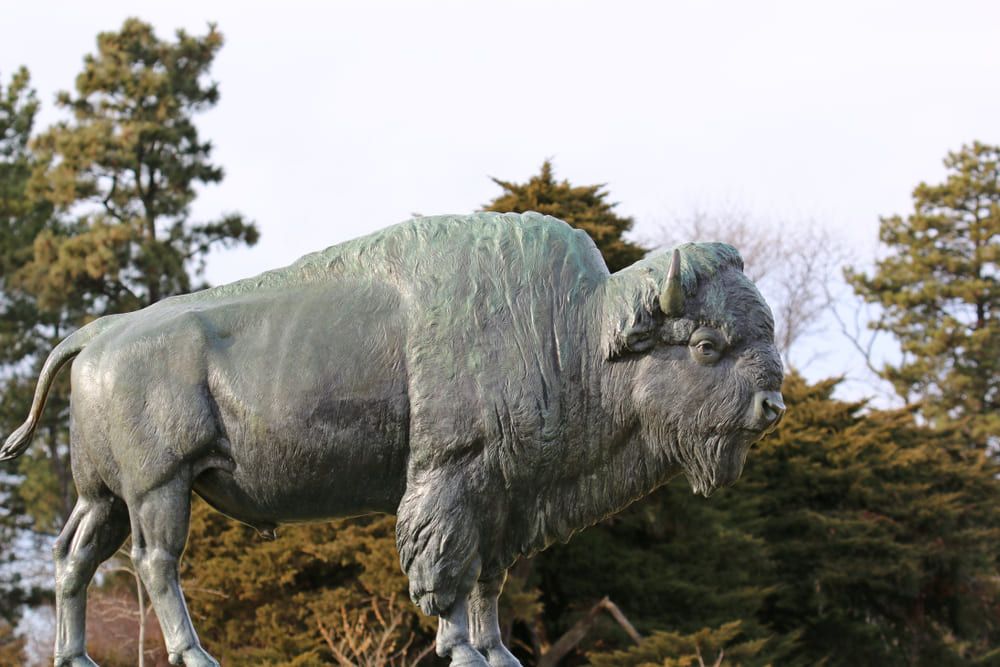
This probably isn’t the first—and won’t be the last—time you see a bison here. In Cody, bison statues are everywhere, and there’s a good reason for that. The bison is one of the most iconic animals in the history of the Great Plains.
For centuries, it was at the heart of life for the Indigenous peoples of this region. For many Plains nations, including the Lakota, Cheyenne, and Shoshone, it meant far more than just a source of food. It supported nearly every part of daily life: the meat was eaten fresh or dried for preservation, the hides were used for clothing, blankets, and tipis, the bones were turned into tools, and the sinews into strong cords.
Even the fat and hooves were used, and in many traditions, the bison also carried deep spiritual meaning. To hunt such a powerful animal, different techniques were developed, one of the most impressive being the bison jump, where hunters would guide a herd toward the edge of a cliff; carried by the movement, the animals would fall, allowing the community to gather enough resources to last for months. But in the 19th century, with the arrival of settlers and the rise of commercial hunting, this balance was broken.
Millions of bison were killed in just a few decades. The U.S. Army even supported this destruction, knowing that taking away the Plains peoples’ main resource would weaken their resistance.
By the late 1880s, the great herds had almost completely disappeared, with only a few dozen wild bison left, especially around Yellowstone. In the early 20th century, conservation efforts began, and Yellowstone played a key role in protecting the species. Thanks to these efforts, the population has slowly recovered, and today several thousand bison live in and around the park.
Cody itself has a somewhat paradoxical connection to the bison. William Frederick Cody earned his nickname Buffalo Bill as a buffalo hunter, reportedly killing up to a dozen animals a day to supply railroad workers, totaling more than three thousand bison in just eight months. And yet, his Wild West Show also helped spread the image of the bison around the world, and that fascination eventually contributed to a growing awareness that led to its protection.
In that spirit, the city launched a unique art project called Where the Buffalo Roam, with around thirty large fiberglass bison installed throughout the city. The original model was created by local artist Jeff Rudolph, and each one was then decorated by artists from the region. Some are covered in bright, colorful patterns, while others use unexpected materials like leather, metal, or even newspaper.
These sculptures were part of a fundraising effort for Cody’s hospital, and after the exhibition, some were purchased by private collectors or businesses, while others remained in public spaces. Today, they form a kind of artistic herd scattered across the city. As you come across them on a street corner or in a park, you’re not just looking at a piece of art, but at a symbol of Yellowstone’s wildlife and a reminder of the complex history of the American West.
Aucun avis pour le moment
