




Walk
Short tour - Wall Street: Towers of Power
New York, United States
Walk
Short tour - Wall Street: Towers of Power
New York, United States
Distance
4.4 kmDurée
1h45Audios
15Parcours
Loop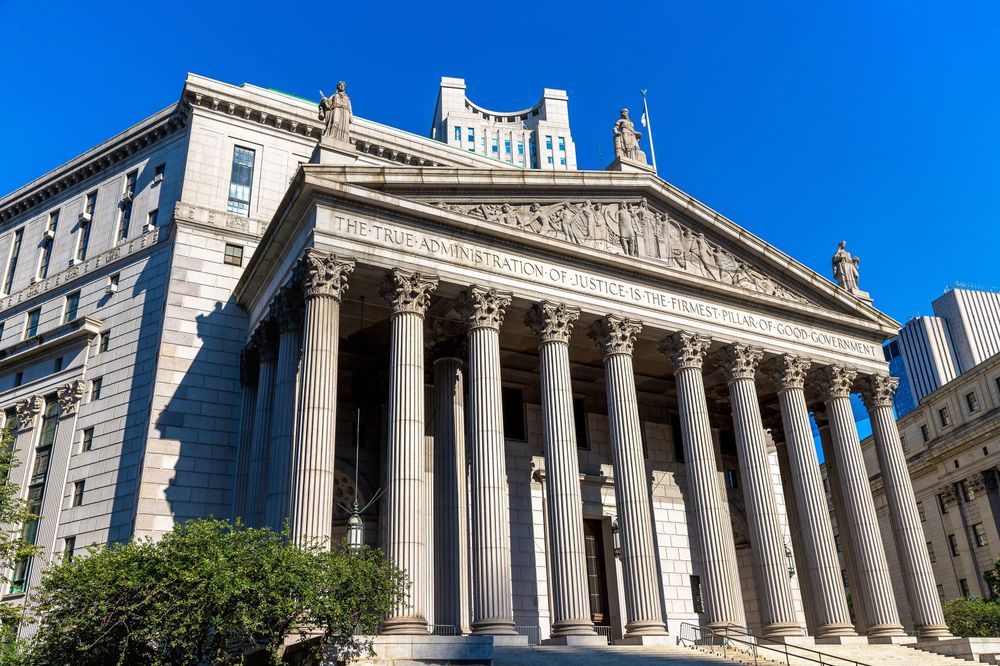
Shutterstock
To your right lies what could be called New York's administrative and judicial center, home to some of the city's most impressive government buildings. Among them is the enormous Manhattan Municipal Building, just a short walk from City Hall. Its size alone gives you an idea of just how much New York had grown by the early 20th century! Built between 1909 and 1914, it was designed to house the many city departments that had outgrown City Hall following the great consolidation of 1898, when New York's five boroughs were brought together to form the city we know today. Standing 581 feet (177 meters) tall, it's one of the largest government buildings in the world. Its grand architecture brings together classical, Italian Renaissance, and Roman influences. Its enormous central arch even bears a resemblance to the Arch of Constantine in Rome! Right nearby, you'll find another architectural gem: the Surrogate's Courthouse. With its elaborate Beaux-Arts design, it's an impressive sight in its own right. But there's more going on inside than you might expect. Alongside the court, the building houses the New York City Municipal Archives, where an extraordinary collection of historical records preserves the city's administrative past, with documents dating all the way back to the early 1600s. And if you feel like exploring a little farther, you can head toward Foley Square, where you'll find yourself surrounded by even more of Manhattan's major courthouses. Among them is the Thurgood Marshall United States Courthouse, home to important federal courts, including the U.S. Court of Appeals for the Second Circuit. The building is named in honor of Thurgood Marshall, who made history in 1967 as the first African American justice to serve on the United States Supreme Court. Nearby, you'll also find the New York State Supreme Court, although its name can be a little misleading. Unlike the U.S. Supreme Court, it's not the highest court in its judicial system. Instead, it's a major trial court with broad jurisdiction, handling everything from significant civil disputes to serious criminal cases here in Manhattan. Together, these imposing buildings form what's known as the Civic Center, a neighborhood where government offices, courthouses, and public institutions come together. It may not have the fame of Wall Street or the bright lights of Broadway, but this is where much of the work of running New York City and administering justice takes place, making it one of Manhattan's most important institutional districts.
Aucun avis pour le moment
