



Walk
Behind the Scenes of Liberty
Boston, Estados Unidos
Walk
Behind the Scenes of Liberty
Boston, Estados Unidos
Distance
4.4 kmDurée
1h50Audios
27Parcours
Loop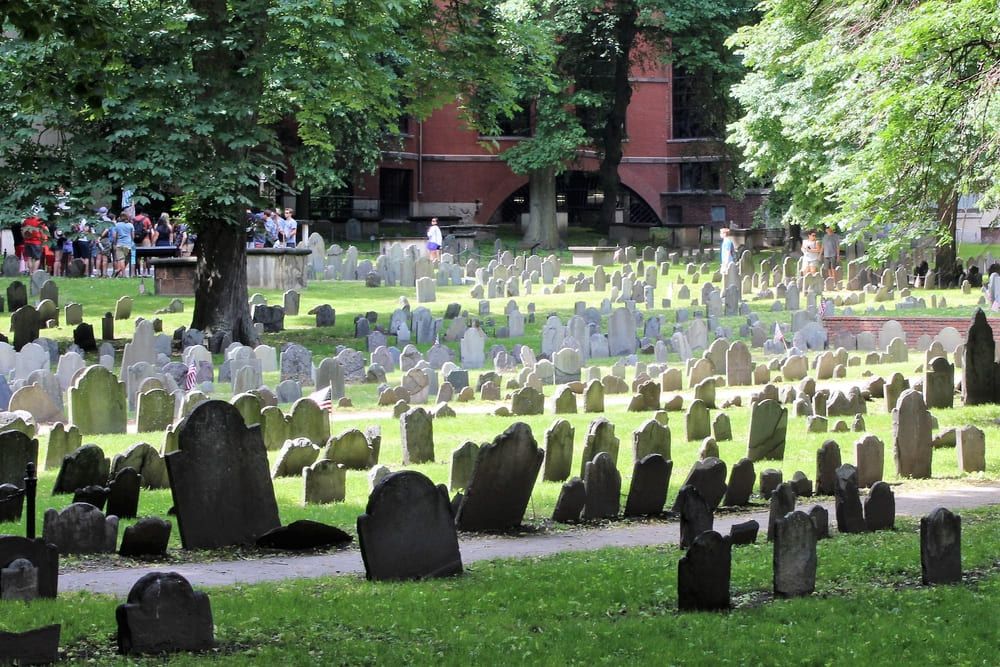
Shutterstock
You’ve now reached the entrance to Granary Burying Ground. Established in 1660, it is Boston’s third-oldest cemetery. As you pass through its monumental Egyptian-inspired granite gateway, you are stepping into a true sanctuary of the American Revolution. The name "granary" however, has nothing to do with religion. It simply refers to a huge municipal grain storehouse that once stood nearby in the 18th century. As you look at the neat rows of graves, you are actually seeing a remarkable optical illusion. Around 2,345 gravestones are visible above ground, but the city estimates that more than 5,000 people are actually buried here, many of them in deep underground family vaults. Even more surprisingly, the arrangement of gravestones you see today is not original at all. During the Victorian era, in the 19th century, the markers were dug up and rearranged into tidy rows. Why? Partly to suit the new aesthetic tastes of the time, but also for a much more practical reason: to make way for a brand-new invention—the lawnmower! As you wander through this maze of slate gravestones, you’ll come across some of the greatest figures, or perhaps the greatest ghosts, in American history. No fewer than three signers of the Declaration of Independence are buried here: John Hancock, Robert Treat Paine, and the famous Samuel Adams. Nearby lies Paul Revere, the patriot and master craftsman who created the copper sheathing for the Massachusetts State House dome, as well as the victims of the Boston Massacre of 1770, including Crispus Attucks, whose story we tell elsewhere in this tour. You have probably already noticed the imposing obelisk, rising nearly 25 feet (or 8 metres) at the centre of the cemetery. Many visitors assume it marks the grave of Benjamin Franklin, but that's a common misconception. The famous inventor is buried in Philadelphia. The monument actually honors his parents, who remained in Boston. Granary Burying Ground, however, tells a much broader story than that of the nation’s founding heroes. This was not a cemetery reserved for the elite. Bostonians from every walk of life were laid to rest here, and historians believe that many Black and Indigenous people were buried anonymously in the front section of the cemetery. So, keep an eye out... you never know what ghosts you might encounter!
Aucun avis pour le moment
