





Walk
A town built on legends
Cody, United States
Walk
A town built on legends
Cody, United States
3.2 km
Distance
1h20
Durée
16
Audios
Loop
Parcours
Shutterstock
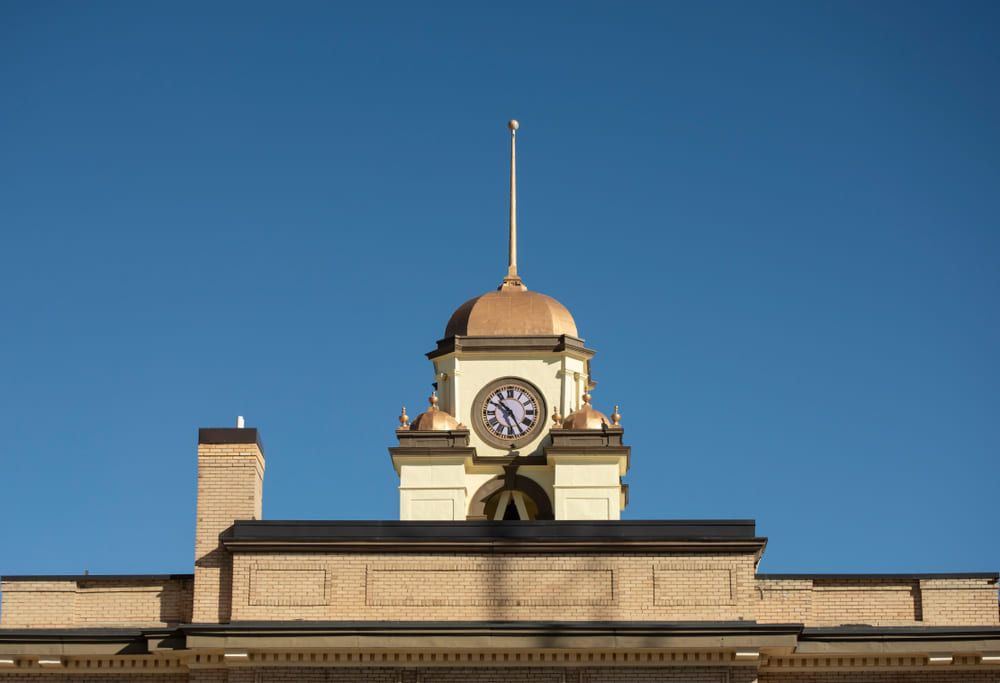
If you look at this light-colored brick building with its tower rising above it, you’re standing in front of the Park County Courthouse. It was built in the 1910s, not long after the county was officially established in 1909, when Cody became the administrative center of the region. At first, local authorities worked out of a temporary building, but it quickly proved too small, so residents decided to fund the construction of a proper courthouse right here in the heart of town.
Its architecture is typical of early 20th-century American courthouses, with a two-story brick and concrete structure, an entrance marked by columns, and a small square clock tower. Back then, the site also included a sheriff’s residence and a small adjoining jail, with cells that could be accessed from the outside and an exercise yard set between the buildings. But this area also tells another side of Cody’s story.
Just next door, on your left, you’ll find the Cody Heritage Museum, a small museum dedicated to local history and the families who helped shape the town. It traces the founding of Cody in the late 19th century, when Buffalo Bill Cody and several partners set out to establish a town centered on agriculture, ranching, and welcoming travelers on their way to Yellowstone. In the museum’s garden, known as the Heritage Garden, you’ll see several historical objects displayed outdoors.
One of the most recent is a bronze sculpture called Work to Be Done, unveiled in 2022 by local artist Tanner Loren. It shows a pioneer couple facing the horizon, the man carrying a tool over his shoulder, ready to work the land, while the woman holds a basket and looks out across the landscape, a tribute to the early settlers who helped build the town in the late 1800s. In the same garden, you’ll also find a historical plaque dedicated to the Halfway House Stage Stop.
It tells the story of a former stagecoach stop located south of Cody, along the road to Meeteetse. In the early 1900s, long-distance travel was done by horse-drawn stagecoach, and the journey was slow and demanding, with regular stops needed to rest the horses and feed travelers. That’s how this small stop came to be in 1903, near a natural spring.
The building itself was simple, dug into the hillside, and served as a place to change horses and grab a meal. By 1904, it even had a public telephone, which was quite a novelty for such a remote area. But this chapter didn’t last long.
With the arrival of automobiles in the early 20th century, stagecoaches quickly disappeared, and the stop was abandoned around 1908. The plaque you see here today is actually the original one that once stood along the road near the site, now preserved here at the museum as a reminder of the time when Cody served as a stagecoach stop along the route west.
Aucun avis pour le moment
