



Walk
From Pacific Royalty to the Aloha Spirit
Honolulu, United States
Walk
From Pacific Royalty to the Aloha Spirit
Honolulu, United States
Distance
4.8 kmDurée
2h00Audios
25Parcours
Loop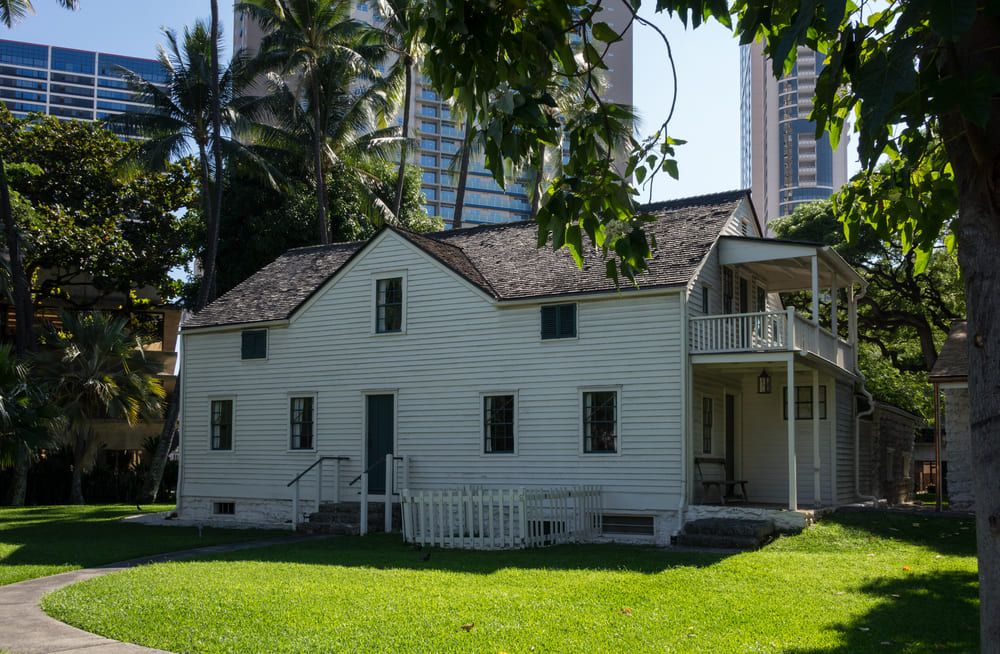
Shutterstock
Take a look at the white wooden house on your right. Completed in 1821, it's the oldest surviving Western-style house in the entire Hawaiian archipelago. And how it got here is quite a story! Every wooden plank was cut to size in Boston, loaded onto a ship called the Thaddeus, and transported all the way around Cape Horn, at the southern tip of South America, before being assembled here in Honolulu. Just beside it stands the stone Chamberlain House, another reminder of how this small missionary settlement gradually became established in Hawaii. But there's something else here that had an even greater impact on the islands' history. It may not look particularly impressive today, but it's Hawaii's very first printing press, a Ramage press brought to the islands by a printer named Elisha Loomis. In January 1822, this machine produced the first pages ever printed in Hawaiian, known as ʻŌlelo Hawaiʻi. Until then, Hawaiian had been an entirely spoken language, with no established writing system. Now, you might have heard that American missionaries arrived in Hawaii and invented a written form of the language on their own, simply so they could spread the Bible. But that's not quite how it happened. The process was far more collaborative. Between 1822 and 1826, Hawaiian scholars worked alongside Tahitian missionaries and American ministers to develop a standardized alphabet and spelling system. And it was Hawaii's own kings and queens who pushed for the creation of schools and provided the funding to teach their people to read and write. The results were remarkable. During the 19th century, Hawaiians embraced literacy so enthusiastically that they became one of the most literate populations in the world. They began publishing their own newspapers, writing their own history books, and using the written word to defend their sovereignty. Today, this site holds one of the largest collections of Hawaiian-language publications anywhere in the world. So when you look at these historic houses, remember that their story goes far beyond the arrival of Western missionaries. They witnessed an extraordinary exchange between cultures, one in which Hawaiians took a technology introduced from abroad and made it their own, using it to preserve their history and protect their identity.
Aucun avis pour le moment
