





Walk
The Strip: A World-Famous Entertainment Icon
Las Vegas, United States
Walk
The Strip: A World-Famous Entertainment Icon
Las Vegas, United States
4.6 km
Distance
2h00
Durée
26
Audios
Through route
Parcours
Shutterstock
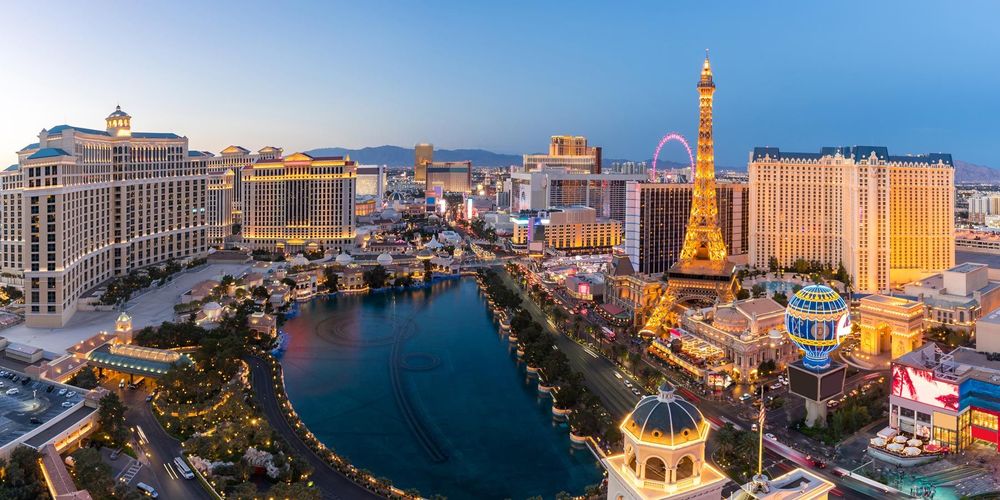
From here, you have a clear view of the luxury shopping center known as The Shops at Crystals. Inside this striking architectural structure, with its crystalline facades, sharp angles, and distinctive rooflines, you will find some of the most prestigious brands in the world, along with a fascinating design that includes suspended gardens, seasonal floral displays, and works of art by well-known artists. You have a few minutes of walking before reaching the next hotel-casino, which gives me the perfect opportunity to tell you a bit about the history of Las Vegas, and especially how this city in the middle of the desert became such a powerful American myth.
It all began in 1829, when Rafael Rivera became the first European to cross the Las Vegas Valley during a trading expedition. The name of the valley comes from Spanish and means “the meadows” or “the fertile plains.” A surprising name for such an arid desert, isn’t it? It actually refers to the underground water sources that once formed precious oases and fed green meadows in the middle of the desert.
Needless to say, with the construction of all these buildings of concrete and neon, the natural springs that gave the valley its name have mostly disappeared today. In 1855, a Mormon fort was built here to protect the route between Los Angeles and Salt Lake City. The mission was quickly abandoned, but the remains of the fort can still be seen today in downtown Las Vegas.
In 1905, a public land auction was organized at the junction of the railroad, marking the beginning of the city. Las Vegas quickly became a supply stop for miners and railroad workers, and even at that time saloons and illegal gambling began to appear, later entertaining the nearly 5,000 workers and their families who moved here during the construction of the Hoover Dam between 1931 and 1935. The first casinos opened in the area now known as Old Vegas, and the state of Nevada officially legalized gambling.
About ten years later, the Strip itself began to take shape with the construction of the first hotel-casino outside downtown, El Rancho Vegas. The following year a second resort appeared, the Hotel Last Frontier, and in 1946 the Flamingo opened, financed in part by members of the New York mafia. The 50s and 60s saw the rapid growth of the Strip under the influence of organized crime families.
Large hotels multiplied, and Las Vegas became the world capital of entertainment. In 1966, Caesars Palace opened its doors, symbolizing Roman luxury and helping define the modern style of the Strip. Six years later, billionaire Howard Hughes began buying casinos and gradually pushed the mafia operators out of the city.
In 1969, Nevada law allowed publicly traded corporations to obtain gaming licenses, opening the door to major corporate groups. The 90s then saw the rise of resorts such as the Mirage, Excalibur, Luxor, and Bellagio. These were no longer simple hotel-casinos but massive mega-resorts that transformed the Strip and attracted ever-growing numbers of visitors.
Today there are 37 hotels along the Strip, offering more than 85,000 rooms, and nearly 65 casinos across Las Vegas. Across the entire state of Nevada, there are more than 300 casinos, which generated nearly 16 billion dollars in gaming revenue in 2025 alone, enough to keep dazzling the nearly 40 million visitors who come to Las Vegas every year.
Aucun avis pour le moment
