





Walk
The birth of a nation
Philadelphia, United States
Walk
The birth of a nation
Philadelphia, United States
4.7 km
Distance
2h00
Durée
24
Audios
Loop
Parcours
Shutterstock
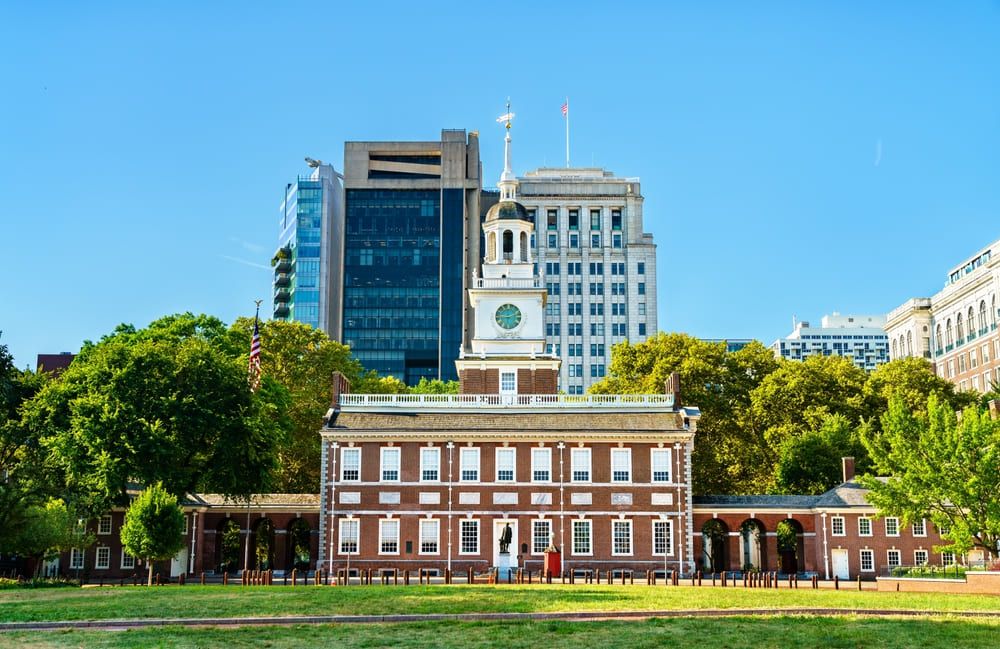
Welcome to the heart of modern American history, right in front of Independence Hall. At first glance, this red brick building may seem fairly simple, but it’s here that some of the most influential political ideas in the world first took shape. Originally, this wasn’t meant to be a symbolic landmark, but simply an administrative building.
Constructed between 1732 and 1753, it served as the seat of Pennsylvania’s colonial government, and nothing at the time suggested it would become such a historic site. Everything changed in 1775, when the large assembly room hosted the Second Continental Congress. Delegates gathered here as tensions with the United Kingdom continued to rise.
For years, the colonies had been protesting new taxes and tighter control imposed after the Seven Years’ War, tensions that turned into open conflict when fighting broke out at the Battles of Lexington and Concord. It was in this building that George Washington was appointed Commander-in-Chief of the Continental Army, with the task of turning local militias into a real army capable of standing up to British forces. The following year, in 1776, came a decisive moment.
On July 2, the colonies voted for independence, and on July 4, they approved the text of the United States Declaration of Independence. Independence was declared, but the war was far from over. The conflict continued for several years, often in favor of the British at first.
A major turning point came in 1777 with the American victory at Battle of Saratoga, which convinced France to support the revolutionaries. With this alliance, the war expanded and took on an international dimension. The outcome came in 1781, when American and French forces surrounded the British army at the Siege of Yorktown, forcing its surrender.
Two years later, the Treaty of Paris officially recognized the independence of the United States. But the story doesn’t end there. In 1787, Independence Hall once again became the center of history as it hosted the Constitutional Convention.
For several months, debates were intense as delegates worked to design a new political system. The result, signed on September 17, became the United States Constitution, which is still in force today. Over time, the building’s role changed.
After the Revolution, it gradually lost its political function and became a place of memory. Today, if UNESCO has listed Independence Hall as a World Heritage Site, it’s not for its architecture, but for what it represents. This is where new ideas took shape: the right to revolution, the principle of self-government, and a vision of power that would go on to influence many countries around the world.
Aucun avis pour le moment
