



Walk
The birth of a nation
Philadelphia, United States
Walk
The birth of a nation
Philadelphia, United States
4.7 km
Distance
2h00
Durée
24
Audios
Loop
Parcours
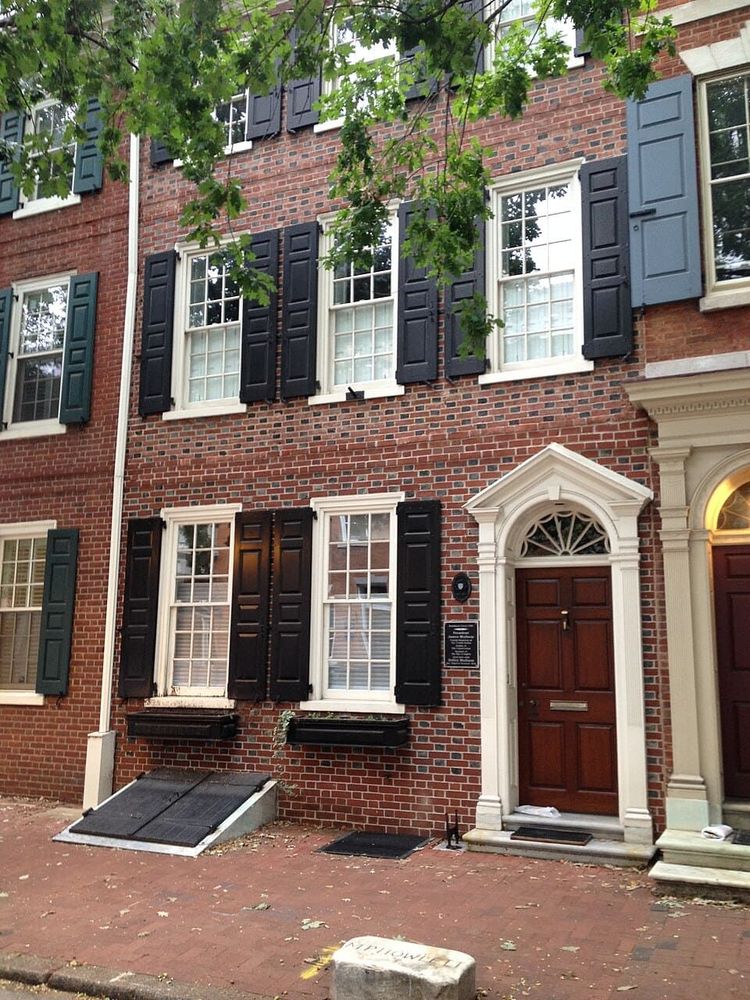
©Jaktar773, CC BY-SA 4.0 <https://creativecommons.org/licenses/by-sa/4.0/deed.fr>via Wikipedia Commons
At number 429, on your right, a small, discreet plaque shows that you’re standing in front of the James Madison House. This private home, not open to visitors, is linked to James Madison, one of the key figures in the founding of the United States. He lived here with his wife Dolley Madison between 1794 and 1797, when Philadelphia was still the nation’s capital.
At that time, Madison was not yet president, but he was already a central figure in the young republic. He is best known for his major role in drafting the Constitution of 1787, which earned him the nickname “Father of the Constitution.” He also contributed to the Federalist Papers, arguing in favor of this new political system, and played an important role in shaping the Bill of Rights, adopted in 1791 to protect fundamental freedoms. He would later become the fourth President of the United States, serving from 1809 to 1817, including during the War of 1812.
The house is also closely tied to Dolley Madison’s personal story. Before her marriage, she lived in Philadelphia with her first husband, John Todd, who died during the yellow fever epidemic of 1793. Moving here marked a turning point in her life.
She would go on to become one of the most influential First Ladies in American history, often described as a “famous hostess.” In practice, this meant she played a central role in social and political life. In Washington, she organized regular gatherings that brought together political leaders, diplomats, and even rivals in a more informal setting. These events became a real political tool, helping to encourage dialogue and ease tensions in a still fragile young republic.
Through her sense of hospitality and connection, she helped shape what the role of First Lady would become in the United States. She is also remembered for saving a portrait of George Washington during the burning of the White House in 1814. Even if parts of the story have been somewhat romanticized, its symbolic importance remains strong.
This house reflects a moment when two major figures in American history were still living an ordinary life, before stepping fully into the national stage.
Aucun avis pour le moment