



Walk
Behind the Scenes of Liberty
Boston, Estados Unidos
Walk
Behind the Scenes of Liberty
Boston, Estados Unidos
Distance
4.4 kmDurée
1h50Audios
27Parcours
Loop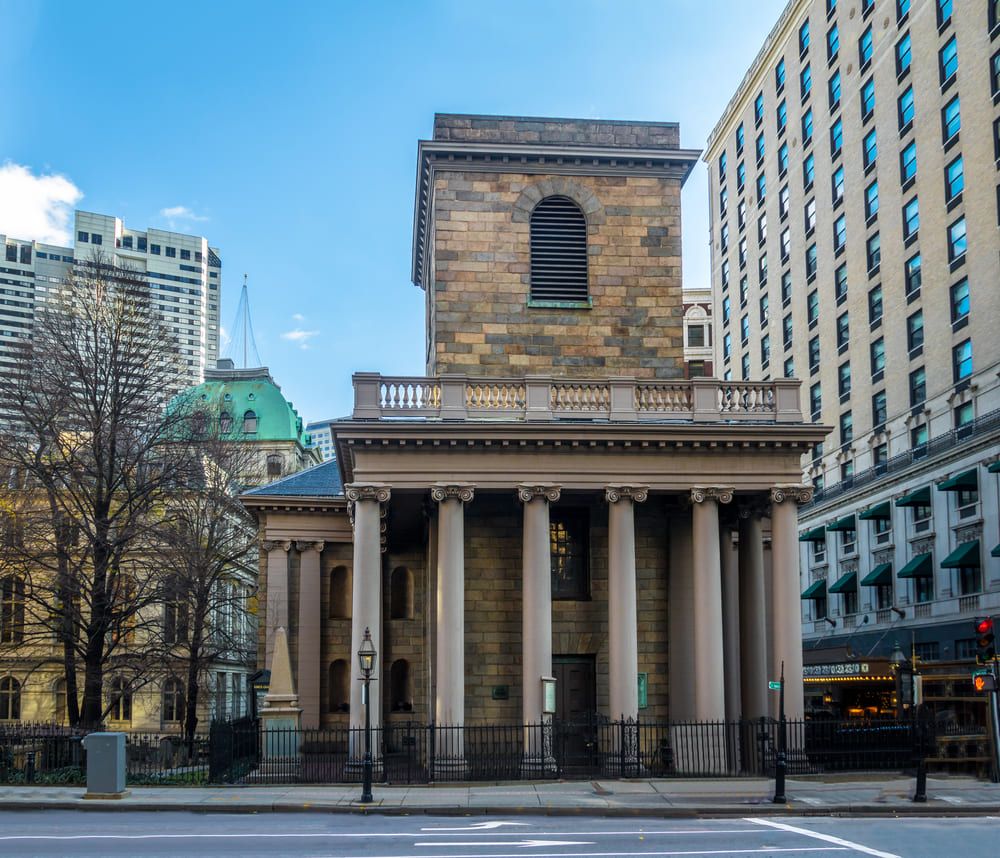
Shutterstock
You have now arrived at King’s Chapel, rising before you behind its imposing granite columns. Founded in 1686, this was Boston’s first Anglican church, a deeply provocative presence in what was then a fiercely Puritan city. To understand just how shocking this was, remember that the Anglican Church was the official church of the English monarch, with a strong emphasis on ceremony and ritual. The Puritans, by contrast, had left Europe to establish a reformed church that was simpler, stricter and more morally disciplined. The arrival of the Crown’s own church in the heart of their colony therefore felt like nothing less than an insult. That tension also helps explain the building’s unusual construction. The stone church you see today was quite literally built around the original wooden chapel. Once the new walls were complete, the old building inside was dismantled and removed piece by piece through the windows. Then came a remarkable reversal. In 1787, this once fiercely royalist church became the first Unitarian congregation in America, embracing a far more progressive theology. King’s Chapel was also chosen as the setting for the Unbound memorial, unveiled in 2025. Created by the artist Harmonia Rosales, the work breaks a long historical silence. It pays tribute to the 219 women, children and men who were enslaved by former ministers and members of the congregation between the 17th and early 19th centuries. The sculpture is filled with symbolism. At its centre, a female figure holds an open cage while bronze birds take flight around her. Be sure to visit the burial ground just to the left of the church. Established in 1630, it became so overcrowded over the years that gravediggers were forced to bury bodies in extremely shallow graves, sometimes placing one coffin directly above another. Among the notable people buried here is Mary Chilton, traditionally remembered as the first woman to step ashore from the Mayflower. Finally, take a close look at the carvings on the slate gravestones. The Puritans who founded Boston banned religious images and crucifixes from their churches, so gravestones became an important outlet for artistic and symbolic expression. Look in particular for the grave of Joseph Tapping, widely regarded as one of the finest in Boston. Its carving shows a skeleton and the figure of Time locked in a struggle against the inevitability of death, a stark and macabre reminder of just how fragile life seemed to the earliest settlers.
Aucun avis pour le moment
