




Walk
Beyond the Picture Perfect Image
San Diego, États-Unis
Walk
Beyond the Picture Perfect Image
San Diego, États-Unis
7 km
Distance
2h50
Durée
24
Audios
Loop
Parcours
Shutterstock
You’re standing in the heart of one of San Diego’s most colourful neighbourhoods: Little Italy. With its Italian restaurants, sidewalk cafés, lively markets, and bustling pedestrian-friendly streets, it is hard to imagine that in the early 20th century this was primarily a working-class waterfront district. Thousands of Italian families settled in this part of San Diego, many of them from Sicily and other coastal regions of Italy.
Fleeing poverty and natural disasters, they saw California’s booming maritime economy as a chance to build a better life. At one point, more than 6,000 Italian families lived here, and Italian accents could be heard on every street corner. The neighbourhood soon became a close-knit community where everyone knew one another.
Fishermen, shopkeepers, families, and restaurant owners all depended on the maritime economy, which revolved around one vital industry: tuna fishing. San Diego grew into one of America’s leading centers for the trade, and Italian immigrants played a major role in its development. They were not alone, however.
Mexican, Japanese, and Portuguese communities also contributed to the expansion of the port and its canneries. Although Little Italy was multicultural from the outset, its Italian identity remained dominant. But that prosperity did not last.
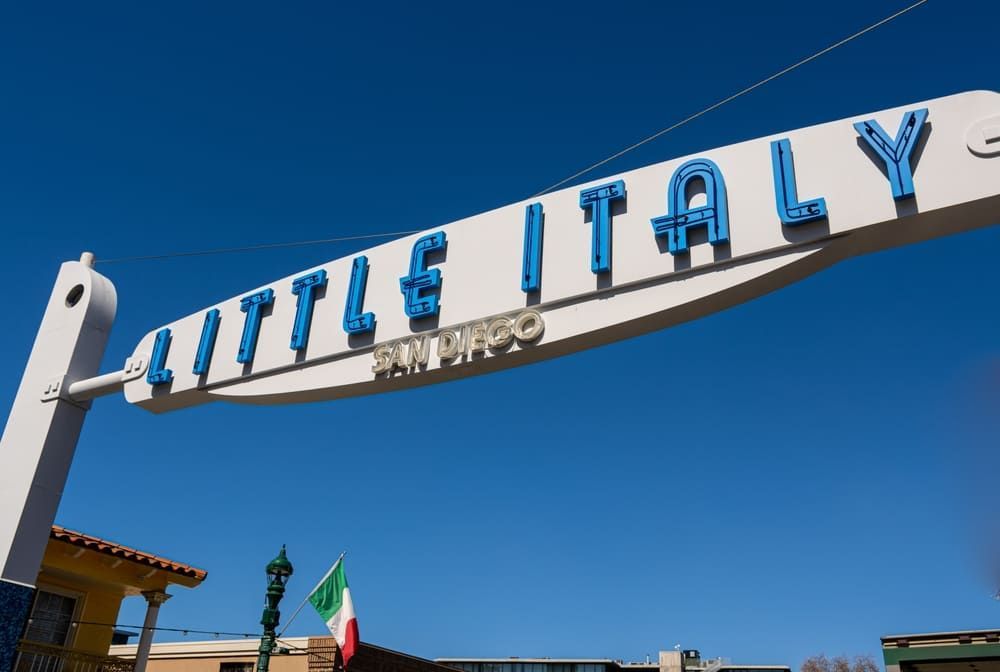
The neighbourhood entered a long period of decline as the tuna industry collapsed and a freeway was built almost through its heart, destroying much of the area and prompting many families to leave. Remarkably, Little Italy came back to life in the 1990s, thanks to local residents and business owners who chose to modernise the area while still preserving its Italian heritage. As you continue straight along India Street, you will see the Little Italy arch and its colourful mosaics, a tribute to this neighbourhood, shaped by generations of family stories.
Aucun avis pour le moment