



Walk
Behind the Scenes of Liberty
Boston, Estados Unidos
Walk
Behind the Scenes of Liberty
Boston, Estados Unidos
Distance
4.4 kmDurée
1h50Audios
27Parcours
Loop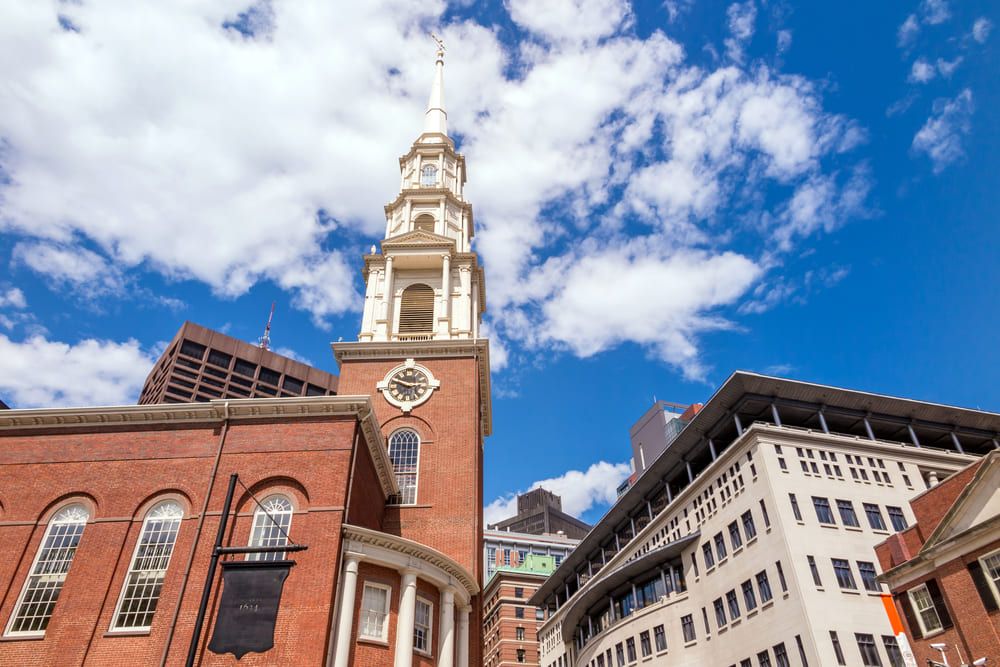
Shutterstock
You've arrived at the corner of Park and Tremont Street, standing in front of the magnificent Park Street Church. Founded in 1809 by a group of just twenty-six worshippers, this historic church was built in less than eight months on the very site of Boston's former public granary. Look up and you'll see its defining feature: a striking white steeple soaring nearly two hundred and sixteen feet (or 66 metres) into the sky, standing about 10 feet (or 3 metres) taller than the dome of the Massachusetts State House. For 35 years, it was the tallest building in the United States, and it remained Boston's tallest landmark for an impressive 57 years. In fact, the city quite literally grew around it. When Columbus Avenue was laid out, engineers were instructed to align it precisely with the church's steeple, which served as a major navigational landmark for travellers approaching Boston. Yet this architectural masterpiece was also the result of a hard-fought compromise. The architect had envisioned a four-tiered steeple, but church leaders felt it was too extravagant and approved only three levels instead. According to local legend, as soon as the scaffolding came down, the crowd gathered on Boston Common immediately regretted the decision—as did the architect, knowing he had never been able to fully realise his vision. But perhaps the most surprising story lies beneath your feet. This intersection has long been known as the "Brimstone Corner." You might assume the nickname comes from fiery sermons about the flames of hell, but the truth is far more military. During the War of 1812, the church crypt was discreetly used to store sulphur, a key ingredient in the manufacture of gunpowder. If you step inside, you'll discover walls that have witnessed remarkable moments in American history. Hanging above is a bell cast in 1819 at London's famous Whitechapel Bell Foundry—the same legendary foundry that produced both Big Ben and Philadelphia's Liberty Bell, although Boston's bell has one advantage: it never cracked. These walls also witnessed a defining moment in the struggle for civil rights. On July 4, 1829, the renowned abolitionist William Lloyd Garrison delivered his very first public anti-slavery speech here, launching the lifelong campaign for equality that would make him one of America's most influential reformers. Then, just two years later, the church secured another spot in the nation's cultural history when the patriotic hymn "America" (better known as "My Country, ‘Tis of Thee") was performed here in public for the very first time. Not a bad resume for a single church.
Aucun avis pour le moment
