






Walk
Beyond the Picture Perfect Image
San Diego, États-Unis
Walk
Beyond the Picture Perfect Image
San Diego, États-Unis
7 km
Distance
2h50
Durée
24
Audios
Loop
Parcours
Shutterstock
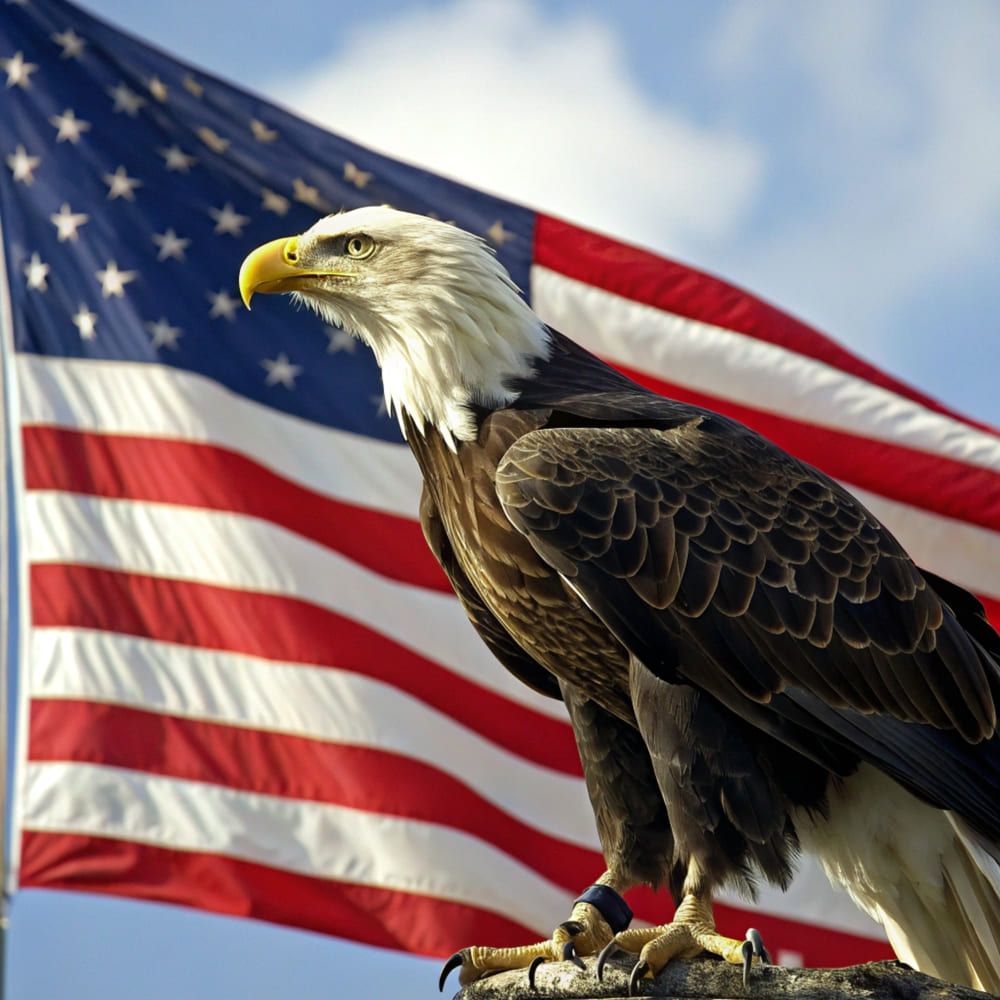
Look up at the mural on your right. It brings together two of the most powerful symbols of the United States: the American flag and the bald eagle, the country’s national bird. This is a good opportunity to revisit the stories behind them.
The American flag was officially established on June 14, 1777, when Congress adopted the first national flag, with thirteen red and white stripes and thirteen white stars on a blue field. That date also gave rise to Flag Day, which is still celebrated across the United States every year on June 14. The thirteen stripes represent the thirteen British colonies that became the United States after the Revolutionary War.
Today, of course, the number of stars has risen to fifty, one for each state, following Hawaii’s admission to the Union in 1960. Some of you probably knew all that already, so let’s turn to the other great symbol featured here: the bald eagle. It became an official emblem of the United States in 1782 and still appears on the Great Seal of the United States, as well as on official documents, coins, and certain military insignia.
The bird was chosen because it is native to North America and came to symbolize strength, freedom, and determination. But did you know that Benjamin Franklin was not especially fond of it? He described the bald eagle as a bird of bad character and would apparently have preferred a rather less impressive national symbol: the turkey.
That would have sent quite a different message, wouldn’t it? The bald eagle itself came close to disappearing during the 20th century. Hunting, habitat destruction, and above all the use of pesticides caused its population to collapse dramatically.
By 1963, only a few hundred breeding pairs remained in the contiguous United States. Fortunately, protective laws helped the species recover, and it was removed from the endangered species list in 2007. What a relief.
You may even have a chance to spot one near the lakes northeast of San Diego.
Aucun avis pour le moment
