



Walk
Behind the Scenes of Liberty
Boston, Estados Unidos
Walk
Behind the Scenes of Liberty
Boston, Estados Unidos
Distance
4.4 kmDurée
1h50Audios
27Parcours
Loop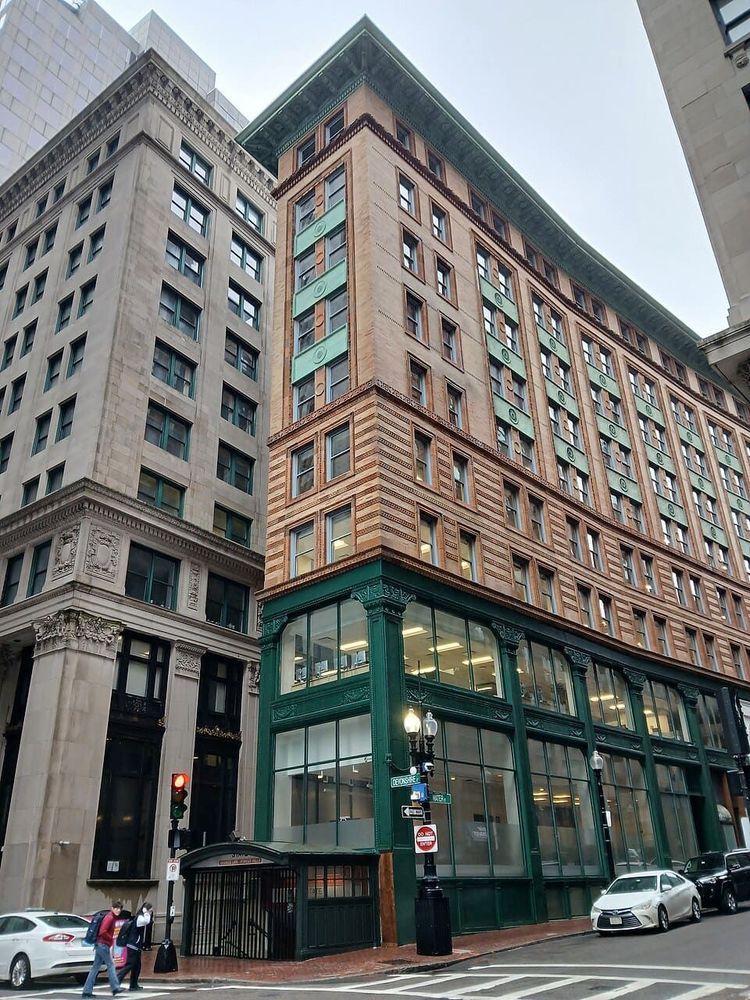
©Epicgenius, CC BY-SA 4.0 httpscreativecommons.orglicensesby-sa4.0, via Wikimedia Commons
You are now standing at the corner of Water Street and Devonshire Street, facing the Winthrop Building, an elegant structure completed in 1894. At first glance, with its warm yellow-orange brickwork, vivid green ground floor and ornate cornice, it looks like a beautiful and colourful period building. Yet behind its traditional appearance lies a remarkable engineering breakthrough: this was Boston's very first steel-frame skyscraper. Designed by architect Clarence Blackall, it introduced the revolutionary "Chicago system" to the city. At the time, many local architects viewed steel construction with deep suspicion, convinced that the metal would expand in the summer heat and bring the entire building crashing down. It's also amusing to remember that, although it is officially recognised as Boston's first skyscraper, it rises to just nine storeys—a modest height by today's standards. But without realising it, you're also standing at the historic birthplace of Boston itself. To understand why, simply walk a few steps into the narrow cobbled alley beside the building, Spring Lane. Nothing there suggests that beneath the paving stones lies the Great Spring. When the English Puritans first crossed the Atlantic in 1630, they settled across the river in Charlestown. The water there, however, was brackish and unsafe, and disease spread quickly through the new settlement. A man named William Blackstone told them about a freshwater spring on this peninsula. As soon as the settlers discovered the Great Spring, they decided to move the entire colony here. That tiny source of fresh water became the centre around which the young town grew. The first church, the marketplace, the prison and the governor's house were all built here because this was where clean drinking water could be found. The spring supplied Boston for nearly two centuries before it was sealed over and paved in the 19th century to accommodate the city's rapid growth. A small bronze plaque, installed in 1907, still marks the spot and commemorates its vital importance. Without this now-hidden spring, Boston would almost certainly never have been founded here.
Aucun avis pour le moment
