





Walk
A town built on legends
Cody, United States
Walk
A town built on legends
Cody, United States
3.2 km
Distance
1h20
Durée
16
Audios
Loop
Parcours
Shutterstock
Let’s use this wide westbound avenue as a chance to step back into the region’s past. Long before European settlers arrived, all of Wyoming was home to several Indigenous nations. Back then, land wasn’t divided by fixed borders like today ; people moved with the seasons, following bison herds and the resources they depended on.
In this area, you would have found groups such as the Shoshone, Crow, Arapaho, Cheyenne, and Lakota, all connected through extensive trade networks that stretched across North America, allowing materials from the Rocky Mountains to travel as far as the Great Plains and beyond. One group in particular is closely tied to Yellowstone: the Tukudika, a branch of the Mountain Shoshone. Their name means “sheep eaters,” a reference to the bighorn sheep they hunted, and they lived for thousands of years in what is now Yellowstone National Park.
Unlike many Plains nations, they didn’t use horses, they traveled mostly on foot, with dogs carrying their belongings. They had a deep understanding of the land, from edible plants and roots to obsidian, a sharp volcanic glass they used to make tools and arrowheads. This obsidian was so valuable that it has been found at archaeological sites thousands of kilometers away.
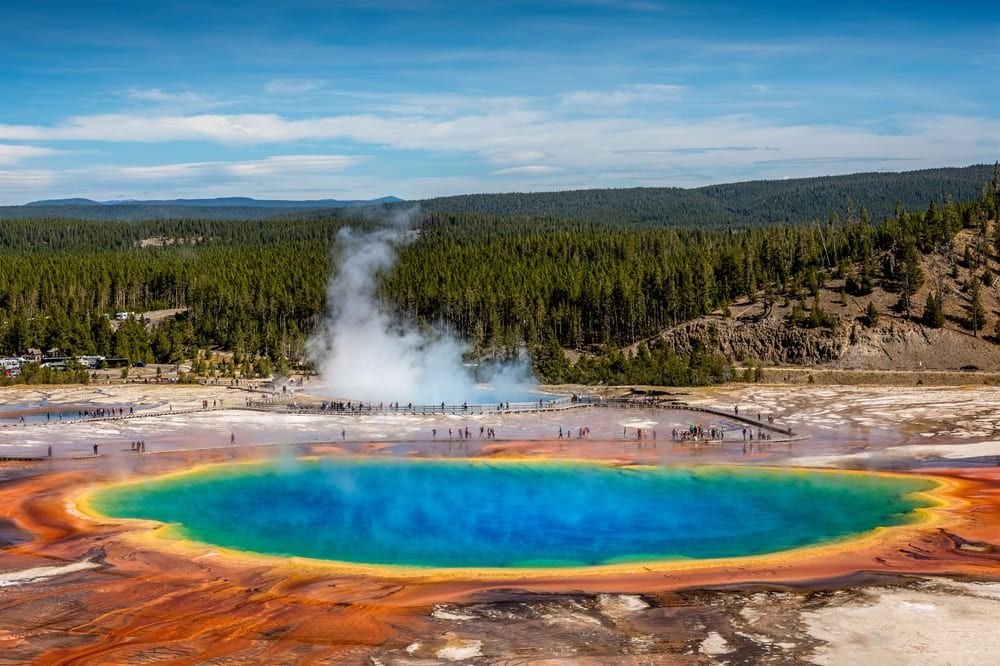
Indigenous peoples also knew Yellowstone’s geysers and hot springs well, as shown by hundreds of ancient campsites, these geothermal features were part of their daily life as well as their spiritual beliefs. Everything changed quickly in the 19th century with the arrival of explorers, trappers, and settlers. Major migration routes to Oregon passed through Wyoming, tensions grew, and conflicts with the U.S.
Army became more frequent. After decades of war and broken treaties, most Indigenous peoples were forced onto reservations. The main one in Wyoming is the Wind River Reservation, created in 1868 for the Eastern Shoshone and later shared with the Northern Arapaho.
In 1872, Yellowstone became the first national park in the world. At that time, the Tukudika were still living there, but over the years, they were gradually pushed out as the area was turned into a protected space focused on tourism. Today, many of their descendants live on nearby reservations.
The town of Cody, about an hour from Yellowstone’s East Entrance, has since become one of the park’s main historic gateways.
Aucun avis pour le moment
