






Walk
Beyond the Picture Perfect Image
San Diego, États-Unis
Walk
Beyond the Picture Perfect Image
San Diego, États-Unis
7 km
Distance
2h50
Durée
24
Audios
Loop
Parcours
Shutterstock
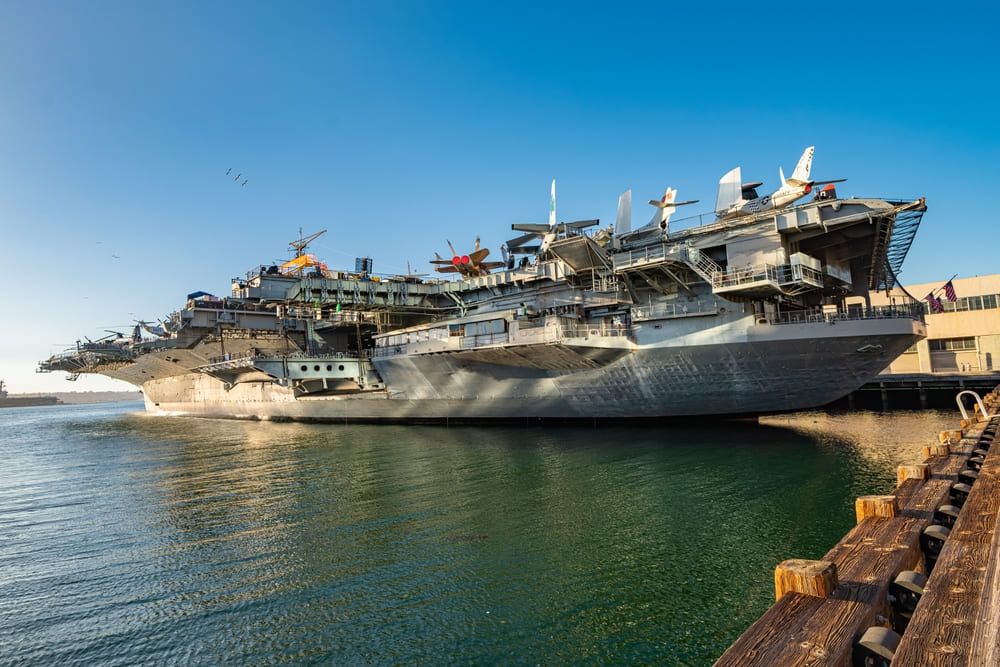
Turn around and take in the immense silhouette of the USS Midway. At more than 1,000 feet long, this enormous aircraft carrier towers over San Diego Bay. Yet as impressive as it is today as a museum, the Midway is best known for having one of the longest and most eventful careers in U.S.
naval history. The USS Midway officially entered service on September 10, 1945. There is a touch of historical irony in that date: it arrived just a few days too late to take part in World War II.
Built in only seventeen months, it immediately came to represent America’s postwar naval power. When it entered service, it was one of the largest warships in the world. Nearly 4,500 sailors lived and worked aboard what was essentially a floating city.
The ship had its own sleeping quarters, kitchens, workshops, hospital, control rooms, and, above all, its enormous flight deck, the true heart of the carrier. Despite missing World War II, the Midway quickly found a new role. By the late 1940s, it had become a floating laboratory for emerging American military technology.
A few years later, the ship had to transform again to keep pace with another revolution: the arrival of jet aircraft. It underwent major modernization, including the addition of an angled flight deck, which had become essential for modern jets. The Midway therefore lived through several technological eras.
Designed at the end of the age of propeller-driven aircraft, it remained in service well into the era of modern fighter jets. The carrier also took part in several major Cold War conflicts, most notably the Vietnam War. Perhaps the most famous episode in its history came during the evacuation of Saigon in April 1975.
During Operation Frequent Wind, the Midway served as a floating base for the evacuation of thousands of refugees as South Vietnam collapsed. In just two days, more than 3,000 people were brought to safety aboard the ship. That operation also produced one of the most extraordinary moments in the carrier’s history.
A South Vietnamese pilot, Major Buang-Ly, approached the Midway in a tiny Cessna O-1 Bird Dog with his wife and five children aboard. There was just one problem: the small plane was never designed to land on an aircraft carrier. To give him a chance, the crew pushed several helicopters overboard to clear the flight deck.
Against all odds, the plane landed safely. The episode became legendary in U.S. naval history and remains one of the most deeply human moments associated with the Midway.
Its final mission before retirement was humanitarian: evacuating civilians after the eruption of Mount Pinatubo in the Philippines. Decommissioned in 1992, the ship finally opened as a museum in San Diego in 2004. Today, it is one of the city’s most visited attractions, so if you’d like to learn more about its remarkable history, you can step aboard and explore this giant of the sea for yourself.
Aucun avis pour le moment
