






Walk
The Eternal Imperial Capital
Hanoi, Vietnam
Walk
The Eternal Imperial Capital
Hanoi, Vietnam
5 km
Distance
2h00
Durée
18
Audios
Loop
Parcours
Shutterstock
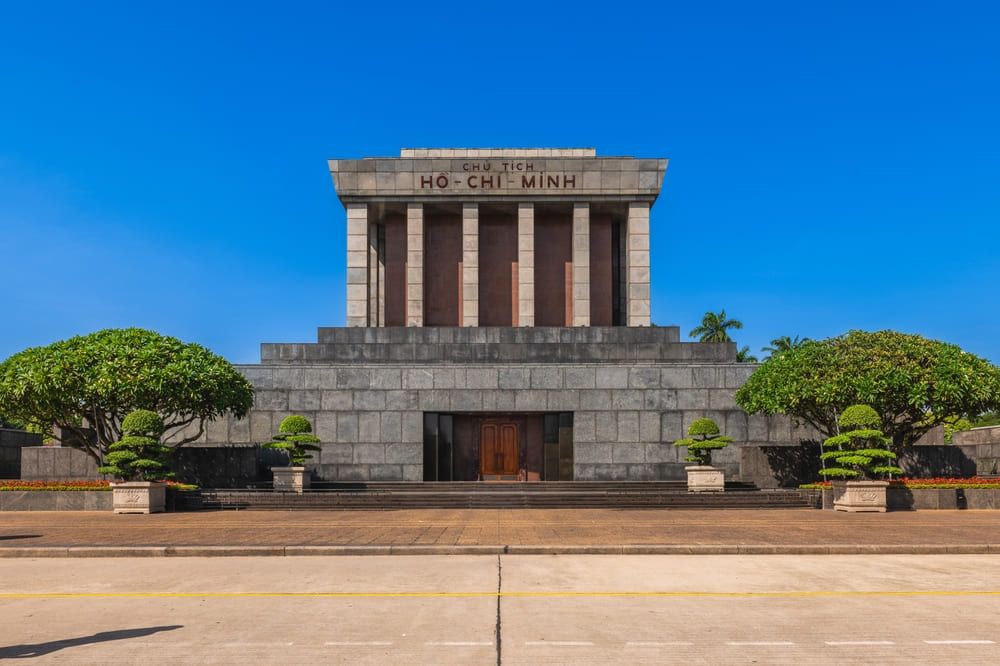
The Ba Đình Square is the political and symbolic heart of Vietnam, the largest square of the country, where Hồ Chí Minh proclaimed independence on 2 September 1945. The Hanoi audio-guided tour stops here, with gravity, to evoke this vast solemn space, founding place of the Republic and bordered by the mausoleum of the historic leader.
Here you are arrived at the level of the immense Ba Đình Square. It is the political and symbolic heart of Vietnam, a vast solemn space where the most founding moments of the modern history of the country were played out. It is here, on 2 September 1945, that Hồ Chí Minh proclaimed the independence of Vietnam before an immense crowd, an event commemorated each year during the national holiday. Hồ Chí Minh is one of the most marking figures of the history of modern Vietnam. Born in 1890, he devoted his life to the struggle for the independence of his country, then under French colonial domination. A tireless traveller, he spent long years abroad before returning to lead the national movement. About three hundred and twenty metres long and one hundred metres wide, Ba Đình is the largest square of Vietnam; it hosts the great official ceremonies, the parades and the daily flag-raisings, in an atmosphere marked by solemnity. All around unfold the high places of power and national memory: the mausoleum of Hồ Chí Minh, where rests, with respect, the body of the leader, the presidential palace, and several official buildings. A place of contemplation as much as of national pride, the square remains the sanctuary of the birth of the Republic. A solemn square and a cradle of independence, the Ba Đình Square is a fine stop of the discovery of Hanoi.
Here you discover, with gravity, the largest square of Vietnam, political and symbolic heart of the country, where Hồ Chí Minh proclaimed independence on 2 September 1945; about three hundred and twenty metres long, it hosts official ceremonies and flag-raisings, and is surrounded by the high places of national memory, including the mausoleum of Hồ Chí Minh and the presidential palace. The Ba Đình Square is the heart of Vietnam. It is a stop to be discovered with respect.
The Ba Đình Square lies in the Ba Đình district, in Hanoi, surrounded by the mausoleum of Hồ Chí Minh and the presidential palace, reachable on foot. It is a solemn public square; you respect the expected dress and behaviour near the places of memory, and the mausoleum follows its own hours and visit rules, which vary. It is best to enquire before coming.
Because it is here that Hồ Chí Minh proclaimed the independence of Vietnam on 2 September 1945, a founding event of the Republic commemorated each national holiday; the largest square of the country, about three hundred and twenty metres long, political and symbolic heart, it is surrounded by the mausoleum of Hồ Chí Minh and the presidential palace.
In the Ba Đình district, in Hanoi, in Vietnam.
Aucun avis pour le moment
