







Walk
Land of the Ancient Dragon
Hanoi, Vietnam
Walk
Land of the Ancient Dragon
Hanoi, Vietnam
7 km
Distance
3h00
Durée
29
Audios
Loop
Parcours
Shutterstock
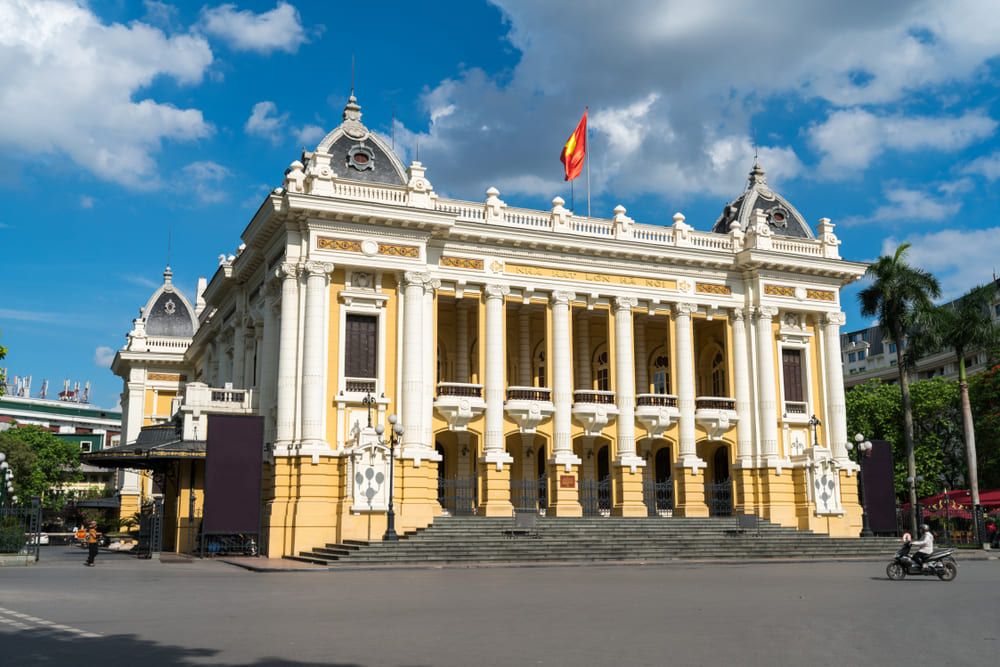
An emblematic building of the French Quarter, the Hanoi Opera House is a true symbol of the modern history of Vietnam. Its façade recalls the Palais Garnier of Paris. The Hanoi audio-guided tour stops here to evoke this elegant monument, a jewel of the colonial heritage of the capital.
Built at the beginning of the twentieth century, in the era of French Indochina, the municipal theatre of Hanoi, or Hanoi Opera House, is inspired by the Palais Garnier of Paris. Its elegant façade, its columns and its refined decor make it one of the finest colonial buildings of Vietnam. A witness of the modern history of the country, it today hosts shows and cultural events.
You admire the elegant façade inspired by the Palais Garnier, its columns and its steps, in the heart of the French Quarter. Attending a show allows you to discover its richly decorated interior. It is a major stop of Hanoi for lovers of architecture, music and colonial history.
The Hanoi Opera House lies in the heart of the French Quarter, near Hoan Kiem Lake, reachable on foot. The façade can be freely admired from the square; the shows and tours follow their own programme and their own access conditions, which vary. It is best to check the agenda in advance.
Its elegant façade, its columns and its decor are inspired by the Palais Garnier of Paris; it is a jewel of the colonial architecture of the French Quarter.
In the heart of the French Quarter of Hanoi, near Hoan Kiem Lake.
Aucun avis pour le moment
