






Walk
The Eternal Imperial Capital
Hanoi, Vietnam
Walk
The Eternal Imperial Capital
Hanoi, Vietnam
5 km
Distance
2h00
Durée
18
Audios
Loop
Parcours
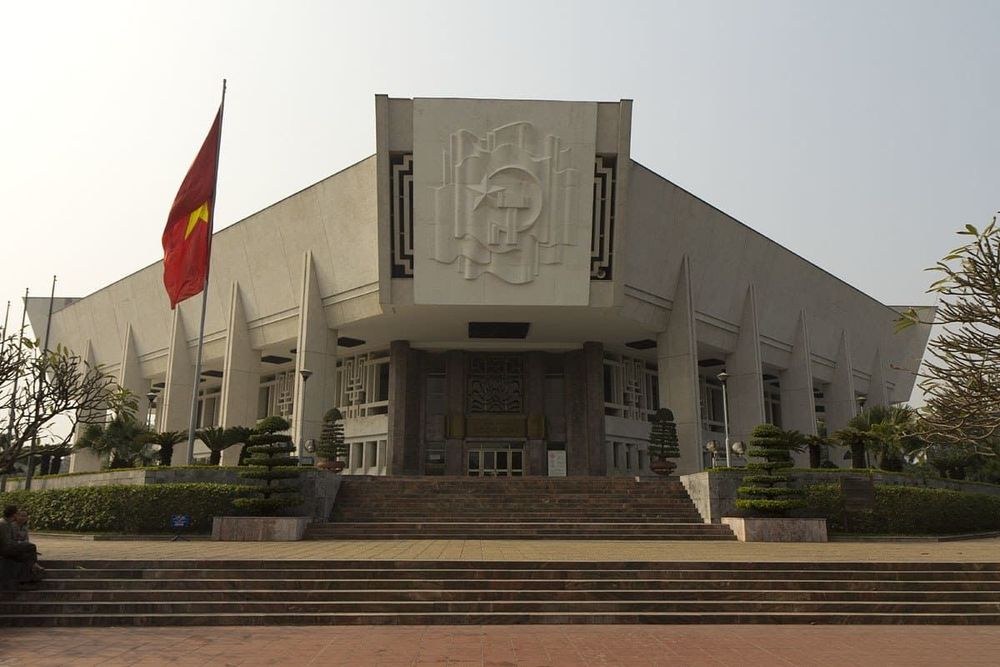
©Stefan Fussan CC BY-SA 4.0. <https://creativecommons.org/licenses/by-sa/4.0/deed.fr>via Wikipedia Commons
The Hồ Chí Minh museum is a great museum of Hanoi dedicated to the memory and the heritage of the Vietnamese revolutionary leader, inaugurated in 1990 for the centenary of his birth. The Hanoi audio-guided tour stops here to evoke this building nicknamed 'the white lotus', that retraces the life of Hồ Chí Minh and the modern history of Vietnam.
Here is the Hồ Chí Minh museum, a place dedicated to the memory and the heritage of the Vietnamese revolutionary leader. It was inaugurated in 1990, on the occasion of the centenary of the birth of Hồ Chí Minh, and symbolises the homage that Vietnam pays to its founding father. Designed with the help of the Soviet Union and the participation of the Vietnamese people, the museum was the fruit of a long project of national scale, carried out after numerous years of preparation and construction. Its architecture is remarkable: nicknamed the white lotus, the building evokes by its form a blossomed lotus flower, a symbol of purity dear to Vietnamese culture and to Buddhism. Inside, the route retraces the life of Hồ Chí Minh, from his birth in 1890 to his role as leader of the struggle for independence, through photographs, documents, personal objects and reconstitutions, but it also places his destiny in the context of world history and the great movements of the twentieth century. The scenography, modern for the era, mingles historical objects and symbolic installations. Situated in the Ba Đình district, near the mausoleum and the One Pillar pagoda, the museum completes the memorial ensemble dedicated to the leader. A memorial museum and a national homage, the Hồ Chí Minh museum is a fine stop of the discovery of Hanoi.
Here you discover the great museum dedicated to the memory of Hồ Chí Minh, inaugurated in 1990 for the centenary of his birth, whose building, nicknamed the white lotus, evokes a blossomed lotus flower; the route retraces the life of the leader and the modern history of Vietnam through photographs, documents, personal objects and symbolic installations, near the mausoleum and the One Pillar pagoda. The Hồ Chí Minh museum is a national homage in Hanoi. It is a fine stop, indoors.
The Hồ Chí Minh museum lies in the Ba Đình district, in Hanoi, near the mausoleum and the One Pillar pagoda, reachable on foot. It follows its own days and opening hours, variable, and entry is generally subject to a fee. You respect the expected dress and behaviour in this place of memory. It is best to enquire before coming.
Because its building evokes by its form a blossomed lotus flower, a symbol of purity dear to Vietnamese culture and to Buddhism; inaugurated in 1990 for the centenary of the birth of Hồ Chí Minh, this memorial museum retraces the life of the leader and the modern history of Vietnam, near the mausoleum and the One Pillar pagoda.
In the Ba Đình district, in Hanoi, near the mausoleum and the One Pillar pagoda, in Vietnam.
Aucun avis pour le moment
