






Walk
The Eternal Imperial Capital
Hanoi, Vietnam
Walk
The Eternal Imperial Capital
Hanoi, Vietnam
5 km
Distance
2h00
Durée
18
Audios
Loop
Parcours
Shutterstock
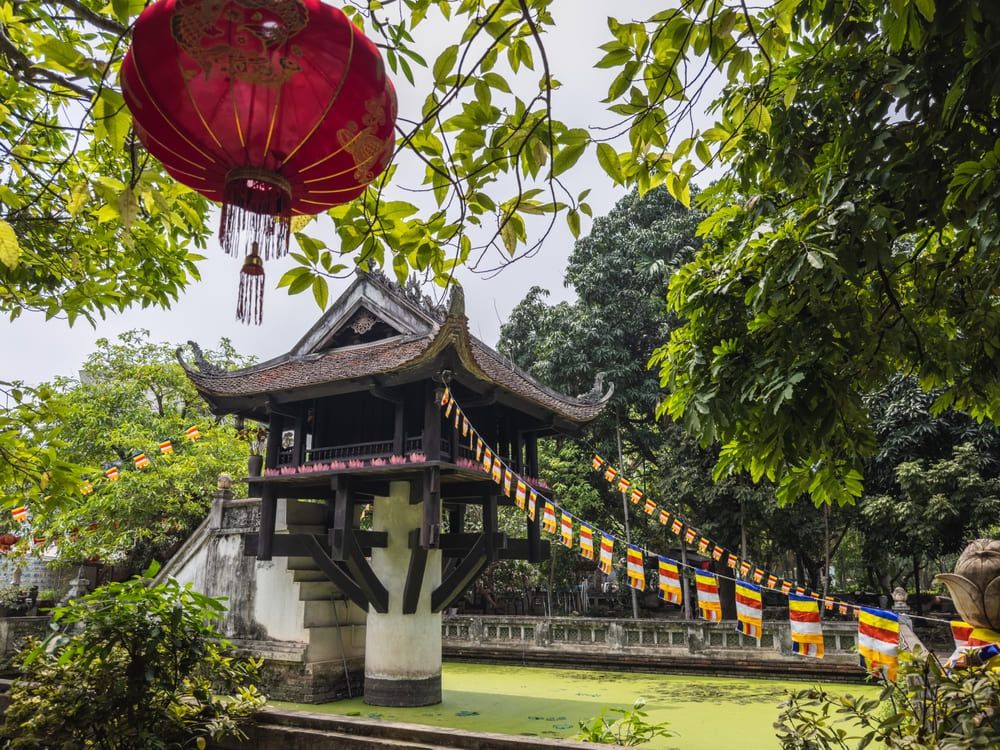
The One Pillar pagoda, Chùa Một Cột, is one of the most emblematic symbols of Hanoi, a Buddhist pagoda of 1049 resting on a single pillar, in the shape of a lotus flower. The Hanoi audio-guided tour stops here, with respect, to evoke this spiritual masterpiece built under the emperor Lý Thái Tông, image of purity and awakening.
You see here the One Pillar pagoda, one of the monuments dearest to the heart of the Vietnamese. Built in 1049 under the emperor Lý Thái Tông, it is a work unique of its kind, whose architecture is charged with symbols. The small wooden sanctuary rests on a single stone pillar planted in the middle of a pond, representing the stem of a lotus, while the building itself evokes a blossomed lotus flower emerging from the water. In Buddhism, very present in Vietnam, the lotus is a powerful symbol: growing in the mud but rising pure above the surface, it embodies spiritual purity, awakening, illumination and rebirth, the passage from ignorance to wisdom. According to tradition, the emperor Lý Thái Tông, without an heir, would have had a dream where the goddess of Mercy, Quan Âm, appeared to him seated on a lotus and handed him a son; a son being born to him shortly after, he had this pagoda in the shape of a lotus built to thank the goddess. Destroyed then rebuilt several times, notably in the twentieth century, the pagoda remains a place of prayer and pilgrimage, where the faithful come, with contemplation, to burn incense and implore protection and fecundity. A Buddhist pagoda and a stone lotus flower, the One Pillar pagoda is discovered with respect.
Here you discover, with respect, one of the dearest symbols of Hanoi, the One Pillar pagoda, built in 1049 under the emperor Lý Thái Tông; a small wooden sanctuary resting on a single stone pillar in the middle of a pond, it evokes a lotus flower emerging from the water, a Buddhist symbol of purity and awakening, and remains a place of prayer born, legend says, from a dream of the emperor. The One Pillar pagoda is a sanctuary of Hanoi. It is a stop to be discovered with respect.
The One Pillar pagoda lies in the Ba Đình district, in Hanoi, behind the Hồ Chí Minh museum, near the mausoleum, reachable on foot. A Buddhist place of worship, it can be visited with respect; access and hours follow the conditions of the place, which vary. It is best to enquire before coming and to respect the sacred character of the sanctuary.
Because it evokes a lotus flower emerging from the water, resting on a single stone pillar figuring the stem of the lotus; a Buddhist symbol of purity and awakening, it was, according to legend, built in 1049 by the emperor Lý Thái Tông to thank the goddess Quan Âm, who had appeared to him in a dream seated on a lotus and had given him a son.
In the Ba Đình district, in Hanoi, behind the Hồ Chí Minh museum, in Vietnam.
Aucun avis pour le moment
