





Walk
The Eternal Imperial Capital
Hanoi, Vietnam
Walk
The Eternal Imperial Capital
Hanoi, Vietnam
5 km
Distance
2h00
Durée
18
Audios
Loop
Parcours
Shutterstock
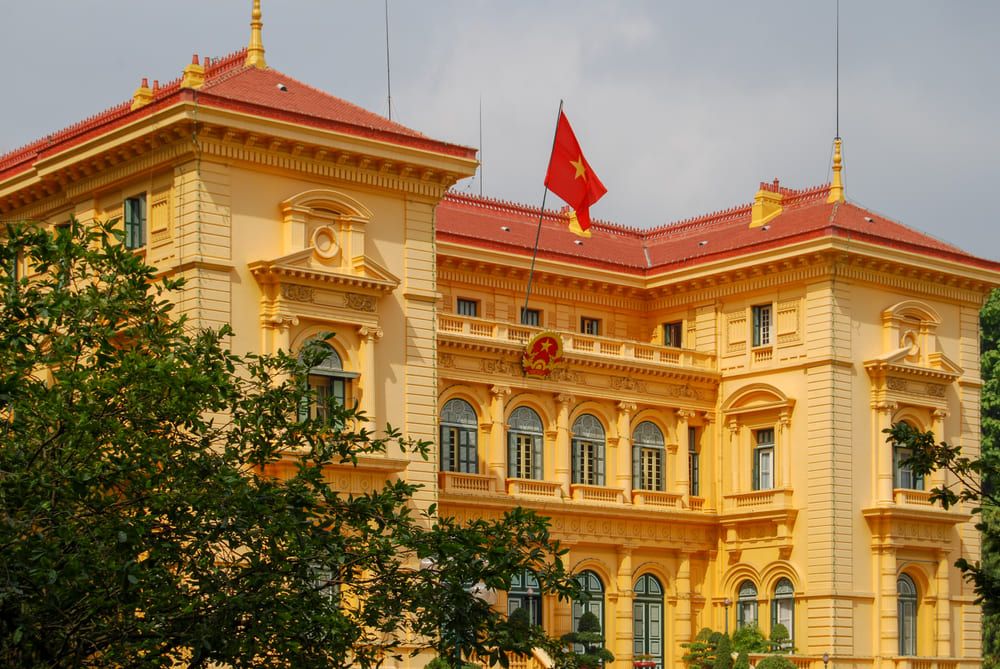
The presidential palace of Hanoi is an elegant French colonial building of yellow colour, built between 1900 and 1906, today the official seat of the presidency of Vietnam. The Hanoi audio-guided tour stops here to evoke this imposing building, former residence of the governor general of Indochina, in the neoclassical and Italian neo-Renaissance style.
Here you are in front of the elegant presidential palace. This magnificent French colonial building, built between 1900 and 1906, is today the official residence of the president of Vietnam and the seat of his office. Originally, it served as residence and office of the governor general of Indochina, under French colonial domination, and symbolised then the power of the colonial administration. Designed by the architects of the time, the palace mingles neoclassical and Italian neo-Renaissance styles, characteristic of official colonial architecture. Its mustard yellow colour, typical of that era in Hanoi, its classical columns, its pediments and its balustrades give it an imposing and refined appearance. Surrounded by careful gardens, lawns and paths, it forms a fine ensemble in the district of power, near the Ba Đình Square. One detail deserves to be underlined: Hồ Chí Minh, become president, refused to settle in this palace that he judged too sumptuous and too marked by colonialism; he preferred to live in a modest house on stilts arranged in the neighbouring park, a gesture of simplicity that remained famous. The palace cannot be visited, but you admire its façade and its gardens from the outside. A colonial palace and a seat of power, the presidential palace is a fine stop of the discovery of Hanoi.
You admire a magnificent French colonial building of mustard yellow colour, built between 1900 and 1906 as residence of the governor general of Indochina, today the seat of the presidency of Vietnam; in the neoclassical and Italian neo-Renaissance styles, with columns and pediments, surrounded by careful gardens, it recalls that Hồ Chí Minh refused to live there, preferring a modest house on stilts. The presidential palace is a building of power in Hanoi. It is a fine stop, to be explored on foot.
The presidential palace lies in the Ba Đình district, in Hanoi, near the Ba Đình Square and the mausoleum, reachable on foot. It is an official building that cannot be visited; you admire its façade and its gardens from the outside, and the neighbouring park, with the house on stilts of Hồ Chí Minh, follows its own visit conditions. It is best to enquire before coming.
Because he judged this colonial palace too sumptuous and too marked by colonialism; become president, he preferred to live in a modest house on stilts arranged in the neighbouring park, a gesture of simplicity that remained famous. This mustard yellow building, built between 1900 and 1906 for the governor general of Indochina, is today the seat of the presidency of Vietnam.
In the Ba Đình district, in Hanoi, near the Ba Đình Square, in Vietnam.
Aucun avis pour le moment
