






Walk
The Eternal Imperial Capital
Hanoi, Vietnam
Walk
The Eternal Imperial Capital
Hanoi, Vietnam
5 km
Distance
2h00
Durée
18
Audios
Loop
Parcours
Shutterstock
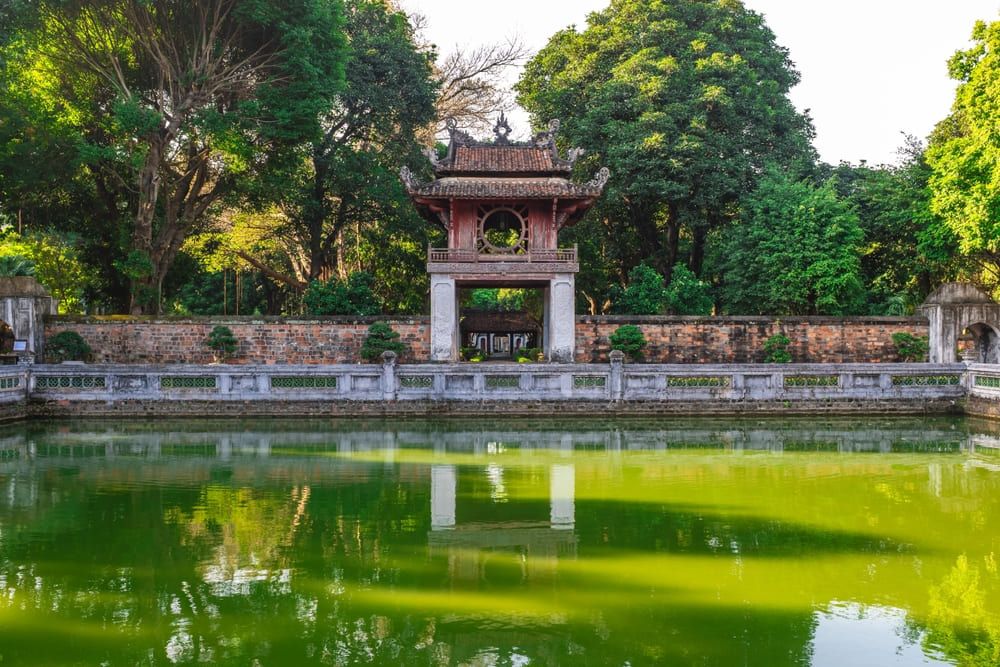
The Temple of Literature is one of the most emblematic monuments of Hanoi, a Confucian temple founded in 1070 and become the first university of Vietnam. The Hanoi audio-guided tour stops here, with respect, to evoke this sanctuary of knowledge, dedicated to Confucius, where generations of scholars prepared the formidable imperial examinations for nearly a thousand years.
On your right is one of the most emblematic monuments of Hanoi, a place where, for nearly a thousand years, you learn that knowledge is a sacred wealth. Founded in 1070 to honour Confucius, the great Chinese master whose thought deeply marked Vietnamese society, this site was transformed in 1076 into the first university of Vietnam, the Quốc Tử Giám, the School of the Sons of the Nation. For centuries, it saw generations of students come to be trained there and to prepare the formidable imperial examinations, that opened the doors of the highest functions of the State to the most brilliant minds. The visit unfolds, with respect, like an initiatory route through five successive courtyards, separated by solemn gates, where even the high dignitaries formerly had to dismount from their horse. You cross peaceful gardens, you walk along ponds and pavilions, before reaching the sanctuary dedicated to Confucius and his disciples. The treasure of the place lies in its famous stone stelae, placed on sculpted turtles, symbols of longevity, that bear engraved the names of the laureates of the examinations, a true memory of the intellectual elite of the country. Heart of Confucian culture and of the cult of knowledge, the temple embodies the deep attachment of the Vietnamese to study. A temple of knowledge and a sanctuary of Confucius, the Temple of Literature is discovered with respect.
Here you discover, with respect, one of the most emblematic monuments of Hanoi, founded in 1070 to honour Confucius and become in 1076 the first university of Vietnam; you cross five courtyards and peaceful gardens to the sanctuary, and you admire the famous stone stelae placed on turtles, engraved with the names of the laureates of the imperial examinations. The Temple of Literature is a sanctuary of knowledge of Hanoi. It is a stop to be discovered with respect.
The Temple of Literature lies in the Đống Đa district, near the centre of Hanoi, reachable on foot. A place of worship and memory, it can be visited with respect; it follows its own days and opening hours, variable, and entry is generally subject to a fee. It is best to enquire before coming and to respect the sacred character of the place.
A Confucian temple founded in 1070 to honour Confucius, become in 1076 the first university of Vietnam, the Quốc Tử Giám, where generations of scholars prepared the imperial examinations; you cross five courtyards and gardens to the sanctuary, and you admire the famous stone stelae placed on turtles, engraved with the names of the laureates.
In the Đống Đa district, near the centre of Hanoi, in Vietnam.
Aucun avis pour le moment
