





Walk
Land of the Ancient Dragon
Hanoi, Vietnam
Walk
Land of the Ancient Dragon
Hanoi, Vietnam
7 km
Distance
3h00
Durée
29
Audios
Loop
Parcours
Shutterstock
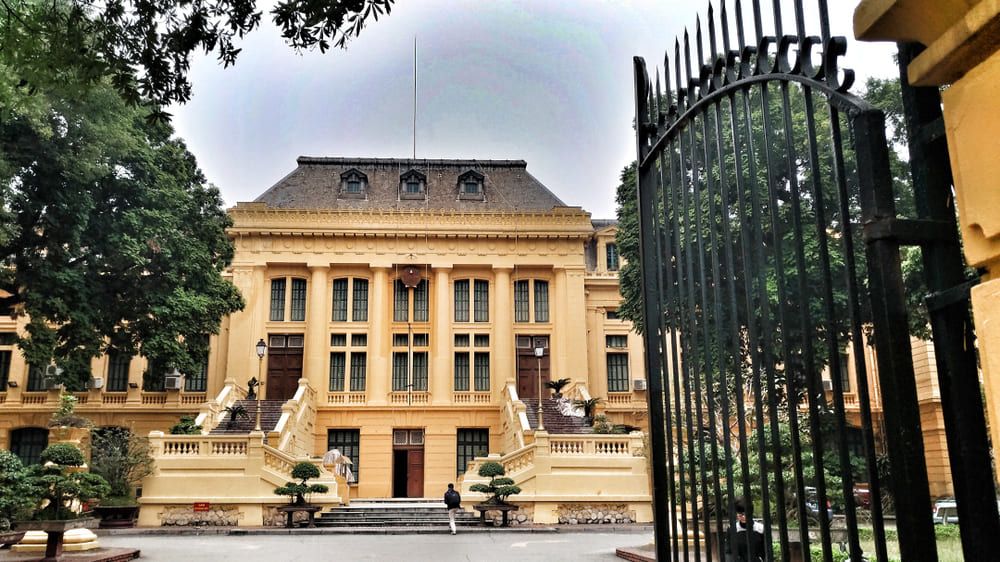
This imposing building was constructed at the beginning of the twentieth century by the French architect Auguste-Henri Vildieu, in the era of French Indochina. The Hanoi audio-guided tour stops here to evoke this building, a remarkable witness of the colonial architecture of the capital.
Built between 1900 and 1906 by the French architect Auguste-Henri Vildieu, then brought into service in the following years, the former supreme court is an emblematic building of French Indochina. Its architecture, marked by the colonial style of the time, illustrates the French administrative presence in Hanoi. The building has kept its judicial function and remains linked to the history of justice in Vietnam.
You admire the colonial-style façade and the imposing appearance of this building of the beginning of the twentieth century, a witness of the architecture of French Indochina. The building illustrates the French imprint in the town planning of Hanoi. It is a stop for lovers of history and colonial architecture, in the heart of the capital.
The former supreme court lies in the heart of Hanoi, reachable on foot. It is a working judicial building: the façade can be freely admired from the street, while access inside is subject to the rules specific to a justice institution. It is mainly discovered from the outside, during the walk.
The French architect Auguste-Henri Vildieu, between 1900 and 1906, in the era of French Indochina.
A colonial style of the beginning of the twentieth century, a witness of the architecture of French Indochina in Hanoi.
Aucun avis pour le moment
