







Walk
Land of the Ancient Dragon
Hanoi, Vietnam
Walk
Land of the Ancient Dragon
Hanoi, Vietnam
7 km
Distance
3h00
Durée
29
Audios
Loop
Parcours
Shutterstock
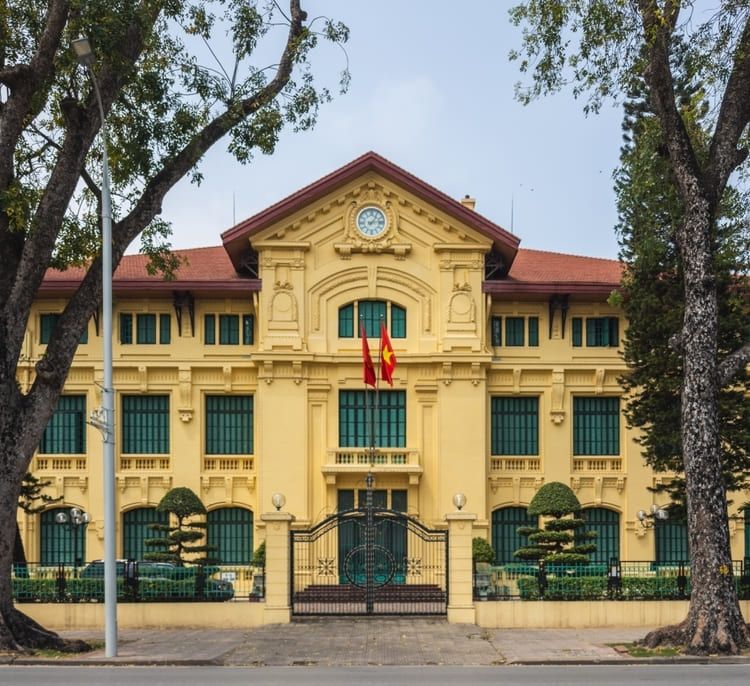
The building that stands here is the Tonkin Palace, the former residence of the Resident Superior in the era of French Indochina. The Hanoi audio-guided tour stops here to evoke this majestic building, become today a state guest house.
Designed at the end of the nineteenth century and built between 1918 and 1919 by the colonial administration, the Tonkin Palace was the residence of the Resident Superior of Tonkin, in the heart of the first French administrative Hanoi. A fine example of colonial architecture, located on Ngo Quyen Street, it today serves as a state guest house and testifies to the history of the French period.
You admire the majestic façade and the colonial architecture of this former palace, a witness of the French administration in Tonkin. Located in the French Quarter, it completes the discovery of the colonial heritage of Hanoi. It is a stop for lovers of history and architecture, in the heart of the capital.
The Tonkin Palace lies on Ngo Quyen Street, in the French Quarter of Hanoi, reachable on foot. Become a state guest house, it is an official building: the façade can be admired from the street, while access inside is reserved and subject to its own rules. It is mainly discovered from the outside.
Between 1918 and 1919 by the colonial administration, as the residence of the Resident Superior of Tonkin; it today serves as a state guest house.
On Ngo Quyen Street, in the French Quarter of Hanoi, in Vietnam.
Aucun avis pour le moment
