© Shutterstock
 Votre guide Ryo
The 11 Most Beautiful Villages of Aubrac to Visit in 2026
It is hard to talk about Aubrac without resorting to superlatives. The most beautiful villages of Aubrac rank among the most captivating hamlets in the Massif Central, and yet they remain surprisingly unknown. This high plateau straddling Aveyron, Lozère and Cantal rises above 1,000 metres, stretches across endless pastures and conceals, in its folds and along the valleys that border it, medieval villages of remarkable heritage density: listed towns, forgotten stops on the Way of Le Puy, high-altitude hamlets frozen in basalt. This Ryo guide lists the 11 villages that truly deserve a visit, with what to see there, how to combine them and when to go. For a broader overview of rural France and its finest addresses, also take a look at our panorama of France's most characterful villages.
1. Laguiole, Capital of the Plateau and Legendary Forge
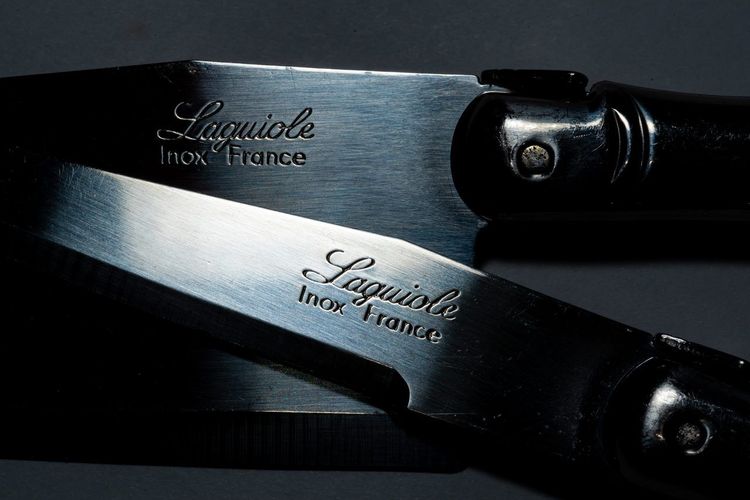
At 1,050 metres above sea level, Laguiole is the flagship town of Aubrac. Its name has crossed borders for one reason: the knife. Since the 19th century, the town's knife-makers have crafted the Laguiole by hand — forged steel blade, juniper wood or Aubrac horn handle, a guilloche pattern drawn on the grindstone. The Forge de Laguiole (Route de l'Aubrac, 12210 Laguiole, rated 4.5/5 on Google across 196 reviews), whose building topped by a giant blade was designed by Philippe Starck in 1987, is today one of the most visited industrial sites in Aveyron. The guided tour lasts about an hour and ends in the shop, where prices reflect the artisanal origin of the product (from €70 to over €600).
But Laguiole far exceeds its reputation as a cutlery town. The Aubrac cow, a hardy breed with dark-rimmed eyes, has grazed here since the Middle Ages. Its milk is used to produce Laguiole AOP cheese, aged for a minimum of four months: the Coopérative Jeune Montagne, founded in 1960, perpetuates a know-how that you can observe during a visit to the cellar. It is also in Laguiole that Sébastien Bras took over the family restaurant Bras, awarded three Michelin stars before deliberately withdrawing from the guide in 2017 — a decision that made headlines around the gastronomic world.
The centre of Laguiole can be explored on foot in forty minutes. The church of Saint-Martin, rebuilt in the 19th century, dominates the main square. From the viewpoint behind the town hall, the gaze reaches as far as the volcanoes of Auvergne on a clear day. In winter, the plateau takes on an arctic dimension, with temperatures sometimes dropping below -15°C — a fact that local guides mention almost with pride.
2. Saint-Chély d'Aubrac, Gateway to the Way of Le Puy
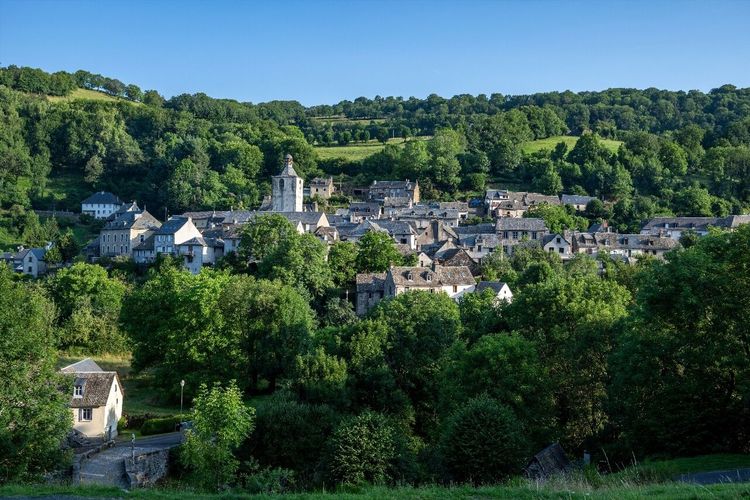
About twenty kilometres south of Laguiole, Saint-Chély d'Aubrac sits on a steep slope overlooking the Boralde valley. This village of a few hundred inhabitants is an unmissable stop on the GR65, the Way of Le Puy to Santiago de Compostela, a pilgrimage route dating back to the 12th century.
The Pont des Pèlerins spanning the Boralde, dated to the 15th century and inscribed on the UNESCO World Heritage List as part of the Routes of Santiago de Compostela, is the first thing that strikes you when arriving along the pilgrim path. A small cross carved on the parapet reminds walkers that they are treading a thousand-year-old route. Just above, the village stretches around its Gothic church and cobbled lanes, where schist houses huddle together against the winds.
The singularity of Saint-Chély d'Aubrac lies in its crossroads position: here you descend from the cold, open plateau into a gentler, more sheltered valley where chestnut trees grow. This landscape transition between two worlds — high and low, harsh and tender — is one of the most striking in all of Aubrac. The village also houses a Black Madonna, an object of devotion since the Middle Ages.
3. Nasbinals, at the Heart of the Lozère Plateau
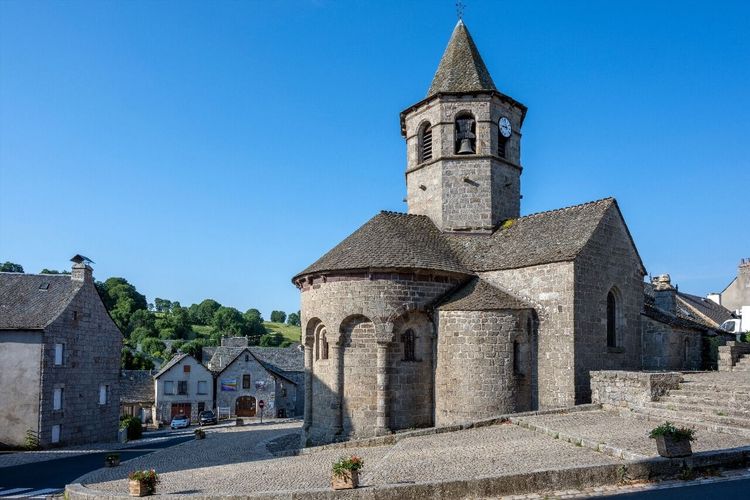
Nasbinals is perhaps the most typical village on the plateau. At 1,180 metres above sea level in the heart of Lozère, it concentrates in a few streets the very essence of Aubrac: black basalt, constant wind, pastures stretching as far as the eye can see, and silence broken only by the bells of the Aubrac cows.
The Église Sainte-Marie, built between the 11th and 12th centuries, is a Romanesque gem in basalt. Its single nave, semicircular apse and octagonal bell tower make it one of the best-preserved religious buildings in the region. The dark, bare interior creates an atmosphere of contemplation that pilgrims on the Way of Le Puy deeply appreciate: Nasbinals is a classic stage on the route.
The transhumance, celebrated every late May as the herds move up to the high-altitude pastures, transforms Nasbinals into a popular festival. Hundreds of Aubrac cows pass through the streets in a tradition unchanged for centuries. For the rest of the year, the village lives at the slow pace of the mountains — which is precisely its charm.
4. Saint-Urcize, the Cantal Edge of Aubrac
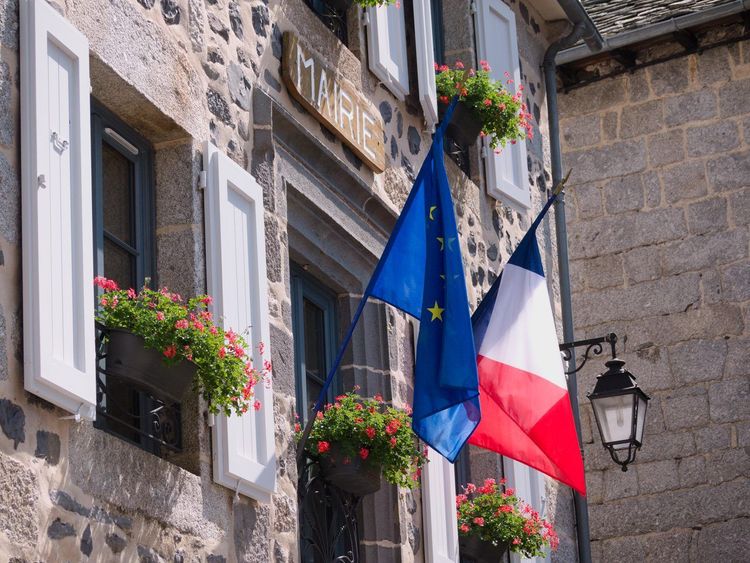
Less well known than its neighbours in Aveyron, Saint-Urcize represents Aubrac on the Cantal side. Clinging to a fold in the plateau at over 1,000 metres, it has only about a hundred inhabitants and gives the impression of being at the end of the world — which, geographically, is not far from the truth.
The village's Romanesque church, dating from the 12th and 13th centuries, has an austere nave and a crypt that long served as a refuge for inhabitants during times of conflict. The rest of the village — a few basalt houses, a central fountain, a café that doubles as the social heart — has barely changed in a century. That is precisely what travellers who venture here come to find: an Aubrac without a safety net, without paid parking, without tourist signposting. It fits naturally into a loop with Nasbinals (25 km) and the village of Aubrac for a full day on the plateau.
5. Mur-de-Barrez, the Medieval Sentinel of the Truyère Gorges
Mur-de-Barrez (Place du Barry, 12600 Mur-de-Barrez, rated 4.5/5 on Google across 36 reviews) is perched on a basalt spur at 800 metres above sea level, overlooking the gorges of the Truyère on the eastern edge of Cantal. A village of character too often overlooked by visitors who confine themselves to Aveyron, it is nonetheless one of the most photogenic hamlets in the region.
The village retains a remarkable medieval architecture and a singular historical link with the Principality of Monaco, whose Grimaldi princes were long lords of the Carladez. The Tour de Monaco, a fortified remnant, preserves that memory. The ruins of the castle (13th–16th centuries) offer from their promontory a striking panorama over the meanders of the Truyère and Lake Sarrans, a hydroelectric reservoir whose dam, built between 1929 and 1934, transformed the geography of the valley. The Gothic church of Saint-Thomas contains listed furnishings including remarkable woodwork.
Mur-de-Barrez has a genuine local life: shops open year-round, restaurants serving Aubrac cuisine (aligot, tripoux), and a few quality accommodation options. It makes a practical base for exploring the Truyère gorges and the Saut du Chien waterfall nearby.
6. The Village of Aubrac, the Highest and Most Mysterious
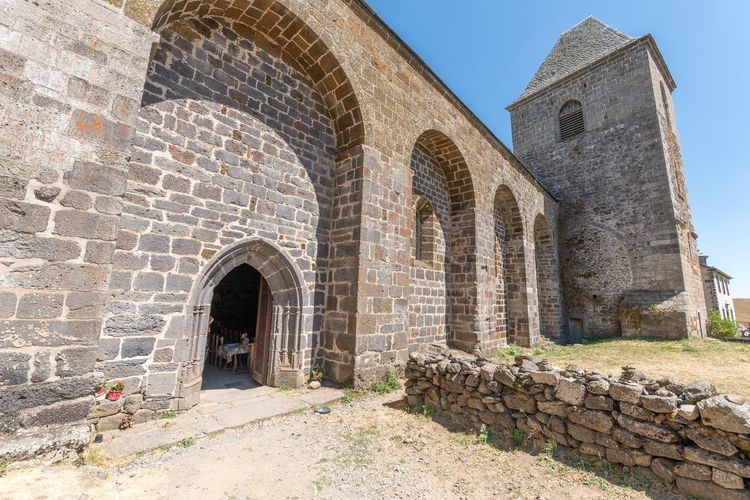
A distinction must be made: Aubrac is both a plateau, a region, a cattle breed and... a very small village. This hamlet of a few dozen inhabitants, situated at 1,307 metres above sea level, is one of the highest points on the plateau and the place that gave it its name.
The Domerie d'Aubrac (Village d'Aubrac, 12470 Saint-Chély-d'Aubrac, rated 4.6/5 on Google across 206 reviews), founded in the 12th century by the Flemish knight Adalard, was originally a hospice for pilgrims caught out by snowstorms. This religious and charitable institution, which could accommodate several hundred people in its prime, disappeared during the Revolution. What remains is the square tower known as the Tour des Anglais, the church of Notre-Dame-des-Pauvres, and a few massive basalt buildings that have withstood eight centuries of plateau winds. The transhumance festival, held each year at the end of May, draws thousands of visitors here. For the rest of the year, the village of Aubrac is one of absolute stillness — a few houses, a hotel-restaurant, and the sound of the wind through the short grass.
7. Arzenc d'Apcher, Wild Lozère Aubrac
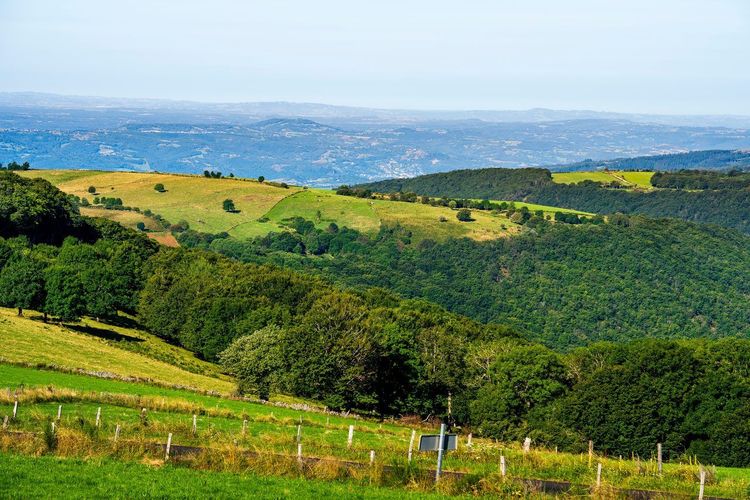
Arzenc d'Apcher (Bourg, 48600 Arzenc-d'Apcher) is one of the least visited villages in Aubrac. Located in the north of Lozère, away from the main tourist routes, it embodies the wild face of the plateau that few travellers take the time to seek out.
The village is organised around a plain Romanesque church whose bell tower, visible from afar, serves as a landmark in this open landscape. The grey basalt houses, with shutters often closed out of season, bear witness to a rural exodus that profoundly marked these territories in the 20th century. But it is precisely this gentle melancholy, this space preserved from the crowds, that draws hikers who know the region well. Arzenc d'Apcher is reached from Marvejols or Saint-Flour along secondary roads — a detour rewarded by a plateau of rare purity, where the horizon seems to recede indefinitely.
8. Estaing, a Listed Medieval Gem on the Lot
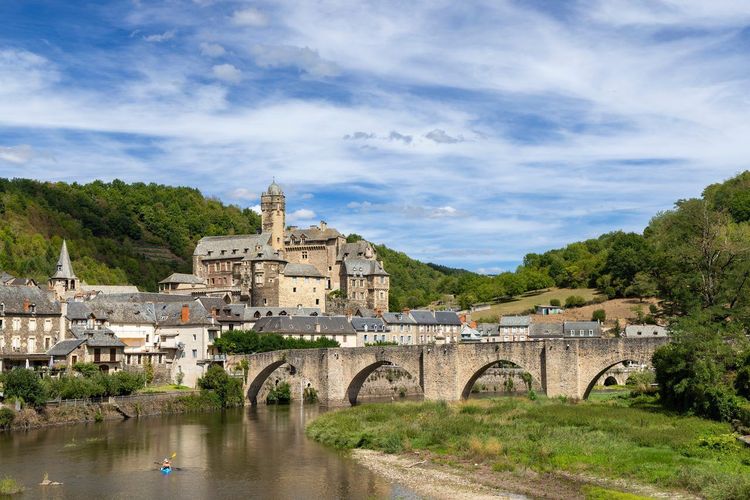
Estaing is undoubtedly the most visually impressive village in this selection. Listed among the « Plus Beaux Villages de France » and with its bridge inscribed on the UNESCO World Heritage List as part of the Routes of Santiago de Compostela, it rises above the Lot in a medieval tableau of rare coherence.
The Château d'Estaing (Place du Fort, 12190 Estaing, rated 4.3/5 on Google across 1,714 reviews), built between the 15th and 16th centuries, dominates the village from its rocky spur. Owned by a foundation, it is open to visitors from May to October. Below, the 15th-century Gothic bridge spans the Lot in perfect balance — it is one of the most reproduced images of Aveyron. The Giscard d'Estaing family bought and restored the castle in 2005, contributing greatly to the village's current renown.
The small commune of around 600 inhabitants deserves half a day of your time. The lanes of the medieval village, the half-timbered houses and the chapels nestled in corners form an ensemble best explored without a map. In July, the pilgrimage to Saint Fleuret, patron of the village, draws the faithful as it has since the 15th century.
9. Saint-Côme d'Olt, the Twisted Spire That Defies Geometry
Saint-Côme d'Olt boasts a monument rare in France: a twisted spire, spiralling on itself like a frozen flame. Built in the 16th century in the Flamboyant Gothic style, its spire, 18 metres tall, twists noticeably to the right and reaches a total height of 42 metres. This contorted appendage appears on the list of historic monuments — and on the unofficial list of things that make you look up and whisper, "how did they do that?"
Labelled a « Plus Beau Village de France », Saint-Côme d'Olt unfolds along the left bank of the Lot. Its medieval fortifications — the Renaissance gateway known as the Porte des Tourrettes, partially preserved ramparts — frame a homogeneous historic centre. The 16th-century Renaissance castle now houses the town hall. The church of Saint-Côme-et-Saint-Damien, from which this wayward spire rises, also dates from the 16th century.
You can stroll through its streets in under an hour — enough time to walk along the banks of the Lot, pass under the arches of the gateway and settle onto a terrace facing the church to admire that improbable spire from every angle.
10. Saint-Geniez-d'Olt, Between Plateau and River
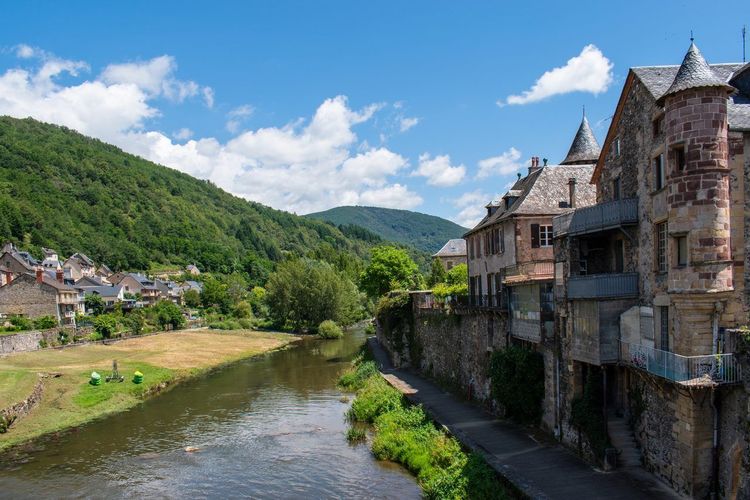
Saint-Geniez-d'Olt (Place du Général-de-Gaulle, 12130 Saint-Geniez-d'Olt) sits in the Lot valley at the precise point where the Aubrac plateau gives way to limestone hillsides. Once a cloth-making town in the Rouergue and the second most important city in the province in the 18th century, it is today a market town of around 1,800 inhabitants with preserved charm.
Its Augustinian convent, founded in the 15th century, now houses a hotel and restaurant. The inner cloister, in granite and limestone, is of magnificent simplicity. The parish church retains listed 18th-century organs. Along the banks of the Lot, the former tanneries bear witness to a bygone artisanal prosperity, inherited from the time when cloth-making sustained thousands of workers. Saint-Geniez is also known for its strawberries: the 'fraise de Saint-Geniez' enjoys a strong local reputation, and the summer market remains a fine opportunity to meet producers from the area.
11. Sainte-Eulalie d'Olt, Serenity on the Banks of the Lot
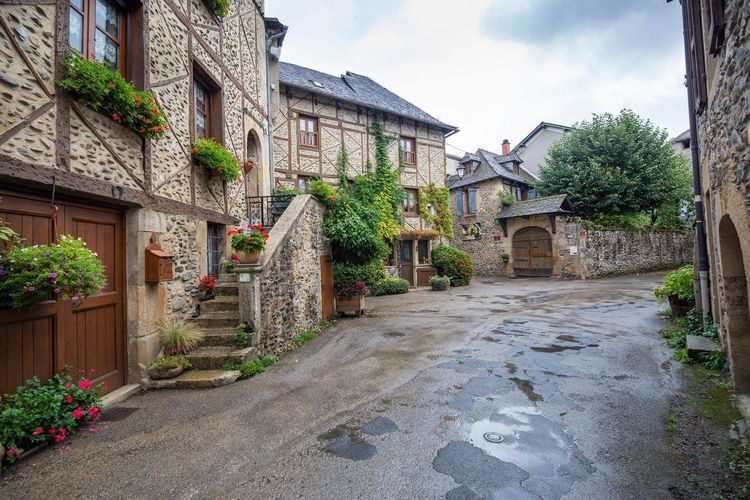
Last but by no means least in this selection: Sainte-Eulalie d'Olt (Bourg, 12130 Sainte-Eulalie-d'Olt, rated 4.6/5 on Google across 17 reviews), set on the left bank of the Lot downstream from Saint-Geniez, brings together several centuries of architecture and absolute calm within a tiny perimeter.
Labelled a « Plus Beau Village de France », the village features a 15th-century medieval castle and a Renaissance chapel dating from the 16th century, whose balanced proportions contrast with the rustic schist houses surrounding it. Its 11th-century Romanesque church preserves a relic of the Holy Thorn, a venerated fragment of the Crown of Christ, celebrated each July during a traditional procession. The water mill on the Lot, still visible from the bank, is a reminder of the town's former milling activity. A visit takes about thirty minutes, though one can easily linger for two hours walking along the river, photographing the facades and sitting on a bench facing the castle. Sainte-Eulalie d'Olt pairs naturally with Saint-Geniez (10 km) and Saint-Côme d'Olt (30 km) for a full day in the Lot valley.
When to Visit Aubrac and How to Plan Your Trip
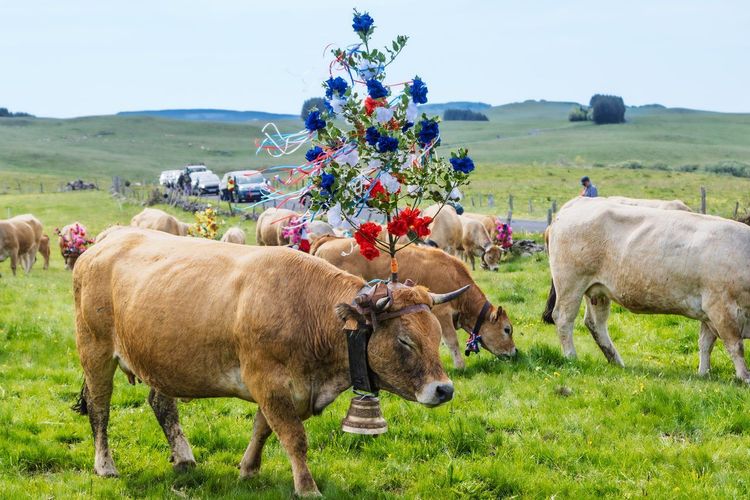
The best time to discover Aubrac is the May to September period. Late spring offers the advantage of the transhumance (last weekend of May), a unique spectacle in which herds of Aubrac cattle move up to the summer pastures in a festive procession. Summer is the high season, busier but ideal for hiking on the plateau. Autumn colours the foliage of the Lot valleys in ochre and golden tones, and the crowds have gone.
In winter, Aubrac is austere and magnificent, but several villages empty out, roads can be snow-covered and many restaurants close. It is not a winter destination for the uninitiated.
Getting around: a car is essential for travelling between villages. There is no public transport network covering the entire plateau. From Paris, Rodez is accessible by plane (1 hour) or by train (around 4 hours via Clermont-Ferrand). From Lyon, allow 3 hours by car. From Montpellier, 2.5 hours. To plan your itinerary, the Ryo audio guides allow you to contextualise monuments and villages as you travel, without a paper guide.
Where to stay: Laguiole has the widest range of accommodation (hotels, gîtes, bed and breakfasts). Mur-de-Barrez and Saint-Geniez-d'Olt also offer quality options. For total immersion, rural gîtes scattered across the plateau provide an authentic experience beyond the reach of hotel chains.
To extend your exploration of rural France and its medieval villages, our 13 villages of Dordogne make an ideal complementary destination. In a very different register, the villages of Calvados offer another face of the French countryside.
FAQ
What is the most beautiful village in Aubrac?
The answer depends on what you are looking for. Estaing is probably the most visually spectacular, with its medieval castle dominating the Lot and its 15th-century Gothic bridge. Saint-Côme d'Olt charms with its twisted spire, one of the most spectacular in France. Nasbinals is the most typical of the plateau with its Romanesque basalt church. If you can only visit one, Estaing stands out, though it sits in a valley bottom, far from the plateau itself.
When does the transhumance festival take place in Aubrac?
The transhumance takes place every year at the end of May, usually on the last weekend of the month. The herds move up toward the summer pastures from the villages in a colourful procession. The main festivities are centred on the village of Aubrac and Nasbinals, where local celebrations — markets, music, and entertainment — accompany the passage of the animals. It is one of the most popular events in Aveyron, drawing several thousand visitors each year.
Which departments does Aubrac span?
Aubrac covers three departments: Aveyron (12), which contains the largest part of the plateau and the most visited villages such as Laguiole and Saint-Chély d'Aubrac; Lozère (48), with Nasbinals and Arzenc d'Apcher; and Cantal (15), with Saint-Urcize and Mur-de-Barrez. This triple affiliation explains the diversity of landscapes and village characters depending on whether you are in the west, centre, or east of the plateau.
What should you eat in Aubrac?
Aubrac has a strong culinary identity. Aligot is the signature dish: mashed potatoes blended with fresh Laguiole tome cheese and stretched into long, elastic ribbons — a spectacular preparation often performed tableside. Tripoux (stuffed lamb tripe) is a more niche speciality. Laguiole AOP cheese can be enjoyed at every stage of ageing. Charcuterie and mountain honey complete a table that regional chefs have elevated to new heights.
What is the name of the cattle breed from Aubrac?
The breed simply takes its name from the plateau: the Aubrac cattle. Recognisable by their golden wheat-coloured coat, lyre-shaped horns, and dark-rimmed eyes, they are symbols of the plateau landscape. Hardy and well-adapted to high altitudes, they graze on summer pastures from June to October. The 'bœuf fermier Aubrac' sector holds a Label Rouge and a PGI designation that guarantee the origin and farming conditions.
Can you hike in Aubrac?
Aubrac is an exceptional hiking destination. The GR65 (Way of Le Puy to Compostela) crosses the plateau from east to west, passing through Nasbinals and Saint-Chély d'Aubrac — one of the most spectacular stages of the route. Waymarked circuits also allow you to connect villages on foot or by mountain bike. Beyond the marked trails, a free crossing of the plateau (navigating by the burons) is an option for experienced hikers. The Ryo app offers audio guides for many historical sites across France, useful for contextualising the monuments you encounter along the way.
Conclusion
Aubrac never disappoints those who take the trouble to leave the main road. Its villages — from the sentinel of Mur-de-Barrez to the lanes of Saint-Côme d'Olt, from the basalt of Nasbinals to the serenity of the Lot at Estaing — form a network of understated beauties that require time and curiosity to be truly appreciated.
If you wish to broaden your exploration to other regions of France, Ryo's selections cover France's most remarkable villages as well as destinations in Corsica, Brittany and the South-West. Every region holds its own surprises.