© Shutterstock
 Votre guide Ryo
The Most Beautiful Villages of Calvados to Visit in 2026
There is something strange about Calvados: travelers who pass through remember city names — Caen, Bayeux, Deauville — but forget that the department's true face is hidden in its villages. Half-timbered hamlets nestled between apple trees and damp meadows, fishing ports where grey granite mirrors itself in the tide, medieval market towns whose wooden market halls have stood for five centuries without flinching. These are the most beautiful villages of Calvados that this article explores, from the Pays d'Auge to the Bessin, from the Côte Fleurie to the deep countryside.
Beuvron-en-Auge ranks among the most photographed villages in Normandy, with its half-timbered houses that seem lifted from a picture book. Honfleur, listed among the most beautiful towns in France, actually transcends the category of 'town': it is a port village whose scale remains human and whose alleyways are labyrinthine. Cambremer combines the best of the Cider Route into a single town — blossom-filled orchards in spring, apple fairs in autumn. Orbec, on the edge of the Lieuvin, is never mentioned in guidebooks but is well worth the detour. To prepare your visit and explore these villages in depth, the Ryo app offers audio guides to the main Norman destinations — a great way to make sure you miss none of the stories hidden behind every façade.
This guide covers 14 remarkable villages and towns in Calvados, with what to see in each, the best season to visit, and tips for avoiding the crowds. It is aimed equally at Parisians on a weekend break and visitors who have a full week to explore the department.
Beuvron-en-Auge, the Most Famous Village in Calvados
Beuvron-en-Auge (Place Michel Vermughen, 14430 Beuvron-en-Auge, rated 4.7/5 on Google with 3,200 reviews) is the quintessential Norman village. Listed among the 'Plus Beaux Villages de France' since 1991, it sits around forty kilometres east of Caen, at the heart of the Pays d'Auge, on the Cider Route. Its central square, surrounded by 16th- and 17th-century half-timbered houses, is one of the most architecturally cohesive in all of Normandy — not a single building strikes a jarring note, not a single patch of modern render breaks the harmony of timber and daub.
The Manoir de Sens, built in the 15th century and restored over the centuries, sets the tone from the village entrance. Inside the town, the jettied houses form a continuous gallery beneath which craftspeople and merchants have followed one another for generations: ceramicists, chocolatiers, calvados and pommeau producers. A visit rarely lasts more than two hours, but the pleasure lies in taking it slowly — sitting on the terrace of one of the square's cafés and watching the stones change colour with the light.
The Sunday morning market draws residents from neighbouring villages and a handful of connoisseurs. This is where you find the region's finest cheeses — livarot, AOC Camembert de Normandie, pont-l'évêque — as well as artisan ciders that never cross the department's borders. If you come in May, the village hosts the apple tree festival, with tastings of ciders and calvados in the cellars of local producers.
The area immediately surrounding Beuvron deserves as much attention as the village itself. The Cider Route passes through here, linking around ten producers who open their doors to visitors in a 40-kilometre loop. By bicycle, it is the ideal way to travel it: the terrain is gentle, the roads quiet, and the bocage hedgerows lining the lanes shelter remarkable wildlife in spring. By car, allow half a day for stops at the producers.
For hikers, the Sentier des Haras connects Beuvron to the neighbouring hamlets of Saint-Julien-de-Mailloc and Victot-Pontfol through fields and orchards. Allow 2h30 for the return trip. Waymarking is regular and the Beuvron tourist office provides free hiking maps.
Shop opening hours: most are closed on Tuesdays outside the summer season. In July and August, the village receives up to 2,000 visitors a day — arrive before 10am or after 5pm to avoid the crowds.
Honfleur, Between Norman Port and Painters' Village
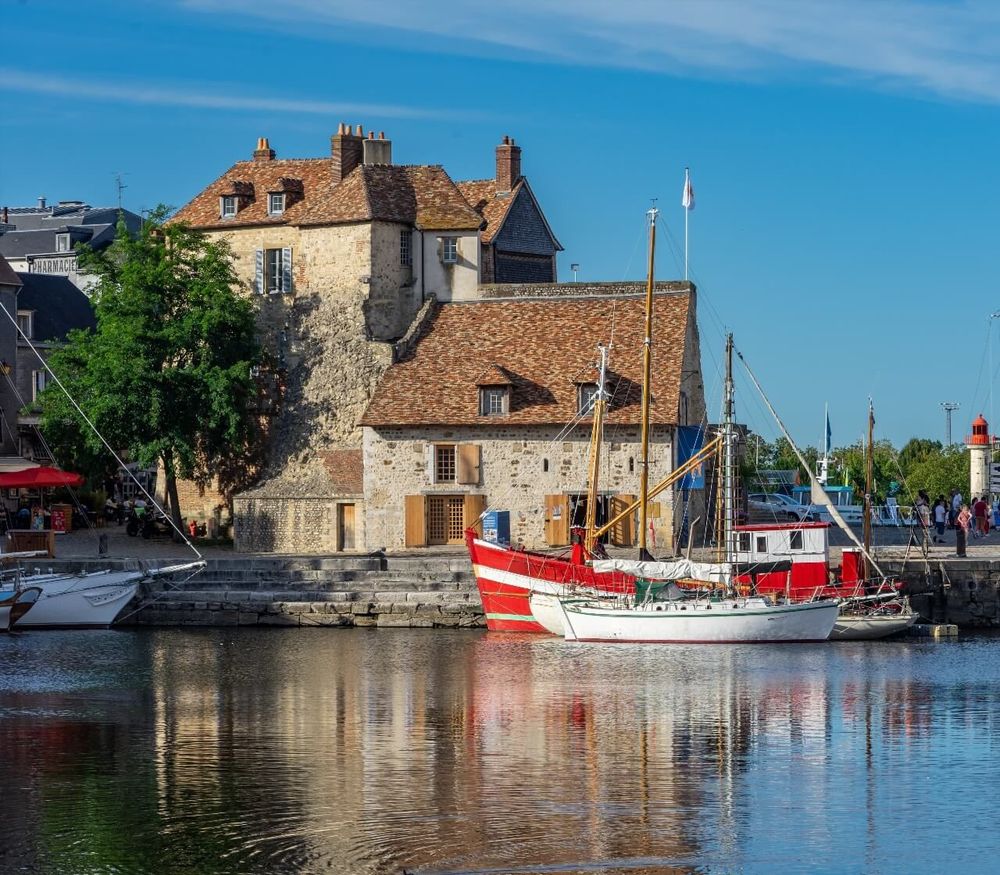
Honfleur is a happy anomaly: a town whose scale remains that of a village, yet which concentrates a historical and cultural heritage that many larger cities would envy. The old harbour, the Vieux-Bassin, built in the 17th century on the orders of Colbert, is lined with tall, narrow houses whose slate façades are reflected in the green water of the port. It is one of the most painted landscapes in France, and it has lost none of its power of attraction since Boudin, Monet and Jongkind set up their easels there.
The Lieutenance, former residence of the royal governor, closes off one side of the harbour and gives the ensemble its medieval silhouette. Just behind it, the Rue Haute and the Rue de la Prison concentrate the oldest half-timbered houses in the town, some dating from the 15th century. Take the time to look up: the jettied overhangs, the carved timber frames, the pedimented dormers — every façade tells a story of merchants and shipowners enriched by transatlantic trade.
The Musée Eugène Boudin (Place Érik Satie, 14600 Honfleur, rated 4.2/5 on Google with 969 reviews) holds the largest collection dedicated to 19th-century Norman painting: Boudin of course, but also Monet, Courbet and Dubourg. Admission costs €5.50 (reduced rate €4). Closed on Tuesdays. It is one of the most accessible and best-curated museums in the region, and a visit (allow 1h30) provides precious context for what you see while walking the streets.
The Sainte-Catherine church, built entirely in wood by ships' carpenters in the 15th century, is the most singular building in Honfleur. Its structure recalls the inverted hull of a ship: the master builders who constructed it knew timber and the sea, not the stone and ecclesiastical Latin of traditional religious architecture. Visit at night when the tourists have gone: the modern stained-glass windows emit a cold, blue light that completely transforms the space.
Honfleur is also the natural starting point for exploring the Côte Fleurie — Trouville and Deauville are 15 kilometres away along the D513. But if you only have a day, stay in Honfleur: the alleyways of the Sainte-Catherine quarter, the cider cellars converted into galleries, the quaysides at sunset — it is more than enough for a full day.
Practical note: the Môle car park (free out of season, paid in July–August) is the closest to the Vieux-Bassin. In high season, arrive before 9am or use the shuttle buses from the park-and-ride facilities on the outskirts.
Beaumont-en-Auge, the Forgotten Medieval Town
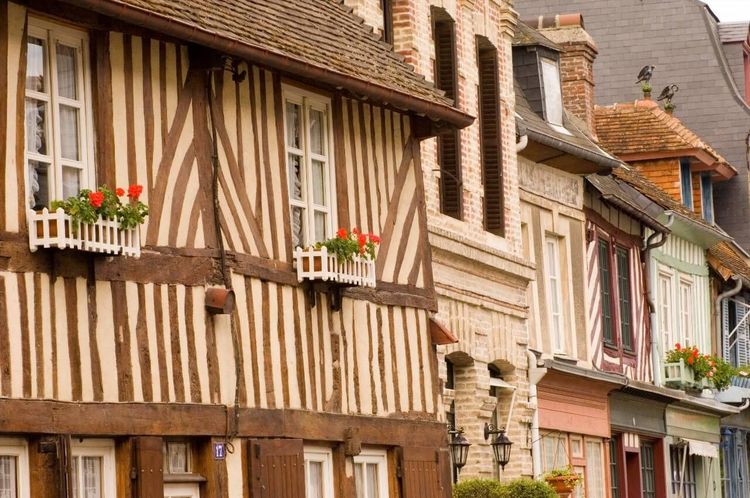
Beaumont-en-Auge (Place du Prieuré, 14950 Beaumont-en-Auge, rated 4.5/5 on Google with 13 reviews) clings to a ridge overlooking the Touques valley some twenty kilometres from Honfleur. The village is less well known than Beuvron, which is precisely why you can stroll through it on an August Saturday without battling the crowds. Its Benedictine priory, founded in the 11th century and partially converted into a guesthouse, gives the town a monastic atmosphere that the half-timbered houses only reinforce.
The Place du Prieuré is the heart of the village. The houses surrounding it mostly date from the 16th and 17th centuries, and their half-timbered façades were carefully restored in the 1990s. The panoramic view from the edge of the ridge over the Touques valley and its damp meadows is worth the detour in itself. On a clear day, you can make out the Seine estuary and the cranes of the port of Le Havre on the horizon.
Beaumont-en-Auge is the birthplace of Pierre-Simon de Laplace, an 18th-century mathematician and astronomer, one of the founding fathers of celestial mechanics. A plaque and a small statue commemorate him in the town. The anecdote lends the visit an unexpected dimension: beneath this so-often-overcast Norman sky, a village boy became one of the most important scientific minds in history.
The village has a handful of restaurants; La Table de Beaumont is the recommended address for lunch with a view over the valley. Set lunch menu around €20, local produce, no-fuss service. Booking advised at weekends.
If you combine Beaumont-en-Auge with Beuvron-en-Auge in the same day — which is perfectly feasible as the two villages are 25 kilometres apart — start at Beaumont in the morning to catch the light on the valley, then head down to Beuvron for lunch and the afternoon.
Cambremer, the Village of the Cider Route
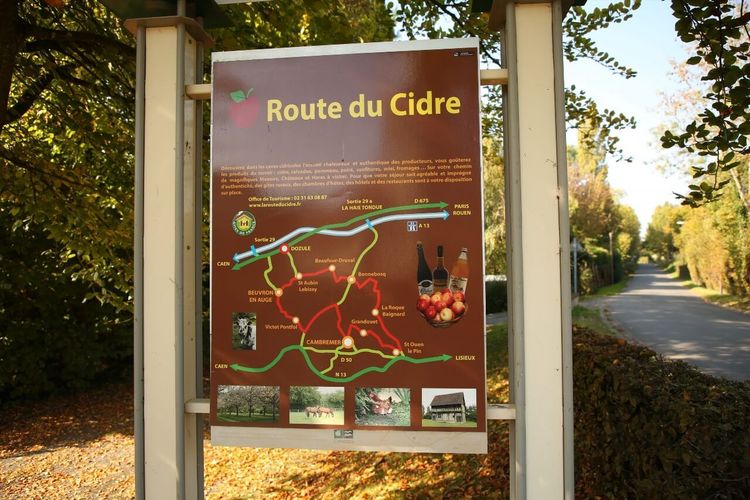
Cambremer (Place de l'Église, 14340 Cambremer, rated 4.4/5 on Google with 540 reviews) is the central town of the Cider Route, a 40-kilometre loop that winds through the orchards of the Pays d'Auge between Lisieux and the sea. The village itself is modest — a few streets, a 12th-century church, a Friday morning market — but its immediate surroundings are among the most beautiful in Normandy: apple trees as far as the eye can see in spring, their white and pink blossom contrasting with the green of the meadows.
The Manoir de Sens, two kilometres from the town, is one of the finest properties in the Pays d'Auge: a 15th-century half-timbered house surrounded by a conservation orchard where more than 180 heritage apple varieties grow. The guided tour (available in season, by reservation) is a lesson in cider culture and the history of Norman orchards.
In October, Cambremer hosts the cheese and cider fair, one of the most popular agricultural markets in the department. Local producers, cheese affineurs, calvados distillers — it is the kind of event that draws as many locals as food lovers up from Paris.
The regional cooperative cellar offers tastings year-round. The brut Pays d'Auge cider, AOC since 1996, is fermented slowly — in oak barrels or stainless-steel tanks depending on the producer — and develops an aromatic complexity that industrial ciders never achieve. A bottle of AOC cider costs between €4 and €8 directly at the farm.
Saint-Pierre-sur-Dives, the Town with Medieval Market Halls
Saint-Pierre-sur-Dives is not a village in the strict sense — its 4,500 inhabitants make it a rural market town — but it earns its place in this guide for its medieval market halls, the largest in Normandy. Built in the 11th century by the monks of the local Benedictine abbey, they cover an area of 1,600 square metres beneath an oak and chestnut timber frame that was entirely restored in the 1980s after a fire.
The Monday market has been held beneath these halls since the Middle Ages — a remarkable continuity broken only by wars. Norman cheeses, poultry, bocage vegetables, seafood from Isigny or Port-en-Bessin: it is the most authentic market in inland Calvados. Arrive before 9am to have the best choice.
The neighbouring abbey church, founded in the 11th century, houses a remarkable collection of carved stonework and high-quality modern stained glass. The crypt, accessible during heritage open days, preserves some of the oldest Romanesque capitals in the department. Admission is free; opening hours vary by season — check with the local tourist office.
Saint-Pierre-sur-Dives sits at the junction of several scenic roads leading north to Lisieux, south to Falaise and east to Mézidon-Canon. It makes a good base for exploring the surrounding countryside by bicycle: the Dives valley offers flat, wooded routes that are particularly pleasant in spring.
Orbec, the Town of a Hundred Half-Timbered Houses
Orbec (Grande Rue, 14290 Orbec, rated 4.3/5 on Google with 690 reviews) is Calvados's best-kept secret. This town of 2,500 inhabitants in the Orbiquet valley, on the border with Eure, concentrates an extraordinary number of half-timbered houses — more than a hundred, some dating from the 15th century — without ever being mentioned in mainstream tourist guides. That is precisely what makes it one of the most rewarding discoveries for anyone willing to venture off the beaten track.
The Grande Rue is the thread that guides the visit. Half-timbered façades follow one another for several hundred metres, forming a cohesive ensemble that urban historians describe as an 'intact medieval urban fabric'. The municipal museum, housed in a former 16th-century manor, presents a collection of 19th-century Norman paintings and local art objects. Free admission. Closed Tuesdays and in winter.
The Église Notre-Dame dominates the town from a small rise. Its 15th-century Gothic tower is one of the most elegant bell towers in the region. Inside, 16th-century wall frescoes have been partially preserved. The visit is free and open access.
Orbec is also renowned for its gastronomy. The restaurant Au Caneton, set in a 17th-century Norman house, is a well-known address for lovers of classic Norman cuisine. House specialities: sole normande, duck with apples, a full plate of local cheeses. Menus range from €25 to €45.
Dives-sur-Mer, the Port of William the Conqueror
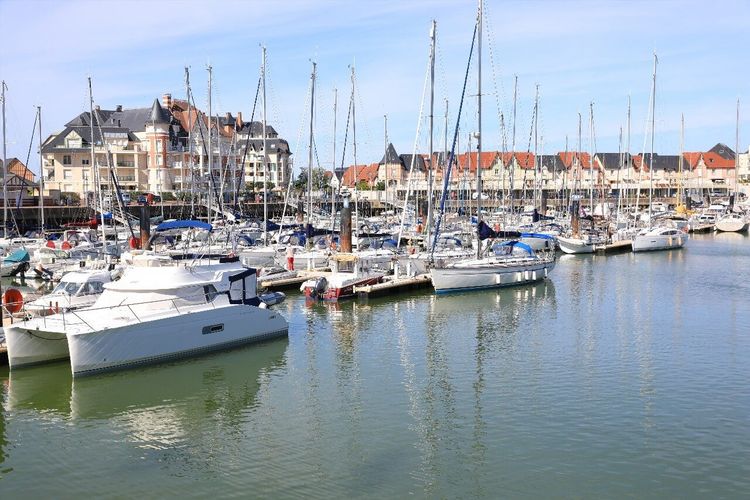
Dives-sur-Mer is inseparable from the medieval history of Normandy. It was from this port — now silted up — that William the Conqueror set sail in September 1066 with an army of 7,000 men bound for England. The conquest that followed reshaped Europe and brought the era of Viking invasions in England to an end.
The 11th-century Église Notre-Dame preserves a list of William's companions engraved in marble. This record, compiled in the 19th century by the historian Léchaudé d'Anisy from medieval sources, lists 475 names — a kind of war memorial in reverse, erected in honour of the victors rather than the victims. The sailors' chapel, accessible from the left aisle, contains votive boat models that testify to the ancient ties between the village and the sea.
The Village Guillaume le Conquérant, a collection of half-timbered houses and craftspeople's workshops set within a 15th-century manor, is the ideal place for a break. Ceramicists, glassmakers, jewellers, bookbinders — around twenty workshops open to the public allow visitors to watch the craftspeople at work and buy original pieces directly. Open daily in season.
Dives-sur-Mer is adjacent to Cabourg — the two communes form a continuous urban area. Visitors who stop at one rarely stop at the other, which is a mistake: the walk from the centre of Dives to the Cabourg casino takes half an hour and offers interesting views over the Dives estuary.
Villerville, the Authentic Seaside Village
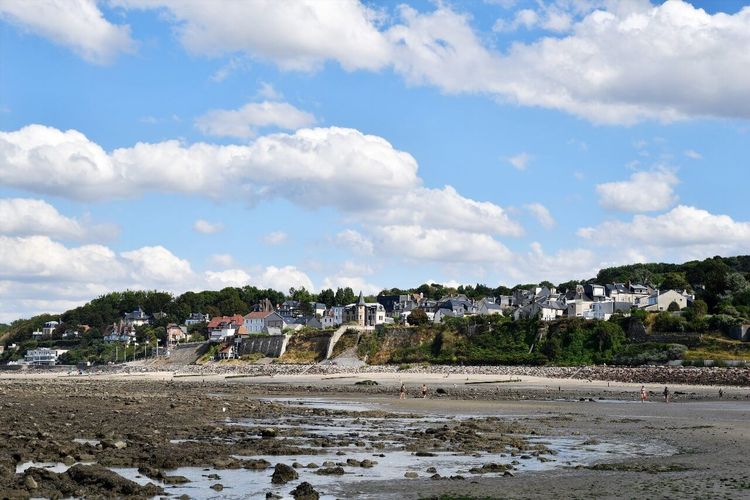
Villerville is Normandy's answer to the question 'how can a seaside village stay authentic?'. Located 12 kilometres west of Honfleur, this small fishing port of 700 inhabitants has never succumbed to the temptation of reinventing itself as a resort. Its Belle Époque wooden villas, its cobbled lanes running down to the sea, and its modest casino — a restrained building, nothing like Deauville — give it the atmosphere of a 1930s seaside resort that simply forgot to age.
The pebble beach stretches for 1.2 kilometres between two flint cliffs. The view over the Seine estuary — with tankers heading upriver toward Rouen and the Pays de Caux hills as a backdrop — is one of the finest perspectives on the Côte Fleurie. At low tide, the exposed rocks are ideal for rock pooling: cockles, mussels, green crabs — an activity accessible to children from age 6.
The cliffs at Villerville have been classified as a nature reserve since 1984 for their colonies of kittiwakes. From March to July, thousands of birds nest in the crevices of the flint. Waymarked paths restrict access to the cliff base during the nesting season, but the spectacle from the clifftop is breathtaking.
Villerville has two restaurants and a café-grocery. The best-known address is La Terrasse, a crêperie with a sea-view terrace. Savoury galettes and crêpes with local cider. Menu around €15. Open Wednesday to Sunday out of season.
Creully-sur-Seulles, the Castle of the Liberation
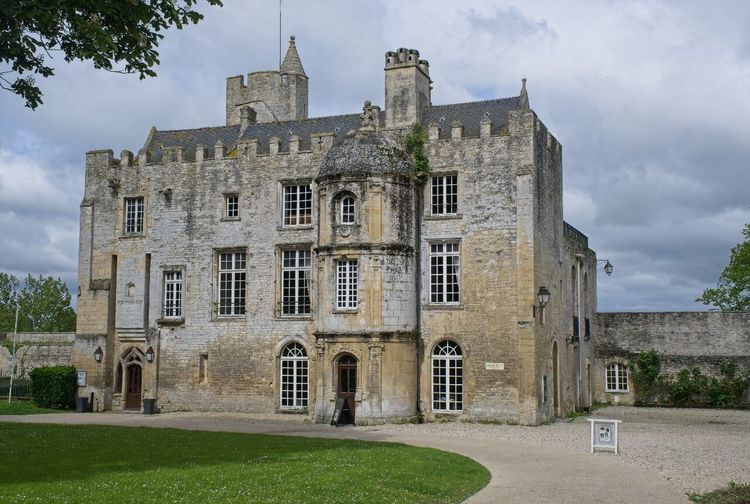
Creully-sur-Seulles is a village in the Bessin, 16 kilometres north of Caen, whose fame rests on a specific episode of the Second World War. On 6 June 1944, British troops under General Montgomery established their headquarters in the medieval château at Creully. The BBC set up a mobile radio studio there from which war correspondents broadcast the first reports on the Normandy landings.
The château, whose origins date to the 11th century, is today partially open to the public. The keep houses a small museum dedicated to wartime communications and the presence of BBC correspondents. Guided tours are available in summer (admission: €4 per adult). The remainder of the château belongs to the local authority and serves as a venue for temporary exhibitions.
The village itself is a fine example of Bessin architecture: white limestone, blue slate roofs, flower-filled gardens. The Église Saint-Martin, Romanesque in its nave and Gothic in its chancel, is worth a five-minute stop. The walk along the Seulles, a trout river that flows through the town, is pleasant in all seasons.
Creully is 10 kilometres from the D-Day beaches (Gold Beach, Juno Beach), making it a good base for anyone wishing to combine medieval heritage and Second World War remembrance in a single day. The same logic applies to Caen, whose ducal past our audio walking tour covers over 4.6 kilometres.
Balleroy-sur-Drôme, the Village and Its Louis XIII Château
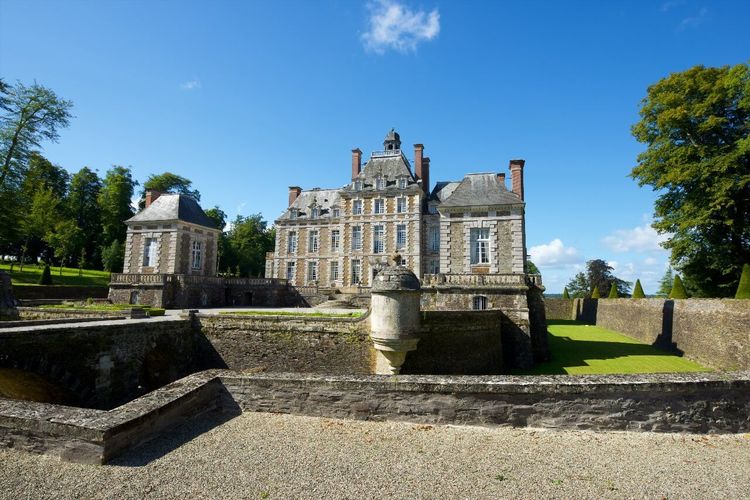
Balleroy-sur-Drôme is a planned village, built in one go in the 17th century along an axial layout more commonly associated with the great Baroque capitals. The main avenue, lined with two rows of identical limestone houses in the Bessin style, leads directly to the façade of the Château de Balleroy (Avenue du Château, 14490 Balleroy-sur-Drôme, rated 4.3/5 on Google with 805 reviews), a masterpiece by François Mansart completed in 1636. The perspective from the village entrance to the château is striking.
The Château de Balleroy was purchased in 1970 by Malcolm Forbes, the American publishing magnate, who established the Balloon Museum there in 1975 — a collection unique in Europe of historic aerostats and hot-air balloons, accompanied by photographic and documentary archives on the history of lighter-than-air flight. The château has since changed hands, but the museum remains its star attraction. It is open from April to October (adult admission: €8).
The Balleroy Hot-Air Balloon Festival, held each year in June, is one of the oldest balloon gatherings in France. Dozens of multicoloured balloons lift off at sunrise from the estate's meadows — a spectacle that can be enjoyed for free from the surrounding paths.
The village itself, beyond the château and museum, can be visited in thirty minutes. But it is the ensemble as a whole — the château, the planned village, the landscaped park and the nearby Cerisy forest — that justifies the detour from Bayeux (20 kilometres).
Livarot-Pays-d'Auge, the Birthplace of the Pungent Cheese
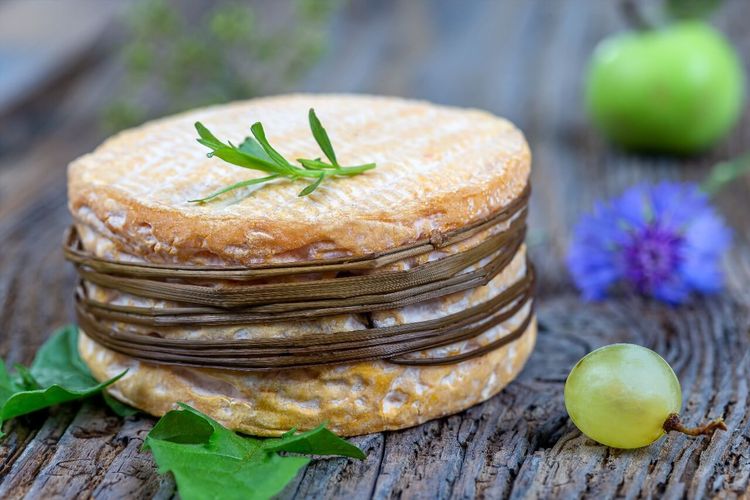
Livarot gave its name to one of the four Norman PDO cheeses, alongside camembert, pont-l'évêque and neufchâtel. This soft, washed-rind cheese, wrapped in five strips of reed or paper (hence its nickname 'the colonel'), has been produced in the Vie valley since at least the 17th century. The town of Livarot, renamed Livarot-Pays-d'Auge after the 2017 municipal merger, is its historic centre.
The Village Fromager is the unmissable attraction of the visit. Set in a converted former industrial dairy, it offers a guided tour of livarot production and a tasting of the region's cheeses. Adult admission: €6. The shop sells maturing cheeses, AOC cider and calvados — the two traditional accompaniments to livarot at the table.
The town retains several 16th-century half-timbered houses around the church. The Thursday morning market is the weekly meeting point for local producers. To extend the visit, the roads around Livarot pass through meadows where Norman cows graze — a brown-and-white dappled breed now undergoing a revival after nearly disappearing in the 1980s in favour of Holsteins.
Cabourg, Marcel Proust's Seaside Resort
Cabourg is not a village in the strict sense, but this seaside resort built from scratch at the end of the 19th century has an architectural coherence and atmosphere that place it closer to a village than a town. Its radio-concentric layout — all avenues radiating from the Grand Hôtel facing the sea — is unique in France and was designed by the architect Gerber in 1861.
Marcel Proust stayed at the Grand Hôtel every summer from 1907 to 1914. Cabourg is 'Balbec' in In Search of Lost Time, the seaside resort of the narrator's childhood and first aesthetic emotions. A promenade now bears his name. The Grand Hôtel, still in operation, has preserved its Belle Époque décor: red carpets, gilded plasterwork, bevelled mirrors. The tearoom is accessible without a hotel reservation.
The beach at Cabourg stretches for 3.5 kilometres — one of the longest on the Côte Fleurie. Fine sand, lifeguards in season, free access. The dunes near Merville-Franceville, at the eastern end of the beach, are classified as a nature reserve.
The D.Day le 6 juin festival has turned Cabourg into a pilgrimage for French chanson fans since 2007. Tens of thousands of people gather for open-air concerts, largely free of charge. An event that has little that is picturesque about it, but which says something about the attachment the French feel to this stretch of Norman coast.
Grandcamp-Maisy, the Fishing Port at the Edge of the Bessin
Grandcamp-Maisy lies at the western tip of the department, where the Bessin meets the Cotentin. This active fishing port of 1,600 inhabitants is one of the last on the Norman coast to have preserved a working fishing fleet: around twenty boats still head out each morning to the Channel beds in search of scallops, sole and lobster. The fish auction takes place on Tuesday and Thursday mornings — the time when restaurant owners come to stock up and individuals can buy ultra-fresh fish at direct-from-the-boat prices.
The Pointe de la Percée and the Pointe du Hoc, a few kilometres to the east, are Second World War memorial sites of particular intensity. The Pointe du Hoc, where American Rangers scaled 30-metre cliffs under enemy fire on 6 June 1944, is today a site of the Normandy Memorial managed by the American Battle Monuments Commission. Admission is free. The craters left by the pre-landing bombardments are still visible in the fields.
Beyond its harbour, Grandcamp-Maisy owes much to the memory of the D-Day landings, but it is above all maritime life that gives the town its rhythm. The Rangers Museum, in the town centre, traces the assault on the Pointe du Hoc and the role of this stretch of coast on 6 June 1944. Seafood lovers should not miss the scallop tasting in season, directly on the harbour, where the boats land their catch.
Clermont-en-Auge, the Balcony of the Pays d'Auge
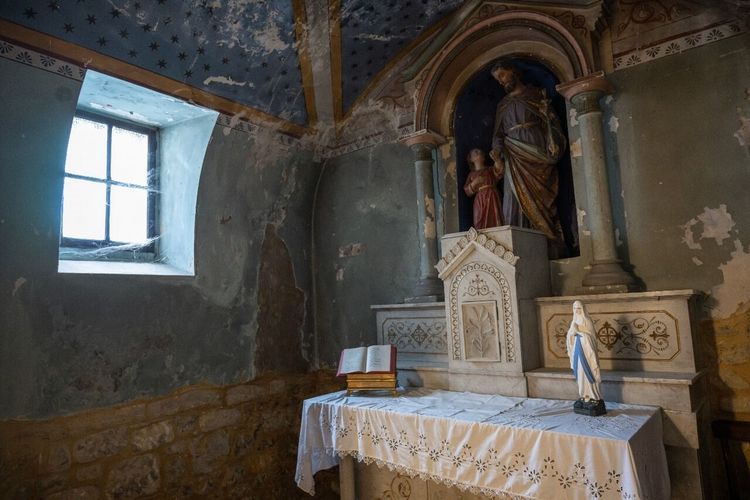
Clermont-en-Auge is a hamlet perched on a ridge in the Pays d'Auge, some twenty kilometres north-east of Lisieux. Its main draw is the Chapelle Saint-Michel, built at the top of the hill and offering a 360-degree panorama over the Norman countryside: orchards, bocage, the steep valleys of the Touques and the Vie, and on a clear day, the coast between Honfleur and Trouville.
The chapel itself, from the 15th century, is modest but harmonious. It is accessible via a waymarked hiking path from Beuvron-en-Auge (3 kilometres one way, yellow waymarking). This is the route that Pays d'Auge regulars recommend for combining a visit to the village with an hour's walk through the apple orchards.
The spot is particularly photogenic at the golden hour — one hour before sunset — when raking light transforms the orchards into paintings. It is also the moment when Sunday hikers have gone home, leaving the site to those with a good sense of timing.
How to Plan Your Visit to the Norman Villages
Calvados is a medium-sized department — 5,548 square kilometres, roughly the size of Corsica — but its villages are unevenly distributed. The vast majority of the destinations covered in this guide are concentrated in the Pays d'Auge, between Lisieux, Honfleur and the Côte Fleurie. A car is essential to get between villages: public transport links are rare and slow outside the Caen–Lisieux and Caen–Honfleur axes.
A two-day weekend reasonably allows you to cover 4 to 5 villages in the Pays d'Auge. The classic itinerary starts in Honfleur on Friday evening or Saturday morning, passes through Beuvron-en-Auge and Beaumont-en-Auge, makes a stop in Cambremer or Saint-Pierre-sur-Dives, then heads back to the coast via Dives-sur-Mer and Villerville. Allow 150 kilometres for this loop, roughly 3 hours of driving time not including stops.
For a full week, it is possible to explore the Bessin and the western coast from Bayeux or Caen. The villages of Creully-sur-Seulles and Balleroy-sur-Drôme fit naturally into a circuit between Bayeux and the D-Day beaches. Grandcamp-Maisy and the Pointe du Hoc extend the itinerary westward.
Accommodation: bed and breakfasts are the accommodation format most in keeping with the spirit of Calvados's villages. Many Norman manors and farms offer rooms in authentic surroundings for €70 to €130 per night, including breakfast. Rural gîtes are a good alternative for families or groups.
Food budget: village restaurants charge reasonable prices outside Honfleur and Deauville. A lunch with starter, main, dessert and a glass of cider comes to €18–25 at unpretentious addresses. The markets — Beuvron on Sundays, Saint-Pierre-sur-Dives on Mondays, Livarot on Thursdays — allow you to picnic for around ten euros by buying directly from producers.
With children: Norman villages offer few activities specifically designed for very young children, but rock pooling at Villerville, tasting workshops in Cambremer and the Balloon Museum at Balleroy are suitable from age 8. The beaches at Cabourg and Dives-sur-Mer are suitable for younger children.
To enrich your discovery of the villages and make sure you miss none of their hidden stories, the Ryo app offers audio guides to the most beautiful villages of France — a valuable tool for travelling at your own pace without needing a human guide on the ground.
Accessibility: most historic village centres are partly cobbled, which can make getting around difficult in a wheelchair or with a pushchair. Beuvron-en-Auge, Beaumont-en-Auge and Orbec have pedestrian cobbled areas that are poorly suited to mobility aids. Honfleur has a few waymarked accessible routes — check with the local tourist office.
When to Explore These Norman Villages
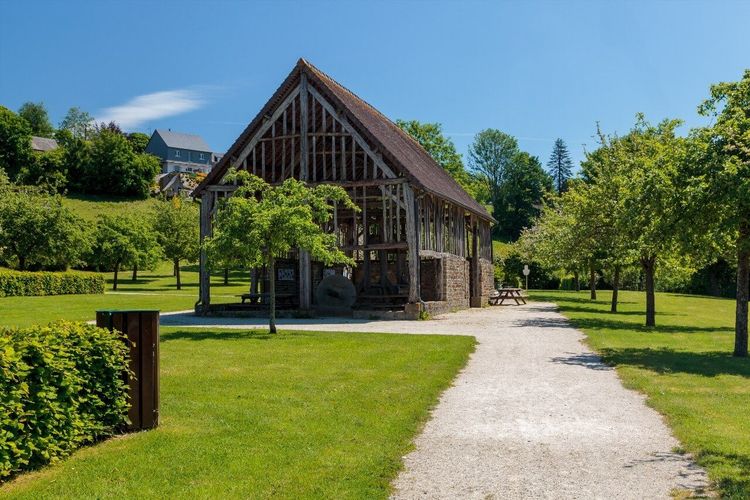
Every season has its merits, and Calvados is one of the rare French departments where the low season is not a sacrifice but a genuinely interesting alternative.
Spring (April–May) is objectively the most beautiful season for the orchards. Apple blossom — which typically appears between the last week of April and the second week of May depending on altitude and aspect — transforms the Pays d'Auge into a painter's canvas. It is also the time of foals in the meadows and lambing on the farms. Tourist numbers remain low: the villages are quiet, and guesthouse rooms are available without booking far in advance.
Summer (July–August) is unambiguously high season. Beuvron-en-Auge, Honfleur and Villerville see their populations multiply tenfold at weekends. Accommodation prices rise by 30 to 60%, and some restaurants are fully booked two weeks in advance. If you come in summer, avoid July weekends and opt for weekday visits, early in the morning or late afternoon.
Autumn (September–October) is the season of apples and fairs. The golden light of September, the morning mist hanging over the valleys, the apple and cider markets in October — it is the second-best season for the Pays d'Auge. The Cambremer cheese fair takes place in October. The colours of the Norman bocage at this time of year are incomparable.
Winter (November–March) is the season tourists avoid and locals appreciate. Most museums reduce their hours, some guesthouses close over the holidays. But the weekly markets continue, restaurants are quieter, and the winter light on the Norman landscape — grey, diffuse, almost opalescent — has its own beauty. It is also the season when Isigny oysters and Grandcamp scallops are at their very best.
Weather to bear in mind: Calvados receives an average of 800 to 1,000 mm of rain per year, spread across much of the year. Always pack a waterproof, even in July. Fine days do exist — what locals call 'beau normand' — but they cannot be scheduled in advance.
FAQ
What are the most beautiful villages of Calvados not to miss?
Beuvron-en-Auge is the most frequently cited village, and for good reason: its 16th-century half-timbered houses form the most architecturally cohesive ensemble in the department. Honfleur comes in second place for its harbour atmosphere and museums. Villerville and Beaumont-en-Auge round out the podium for travelers looking to stray from the most well-trodden routes. Orbec, finally, is the discovery no one expects: a hundred half-timbered houses in a quiet valley, on the border of Eure.
Is Calvados easy to visit without a car?
The honest answer is no. SNCF serves Caen, Lisieux, Honfleur (via Pont-l'Évêque) and Cabourg in summer, but connections between villages are nearly non-existent by public transport. Departmental buses link some towns on market days, but frequencies are very low. To explore the villages of the Pays d'Auge comfortably, a rental car is essential. Car rental agencies are available in Caen and Lisieux.
Can you visit the villages of Calvados as a family with young children?
Yes, with some caveats. The beaches at Cabourg and Dives-sur-Mer are perfectly suited to children. Rock pooling at Villerville, the Balloon Museum at Balleroy and farm and cider house visits in the Pays d'Auge are suitable from ages 6–8. Historic cobbled villages such as Beuvron-en-Auge or Beaumont-en-Auge are less pushchair-friendly. Comfortable walking shoes are a must for the whole family.
Where can you buy real calvados and Pays d'Auge cider?
The best places are directly at the producing farms, accessible via the Cider Route between Cambremer and Beuvron-en-Auge. A 'vente directe' sign or the 'Bienvenue à la ferme' logo indicates farms open to visitors. AOC Pays d'Auge cider costs between €4 and €8 a bottle at the farm. Pays d'Auge calvados, which has held its own controlled designation of origin since 1942, can be found in all the delicatessens in the department, but the best bottles are bought directly from the distillers. Expect to pay between €25 and €60 for a calvados aged 10 to 15 years.
Are there any villages in Calvados labelled 'Les Plus Beaux Villages de France'?
Yes: Beuvron-en-Auge is the only village in Calvados to officially hold this label, awarded by the national association founded in 1982. Other Norman villages such as Lyons-la-Forêt (Eure) or Barfleur (Manche) hold the label, but within the department of Calvados, Beuvron is the sole representative. This is one of the reasons it attracts such heavy tourist footfall, especially on spring and summer weekends.
How many days do you need to visit the most beautiful villages of Calvados?
A three-day weekend allows you to see the essentials: Honfleur, Beuvron-en-Auge, Beaumont-en-Auge and possibly Cambremer or Dives-sur-Mer. For a more complete visit including the Bessin (Creully, Balleroy, Grandcamp-Maisy), plan for five to six days. A full week allows you to explore the department at a pleasant pace, with stops at weekly markets and time for hiking.
What is the best base for exploring the villages of Calvados?
It depends on which area you want to prioritise. Caen is the logical starting point if you are exploring the Bessin and the D-Day beaches; it is also the best-connected city by TGV from Paris (2h10). Honfleur or Pont-l'Évêque are preferable for the Pays d'Auge and the Côte Fleurie: you will be right in the heart of the area without having to cross the Caen urban area. Bayeux is the option ## Conclusion
Calvados is not defined solely by its D-Day beaches and its eponymous spirit. Its villages — Beuvron-en-Auge, Honfleur, Orbec, Villerville, Grandcamp-Maisy and a dozen other quiet towns — form a cohesive territory where Norman architecture, regional gastronomy and bocage landscapes reinforce one another. It is a department that rewards those who travel slowly and curiously, and reveals itself all the more to those who step off the signposted routes.
To prepare your visit and go beyond the must-sees, the Ryo audio guides to the most beautiful villages of France accompany you village by village, with anecdotes and practical information that printed guides never mention. If you are setting out to discover villages around other French destinations, Ryo also offers selections in the Yonne, the Ardèche and around Annecy. Safe travels on the Norman roads.
À lire également