© Shutterstock
 Votre guide Ryo
The Most Beautiful Villages around Annecy: 10 Must-See Stops in 2026
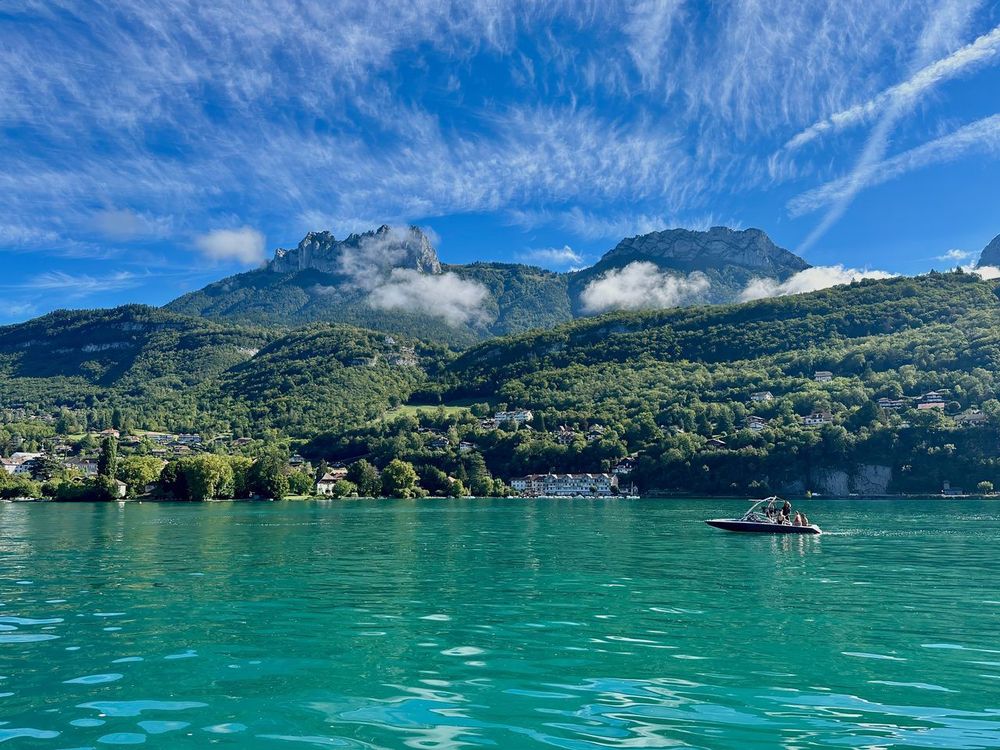
Annecy is rightly fascinating, but the real revelation often begins when you leave the city. All the most beautiful villages around Annecy are concentrated within a radius of a few dozen kilometres, and each one hides medieval castles suspended above the water, cobblestone lanes, sleepy fishing harbours, and mountain pastures that rushed tourists never see. Within less than 30 kilometres of Annecy, you will find Yvoire, a medieval village listed among the most beautiful in France, Talloires with its 11th-century abbey transformed into a legendary hotel, and Duingt whose castle literally rises from the lake. To explore Annecy itself before setting out to discover its surroundings, the Ryo audio guide La Venise des Alpes covers the 2.5 km of the old quarter with 21 audio segments and one hour of walking: an ideal itinerary to fit the village tour into your stay.
This guide takes you to ten villages in the surrounding area, pinpointing each one on the East Bank, the West Bank, or beyond the lake, with the must-see stops, the distance from Annecy, and some practical tips for planning your itinerary according to the time you have available.
Talloires-Montmin: the Jewel of the East Bank
Talloires is the village that appears in every travel account around Lake Annecy, and not without reason. Located 13 km south of Annecy, on the East Bank, it overlooks the narrowest and deepest part of the lake, reaching up to 82 metres deep just in front of the village. This particular geographical configuration gives it a raking light at the end of the day that has attracted painters and photographers since the 19th century. Paul Cézanne stayed at the Hôtel de l'Abbaye in 1896 and painted his famous 'Lac d'Annecy' there; a work attributed to Auguste Renoir is also said to depict these shores.
The Abbaye de Talloires is the pivot of the village. Founded in the 11th century by Benedictine monks, it was converted into a luxury hotel at the end of the 19th century, a transformation that saved it from revolutionary destruction. Even without staying there, you can stroll around the cloister and walk along the walls down to the lake.
Set slightly back from the lake shore, the Port de Talloires is worth a detour. A few fishing boats sit alongside pleasure sailboats, and the panorama over the Roc de Chère, the limestone cliff that drops sheer into the lake on the opposite side, is among the most striking in the entire region. The Roc de Chère is also home to a national nature reserve, created in 1977: its downy oak woodlands and dry grasslands support flora that is rare at this altitude.
Higher up in the village, the Chapelle Saint-Germain rewards the effort: you need to climb for about twenty minutes from the centre. The reward is a natural belvedere over the entire lake, with the Aravis peaks and the Dent du Lanfonnet in the background. Wear sturdy shoes, as the path climbs steeply from the main road.
Montmin, the hilltop hamlet that gives its name to the merged municipality, is located about 6 km above Talloires via a narrow but passable road. At 918 metres above sea level, it offers a spectacular view of the entire lake that is rarely obtained from the shoreline. It is also the starting point for one of the most popular hikes in the area, towards the Col de la Forclaz, a belvedere for paragliders whom you will see soaring above the lake on days with favourable winds. To complete your plans, our article on hikes at the Col de la Forclaz and Lake Annecy details the best routes.
Practical info: Talloires can be reached from Annecy in 25 minutes via the D909 running along the East Bank. Paid parking by the lake in high season; arrive before 9am to find a spot easily. No train station; TIC bus line 60 from Annecy, 45-minute journey.
Menthon-Saint-Bernard and Its Feudal Castle
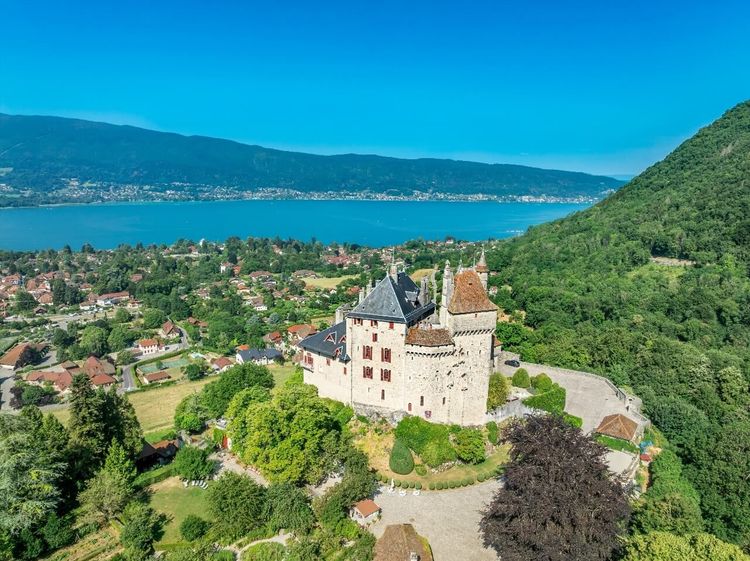
At 9 km south-east of Annecy, Menthon-Saint-Bernard stands out as one of the most photographed villages on the lake, largely because of its castle perched on a wooded promontory 120 metres above the lake. The Château de Menthon-Saint-Bernard (Château de Menthon, 74290 Menthon-Saint-Bernard, rated 4.5/5 on Google with 5,904 reviews) is in fact an aristocratic residence that has been inhabited for nearly a thousand years by the same family, the Menthons, without interruption. A remarkable continuity that gives it an authentic character rarely found: you are visiting a living home, not a museum-like monument.
The guided tour (open in the afternoon during high season, Thursdays and weekends outside high season) allows you to explore the state rooms, the medieval library, and the terraces overlooking the lake. Local tradition has it that Walt Disney, passing through the region, was inspired by the silhouette of its round towers for the castle in Sleeping Beauty: an unverifiable legend, but one that the appearance of the place makes credible.
The lower village of Menthon, by the lake, is equally worth the trip. The municipal beach at Menthon-Saint-Bernard is renowned for the quality of its water and the exceptional clarity of the lake bed, thanks to currents that renew the water in this area. In July–August, the beach attracts large crowds; mornings are preferable. Several lakeside restaurants offer terraces with a direct view of the castle in the background.
Between the lower village and the castle, a marked trail climbs through the woods in about 20 minutes. The path winds beneath beech trees and emerges into the castle courtyard from the rear, which is more picturesque than the road access. Note that Bernard de Menthon, founder of the famous Grand-Saint-Bernard hospice in the Alps, was born here in the 10th century: his name is attached to one of the most historic Alpine crossings in Europe.
Practical info: Access from Annecy in 20 minutes via the D909. Lakeside parking (paid in summer). TIC bus line 60 from Annecy, stop at Menthon-Saint-Bernard. Castle open mainly from April to November; check opening times on the official website before visiting.
Veyrier-du-Lac: the Quiet Shore
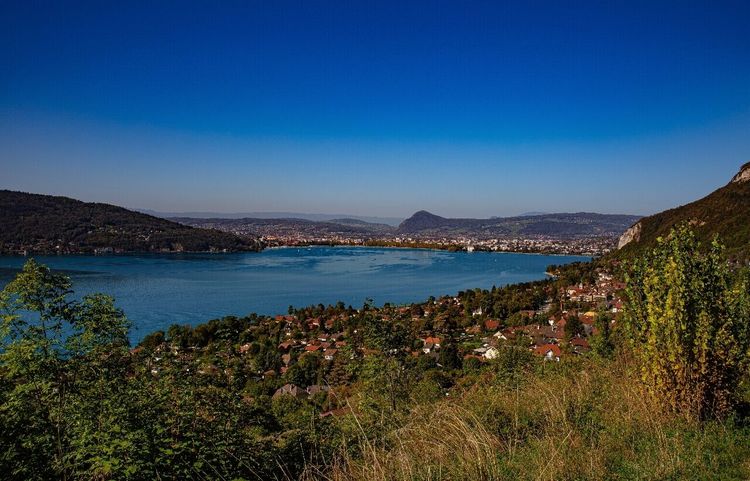
Veyrier-du-Lac does not have the fame of Talloires nor the medieval grandeur of Menthon, and that is precisely what makes it a favourite among regulars. Located just 5 km south-east of Annecy, it is the first village on the East Bank outside the city, a gentle transition between the bustle of the town centre and the tranquillity of the wooded shores.
The village spreads across the slopes of Mont Veyrier (1,291 m), accessible from Veyrier by a cable car inaugurated in 1934. The ascent once offered a gradual panorama over the lake, and the summit, now reached on foot, reveals a 360° view of the Aravis, the Bauges massif, and, on a clear day, Mont Blanc. Allow 1h30 for the round trip including time at the summit.
Along the lake, the walking path between Veyrier and Annecy is one of the most pleasant strolls in the region, suitable in all seasons. In Veyrier itself, the marina is modest but peaceful, surrounded by well-kept private gardens. Several gourmet restaurants, including one with a Michelin star, have set up in the village, attracting diners who come as much for the food as for the terraces.
Practical info: 10 minutes from Annecy by car, or 25 minutes by bike along the lakeside cycle path. Free parking outside high season.
Yvoire, a Medieval Village on the Shore of Lake Geneva
Technically, Yvoire is not situated around Lake Annecy but on the shore of Lake Geneva, 55 km north-west of Annecy via the A41 motorway. This distance puts it about one hour away by car, which justifies making it a full-day excursion rather than a stop on a lakeside tour. Nevertheless, no guide to the most beautiful villages around Annecy can seriously omit it: it is one of the rare medieval villages in France where the 14th-century fortifications have survived intact, and its listing among the 'Most Beautiful Villages of France' is well deserved.
Entry into Yvoire is on foot from the outer car parks, as the village is pedestrianised—an long-standing municipal decision that preserves its atmosphere. The 14th-century ramparts almost entirely encircle the old town, pierced by two fortified gates. Inside, the narrow streets are paved and lined with flower-decked houses—red geraniums and hollyhocks in summer—with the Tour de Savoie and the Église Saint-Pancrace at its heart.
The Château d'Yvoire, a private property, is not open to visitors. However, the adjoining Jardin des Cinq Sens, awarded the 'Jardin remarquable' label, is open to the public from April to October. This reconstructed medieval garden offers a sensory journey—aromatic plants, textures, water sounds—organised around five themed spaces. Allow 1 to 1.5 hours for the full visit.
The port of Yvoire (Le Port, 74140 Yvoire, rated 4.6/5 on Google with 84 reviews), reachable on foot from the ramparts in 5 minutes, overlooks Lake Geneva with a view towards the Swiss Alps. Boat services connect Yvoire to Nyon, Lausanne, and Geneva from May to September, an interesting option for arriving from Switzerland or combining with a visit to Nyon. Several brasseries and fish restaurants line the quay; lake perch is the essential regional dish, best enjoyed at local establishments rather than the tourist-oriented venues that fill the lanes.
In summer, Yvoire is very busy, attracting several hundred thousand visitors a year. For a quieter experience, come on a weekday, preferably between May and June, or in September. The village at 8am, before the tourist coaches arrive, has a completely different atmosphere.
Practical info: 55 km from Annecy via the A41 towards Geneva, exit at Douvaine. Paid outdoor parking in high season (€4–6). Open year-round, but most shops close from October to April.
Duingt: the Castle on the Water
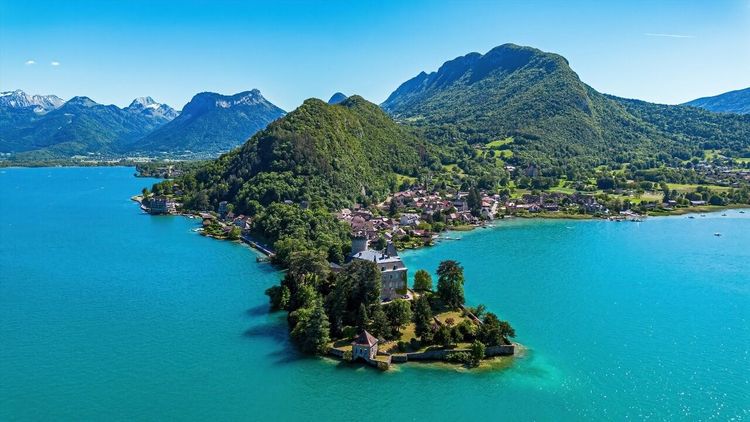
Duingt is one of the most photographed villages on the lake for a very concrete reason: the Château de Duingt (also known as Château de Châteauvieux) stands on a rocky islet connected to the shore by a narrow causeway, giving the impression of floating on the water. The composition is nearly perfect from the West Bank road, especially in the late afternoon when the golden light strikes the towers.
Located 12 km south of Annecy, Duingt marks the lake's 'narrows', the bottleneck between the Grande Île and the West Bank that divides the lake into two basins. This passage is only 1,500 metres wide, creating a funnel that amplifies the winds and stirs the surface of the water. Sailboats gather here on breezy days.
The castle remains private property: it cannot be visited like a conventional museum, but opens its gardens and courtyard for cultural events from May to October (concerts, open-air screenings, the 'La Presqu'Île de l'Imaginaire' festival in early July). Outside these dates, the access causeway remains a popular walking spot. The village itself is modest: a few dozen houses, an old church, a lakeside restaurant. That is its charm. Unlike Talloires or Menthon, which can be overrun in high season, Duingt retains a preserved local atmosphere—people genuinely live here, and you can feel it.
For swimmers, the Plage de Duingt (Route du Lac, 74410 Duingt, rated 4.3/5 on Google with 170 reviews) is one of the most popular beaches on the West Bank: clear water, a clean lake bed, and a view of the castle thrown in for good measure. A few trees provide shade on the shore, a rare luxury by the water.
Practical info: 20 minutes from Annecy via the D1508 (West Bank). Free parking in the village. Accessible by bike from Annecy via the lake tour cycle path.
Sévrier and the Quiet West Bank
Sévrier is the first significant village on the West Bank, 5 km south of Annecy. It is often driven through without stopping by those doing the lake circuit, which is a shame: the village is home to the Bell Museum, unique of its kind, which traces the history of bell-making from Antiquity to the contemporary Savoyard foundries. The Paccard foundry, a renowned establishment founded in 1796 and still in operation, is closely intertwined with the village's history.
The lakeside area in Sévrier is thoughtfully laid out: a cycle and pedestrian promenade runs along the shore, punctuated by municipal beaches, some of which are free. The Marquisats beach is technically in Annecy but extends to the borders of Sévrier. In summer, this area is popular with families and kitesurfers, who make the most of the southerly wind.
Practical info: Reachable in 10 minutes from Annecy by car or bike. Continuous cycle path from Annecy to Duingt along the West Bank. Free parking in the village, except at the main beach in July–August.
Saint-Jorioz: Gateway to the Regional Natural Park
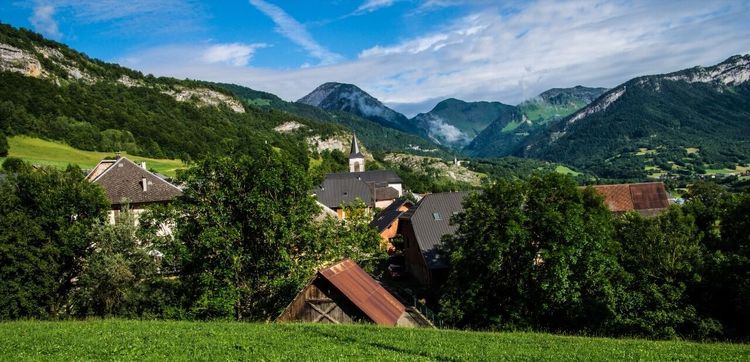
At 10 km south of Annecy, Saint-Jorioz marks the entrance into the territory of the Parc naturel régional du Massif des Bauges, a remarkably well-preserved mid-mountain massif that stretches across two départements (Savoie and Haute-Savoie). For nature lovers, it is one of the strategic villages on the West Bank.
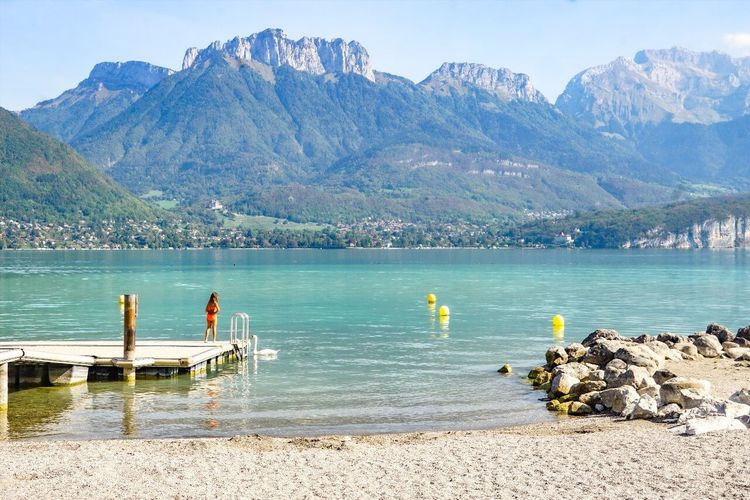
The village has a free beach with an exceptionally shaded setting for the region. It is one of the few beaches on the lake where natural shade is present, thanks to the alders and willows lining the shore. For families looking for a less crowded alternative to the Marquisats beach, Saint-Jorioz is often recommended.
The village is also a starting point for hikes in the Bauges, towards the Semnoz or towards the mountain chalets above the village. To plan your programme, our article on the most beautiful hikes in Haute-Savoie lists options by level and by season. Back in town, Ryo's lakeside audio walking tour (21 stops, roughly an hour) is a gentle way to close out the day.
Practical info: 15 minutes from Annecy via the D1508. Municipal campsite by the lake, one of the cheapest in the region for a waterfront pitch.
Doussard: a Nature Retreat at the End of the Lake
At 17 km south of Annecy, Doussard occupies the southern tip of the lake, where the Eau Morte and the Laudon flow into the lake after crossing the marshes of the Bout du Lac delta. This wetland, classified as a nature reserve, is one of the last natural lake deltas in the French Alps, and one of the few areas around the lake where wildlife takes precedence over tourist activity.
Marked trails wind through the reed beds and alluvial woodlands: grey herons, kingfishers, and egrets can be spotted with patience. Early in the morning, before 8am, is the best time. In summer, a natural beach on the edge of the reserve is appreciated for its relative tranquillity.
Doussard is also the terminus of the lake tour greenway and the starting point for the Faverges valley, heading towards the Aravis. For those spending several days in the region, it is a peaceful base that is noticeably cheaper than Annecy at the height of the season.
Practical info: 25 minutes from Annecy via the D1508. Well-equipped campsite by the water.
Lathuile and the Mountain Pastures between Lake and Mountains
Lathuile is located 20 km south of Annecy, set back from the West Bank on the first foothills rising towards the Bauges. Still an active farming village, several working dairy farms produce the milk that ends up as Reblochon and Tomme de Savoie: it contrasts sharply with the tourist resorts that dominate the lakefront.
A marked walk above the village offers views over the lake below and the Bauges ridgelines in the background. The hamlet of Chaparon, overlooking the Bout du Lac, is one of the most photogenic viewpoints on the West Bank, ideal at sunrise.
Practical info: Access from Doussard via a narrow switchback road. A car is essential from the lakeside. Few shops; stock up in Doussard or Faverges.
Thônes, Capital of Reblochon
At 20 km east of Annecy via the D16, Thônes is not a lakeside village but a small valley town at the heart of the Aravis. Its cheese-making vocation is written into its history: the Reblochon de Savoie AOP has its historical birthplace here, and several maturing cellars welcome visitors by appointment.
The Saturday morning market in Thônes is one of the most authentic farmers' markets in the region. Fresh and aged cheeses, mountain charcuterie, alpine honey, Savoie wines—the selection reflects the agricultural economy of the surrounding valleys. For those interested in local gastronomy, our article on Annecy's culinary specialities makes a useful complement to this excursion.
Thônes is also the gateway to the Aravis ski resorts (La Clusaz, Le Grand-Bornand), reachable in 20–30 minutes. In summer, these become hiking bases with the Aravis chain's alpine pastures and their grazing herds.
Practical info: 25 minutes from Annecy via the D16 towards La Clusaz. Saturday morning market, 8am–1pm. Free parking at the market square.
How to Organise Your Village Tour: Practical Tips
Depending on Your Available Time
With half a day, focus on a single area: the East Bank (Menthon + Talloires) or the West Bank (Sévrier + Duingt). Trying to see everything in a few hours inevitably leads to a series of photographic stops without any real depth.
With a full day, the complete lake circuit via the D1508 and the D909 is doable. Count 40 km of road from Annecy, roughly 2 hours of driving without stops. In practice, with three or four pauses, the day is well filled. Start on the East Bank in the morning (light faces the lake on the East side until noon) and return via the West Bank in the afternoon.
With two days, you can add Yvoire (a full-day excursion from Annecy) and a stop in Thônes. Our article on activities around Annecy will help you fill out the programme.
Getting Around
By car: the most flexible option, and essential for Lathuile, Thônes, and Montmin. In high season (July–August), car parks in popular villages (Talloires, Menthon) fill up before 10am. An early start before 8:30am is recommended.
By bike: the lake circuit along the cycle paths is entirely doable from Annecy. The route covers approximately 45 km and can be completed comfortably in a day at a leisurely pace. Electric bike rentals are available in Annecy. The shores are flat along the lake; once you head up towards Montmin or the Aravis, a mountain bike or e-bike is strongly recommended.
By boat: the Compagnie des Bateaux du Lac d'Annecy offers regular services between Annecy, Menthon, Talloires, and Duingt from May to September. Fares are around €12–15 one way depending on the destination.
By bus: TIC bus lines serve the main villages on the East Bank from Annecy, with a frequency of roughly one bus per hour in summer. The West Bank is less well served. Check timetables online (Sibra/TIC network) before planning your trip.
Avoiding the Pitfalls of High Season
July and August: the lakeside villages are packed. Talloires can welcome several thousand visitors a day in the height of summer, for a village of fewer than 2,500 inhabitants. A few rules that make a real difference to the experience:
- Arrive before 9am or after 5pm for crowd-free photos
- Booking is essential for lakeside restaurants with a view (plan 2–3 weeks ahead in July)
- Avoid the Tour du Lac weekend in July, a sporting event that closes certain roads
Outside high season, from September to June (except Easter holidays), the villages regain their everyday character. Accommodation costs 30 to 50% less, restaurants are accessible without a reservation, and the autumn light on the lake is often more beautiful than in summer. This is also the period ## FAQ
What Is the Most Beautiful Village to Visit around Annecy?
The answer depends on what you are looking for. Talloires is the most complete: a medieval abbey, a fishing harbour, a hike towards Montmin, and a quality of light on the lake that is hard to surpass. Menthon-Saint-Bernard offers the most photogenic beach-and-castle combination. If you are looking for a fortified medieval village, Yvoire stands out, even if it requires an additional full-day excursion to the shores of Lake Geneva.
Can You Visit Several Villages in a Single Day?
Yes, by car or bike the lake circuit allows you to pass through four to six villages in one day. The East Bank (Veyrier, Menthon, Talloires, then Duingt returning via the West Bank) makes a natural loop of around 40 km. It is better to choose two or three main stops and explore them properly than to rush through everywhere.
How Far Are the Villages from Lake Annecy?
The villages on the East and West Banks of the lake are all within 20 km of Annecy. Veyrier is 5 km away, Menthon 9 km, Talloires 13 km, Sévrier 5 km, Duingt 12 km, and Doussard 17 km. Yvoire is the exception: situated on Lake Geneva, it is 55 km from Annecy, approximately one hour by road.
Are the Villages around Lake Annecy Accessible without a Car?
The East Bank is served by TIC buses from Annecy (line 60, hourly frequency in summer). The lake circuit by bike is feasible from Annecy without a car, with rentals available in town. For Yvoire, Thônes, Lathuile, or Montmin, a car remains virtually essential, as public transport connections are very limited.
When Is the Best Time to Visit the Villages around Annecy?
May–June and September offer the best balance between quality and crowds: beaches are open, restaurants are too, the light is beautiful, and car parks do not fill up. July–August is the tourist high season—lively but often crowded in the popular villages. In winter, some lakeside villages have a particular charm under snow, even if most tourist businesses close.
Are There Castles to Visit around Lake Annecy?
Two castles are worth the detour. The Château de Menthon-Saint-Bernard is open for visits in the afternoon during high season (a private residence that has been inhabited for nearly a thousand years). The Château de Duingt is private property that only opens its gardens occasionally for cultural events from May to October, but its silhouette on the rocky islet is one of the most iconic images of the lake. The Abbaye de Talloires, converted into a hotel, is partially accessible even without staying there.
Conclusion
From the medieval lanes of Yvoire to the alpine pastures of Lathuile, taking in the lakeside castles of Menthon and Duingt, these getaways form a surprisingly rich territory within just a few dozen square kilometres. Take the time to discover them on foot, by bike, or by boat: going slowly reveals details here that speed erases.
Before leaving Annecy for the villages, or on returning from your lake circuit, don't miss the Ryo audio guide La Venise des Alpes: 20 audio-guided stops that recount 2,000 years of the city's history in one hour of walking. A way to connect the village tour with the discovery of Annecy's historic centre, and to come away with a complete picture of this Savoyard region.
À lire également