© Shutterstock
 Votre guide Ryo
Land Sailing in Normandy: the Best Spots and Clubs (2026)
Land sailing in Normandy holds a surprise: on the Calvados beaches, land yachts regularly reach 70 km/h in force-4 winds — a speed most participants would never associate with a family beach. Yet this discipline remains accessible from the age of 7, with no prior sailing experience required and all equipment provided by the clubs.
Firm sandy beaches uncovered at low tide, reliable Channel winds from April to October: Normandy brings together the two essential conditions for this activity, along with one of the highest concentrations of clubs in France. This guide presents the active spots in 2026 by area — Calvados, Manche, Seine-Maritime — as well as the available formats and current prices. If your stay extends beyond the beaches, the Ryo audio guide of Caen offers 22 stops to discover the city of William the Conqueror in 1 hour 50 minutes, just a short distance from the beaches of Ouistreham.
Why Normandy Is Ideal for Land Sailing
The discipline requires two ingredients: a wide, flat beach and steady wind. The Normandy coastline stretches for 600 kilometres and features numerous firm sandy beaches that support the weight of wheels without sinking. At low tide, several hundred metres of beach may be uncovered, providing an ideal track to manoeuvre without any space constraints.
On the wind side, the English Channel generates regular breezes driven by Atlantic weather systems and coastal thermal effects. The dominant direction is north-westerly, particularly stable between May and September. Some areas, such as the Cotentin peninsula, enjoy near-guaranteed conditions on sunny summer days, when the temperature difference between the sea and the land produces predictable local breezes.
The density of clubs is the other decisive argument. No other region of mainland France concentrates so many land sailing bases along such a short stretch of coastline. Whether you are based in Caen, Cherbourg or the Pays de Caux, a club is rarely more than 45 minutes away by road. It is also an activity particularly well suited to corporate outings, with several venues having developed specific team-building packages that include a safety briefing and enhanced supervision.
One final advantage, often underestimated: land sailing in Normandy takes place essentially at low tide, which opens up vast expanses of beach. Clubs always communicate the time slots when you book, so there is no need to monitor the tide tables yourself.
Calvados: Cabourg, Asnelles Gold Beach and Honfleur
The Calvados department concentrates the majority of active clubs and the most suitable beaches in Normandy. From the D-Day landing beaches on the Côte de Nacre to the Côte Fleurie, the department offers kilometres of sand uncovered at low tide, with clubs that have been training pilots since the 1980s.
Cabourg is the most accessible spot in the department. The beach is wide, well oriented relative to the dominant north-westerly winds, and the École de char à voile de Cabourg offers time slots throughout the season. Introductory sessions by the hour, half-days and multi-day courses are available depending on the time of year, with land yachts of different sizes suited to participants' ages.
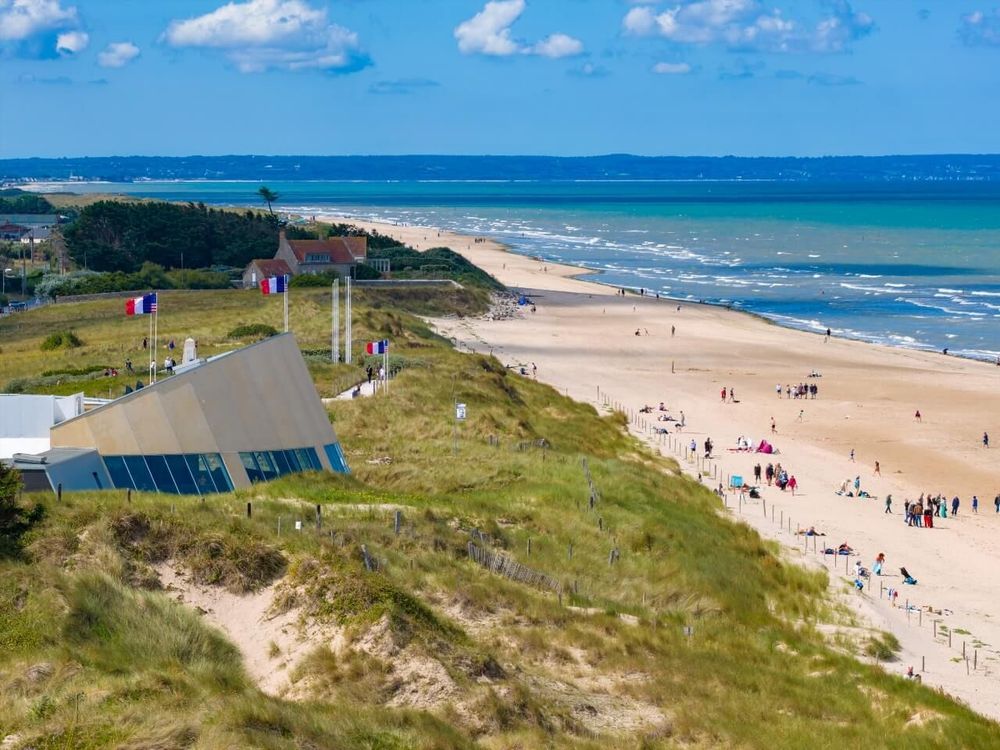
At Asnelles-sur-Mer, on Gold Beach, the D-Day landing beach of 6 June 1944, the Centre de Loisirs Nautiques d'Asnelles (CLNA) includes this activity in its outdoor programme. The historical significance of the site adds a particular atmosphere to sessions on the sand. Introductory sessions are open from age 7, and the centre also welcomes school groups and corporate teams with dedicated packages.
Honfleur is home to the Cercle Nautique de Honfleur (Chemin des Hauts Prés, 14600 Honfleur, rated 4.4/5 on Google from 53 reviews), which organises outings in line with the tidal calendar of the Seine estuary. The beach here is narrower than at Cabourg, but the estuary wind is often of good quality. Between sessions, the town is well worth a visit: the Ryo audio guide Entre mer et lumière covers the Vieux-Bassin and the historic lanes in 20 audio tracks and one hour of strolling.
Ouistreham and the Côte de Nacre
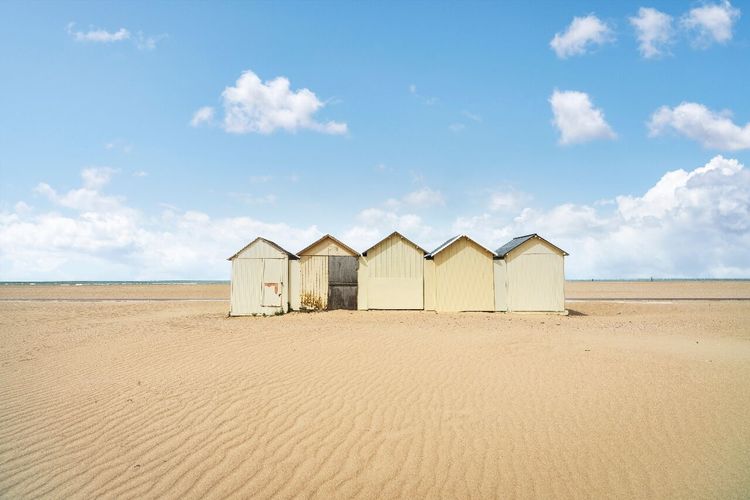
Ouistreham Riva-Bella is the most established reference in Calvados. The CANO (Centre d'Activités Nautiques de Ouistreham Riva-Bella) offers introductory sessions, multi-activity courses and group packages on one of the widest beaches on the Côte de Nacre. From Caen, the beach is reachable in 20 minutes via the D515, a short drive that makes the CANO particularly convenient for a stay based in the Norman capital.
Two points set the CANO apart in the regional offering. First, it has a large number of two-seater land yachts, making it a top choice for families — an adult can accompany a child from the very first manoeuvres. Second, it offers multi-day progression courses for those who want to move beyond the introductory level and work towards independent piloting.
The École d'Activités Nautiques OCEAN, also active along the Calvados coast, offers comparable packages and regularly works with local accommodation providers to create combined stay-and-activity deals.
Further east, Luc-sur-Mer is home to the Luc Yacht Club (1 Avenue du Général-de-Gaulle, 14530 Luc-sur-Mer, rated 4.7/5 on Google from 171 reviews), which operates according to the tides. The beach at Luc is slightly less crowded than Ouistreham or Cabourg at the height of summer — an advantage if you are looking for more space to manoeuvre without other land yachts too close by.
Trouville and Deauville
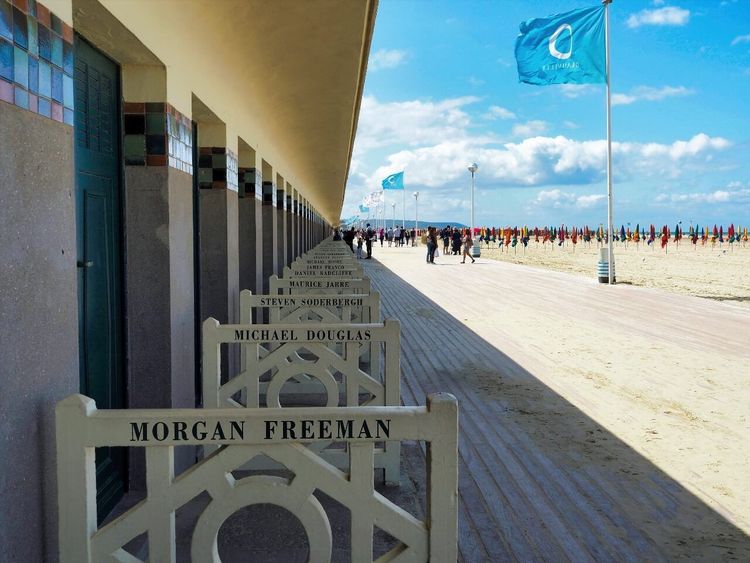
The Trouville-Deauville pairing is not the first image that comes to mind for this sport — people tend to think of the boardwalks and the glamour of the film festival. Yet both beaches offer valid conditions, and the Club Nautique de Trouville Hennequeville (CNTH) is a serious player in the area.
The CNTH organises introductory sessions of 1 to 1.5 hours for beginners, with the option of continuing into a half-day. The beach at Trouville, wide and well exposed, is a good environment for learning to manage the sail without obstacles. Sessions depend on tidal coefficients and wind strength — instructors confirm the slot the evening before or on the morning of the session.
If you are staying in the area, Deauville deserves a complementary half-day visit. The Ryo audio guide of Deauville Entre cabines de plage, caméras et colombages explores the Belle Époque villas, the Planches boardwalk and the Norman half-timbered buildings in 19 audio tracks and 2 hours of walking.
Manche: Vast Beaches Made for Speed
The Manche department operates on a different scale. Its beaches are often even wider than those in Calvados, the tides more pronounced, and the wind sometimes stronger — particularly on the western coast of the Cotentin peninsula, exposed to Atlantic winds. The trade-off: the density of clubs is lower and venues are more geographically spread out.
Most of the Manche spots are concentrated around the Norman-Breton gulf, from Bréhal to Jullouville. These beaches benefit from some of the largest tidal ranges in Europe — the amplitude can exceed 12 metres at Granville during the biggest spring tides — uncovering kilometres of firm sand at low water. In optimal conditions, it is not unusual to have 2 to 3 km of flat beach to sail along without restriction.
VanaSurf (Route de la Plage, 50230 Agon-Coutainville, rated 4.4/5 on Google from 240 reviews), based on the western coast of the Cotentin, includes land sailing among its nautical activities with packages suited to both individuals and groups.
The Centre d'Activités Voile et Vent and the École Voile et Vent Tourlaville also offer introductory sessions, integrated into broader nautical programmes that include dinghies and windsurfing. Both venues regularly work with school groups and local associations.
Coutainville, Granville and Jullouville
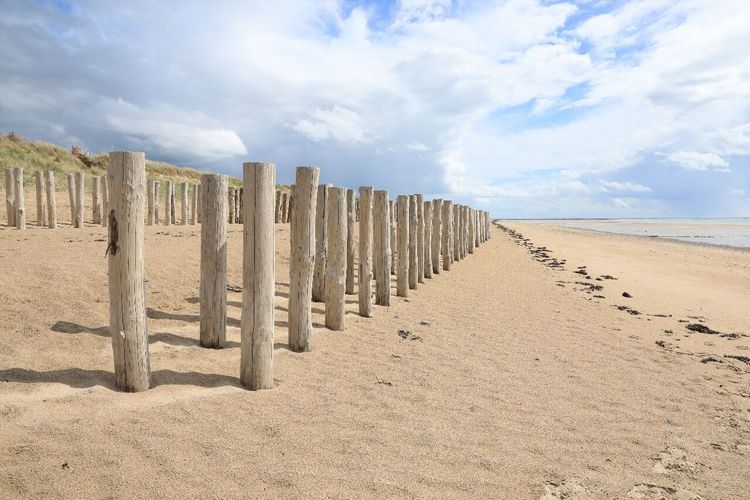
These three beaches form an active triangle on the southern Manche coast, less than an hour from Avranches or Cherbourg.
Coutainville (Agon-Coutainville) is home to the Club Nautique de Coutainville (Avenue de la Mer, 50230 Agon-Coutainville, rated 4.4/5 on Google from 240 reviews), one of the oldest and most well-organised clubs in the Manche. This club offers introductory sessions year-round, not just in summer, and regularly hosts school groups, companies and sports associations. The beach at Coutainville has a solid reputation for consistent wind conditions, even outside the main summer days.
Granville and Jullouville are covered by the 8 Milles Nautic network, which manages several nautical bases along this stretch of coast. The formula is practical: one organisation, multiple sites, centralised booking. 8 Milles Nautic also operates at Bréhal, a coastal village located between Granville and Coutainville, with specific time slots according to the tides.
The Association Nautique Hautaise operates from Hauteville-sur-Mer, a small seaside resort between Coutainville and Granville, with a discreet but serious introductory offer, away from the main summer tourist crowds.
Quinéville and the Northern Cotentin
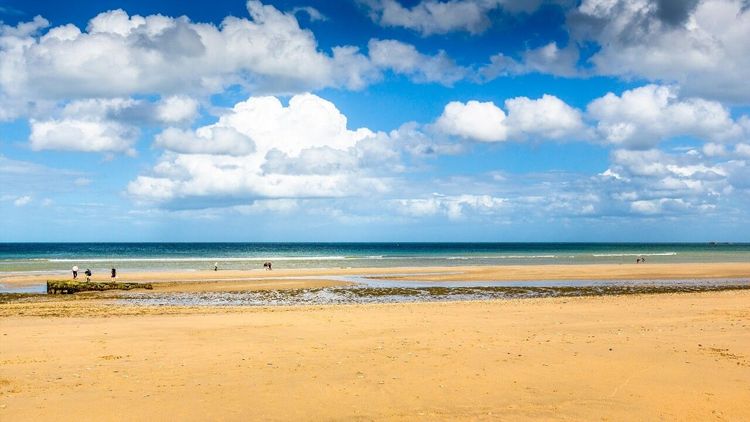
On the eastern side of the Cotentin peninsula, facing the Baie des Veys, Quinéville is home to the Centre Nautique Est Cotentin (Route de la Plage, 50310 Quinéville, rated 3.5/5 on Google from 32 reviews) on a straight, quiet beach. It is the least well-known spot in this guide, and for that reason often the least crowded in July and August. The beach is long, open, with wind conditions less intense than on the western coast but sufficient to progress at a comfortable pace.
It is a great option for families looking for a peaceful setting, or for groups who prefer to practise without sharing the beach with dozens of other land yachts at the same time.
Seine-Maritime: Dieppe and the Côte d'Albâtre
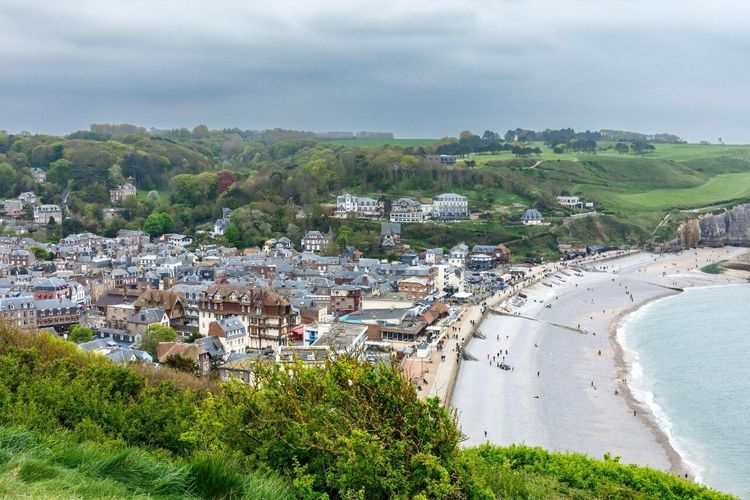
The Seine-Maritime department is less well endowed with spots than its two coastal neighbours, partly due to the prevalence of pebbles on its beaches. However, some sandy beaches do exist near the departmental borders, particularly around Saint-Aubin-sur-Mer.
The Base nautique de Saint-Aubin-sur-Mer (Rue des Pêcheurs, 76430 Saint-Aubin-sur-Mer, rated 4.2/5 on Google from 58 reviews) hosts introductory sessions on a fine sandy beach at the foot of the cliffs. The setting is distinctive — more intimate than the wide-open beaches of Calvados, with a more modest tourist footfall.
Dieppe remains the flagship town of this part of Normandy for visitors, even though land sailing is not its primary activity. If you are combining water sports with cultural discovery during your Norman stay, the Ryo audio guide of Dieppe — 23 audio tracks, 5 km, 2 hours — takes you between the castle-museum, the fishing port and the chalk cliffs. Caen itself takes 23 stops and 4.6 km on our audio walking tour, under two hours between the Abbaye aux Hommes and the Hôtel d'Escoville.
Introductory Session, Course or Training: Which Format Should You Choose?
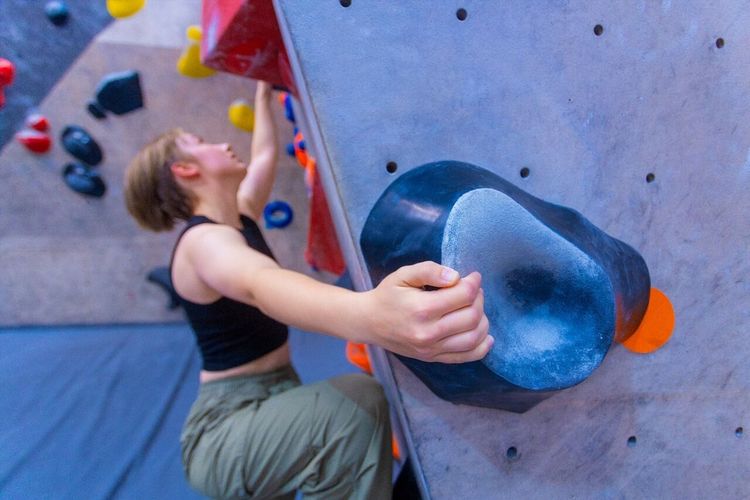
All Normandy clubs offer several levels of commitment. Before booking, it is worth knowing what you are looking for.
The introductory session (1 to 2 hours) is the most common format and the natural entry point. An instructor explains how the land yacht works, how to trim the sail, how to brake (by releasing the sheet), how to take bends gently, then accompanies you during your first run on the beach. This is suited to a one-off discovery, a family outing or a single activity day during a holiday. You will leave with the basics, though not yet the full autonomy needed to pilot solo on an unmarked beach.
The course (3 to 5 days) goes much further. It covers reading the wind, trajectories, points of sail and the fundamentals of independent piloting. Some Normandy clubs offer intensive summer courses with 4 to 6 hours of practice per day, depending on weather conditions. After a well-run 5-day course, most participants reach the level required to pilot solo on a marked beach and begin exploring the sensations at higher speeds.
The year-round school is the format for local residents. The Club Nautique de Coutainville and several Manche clubs offer regular out-of-season classes, often at weekends, with structured progression through the levels of the FFCV (Fédération Française de Char à Voile, the official governing body for the discipline in France).
For companies and groups, the most in-demand format is the half-day: roughly 3 hours including a safety briefing, a group introductory session and free time on the beach, for 8 to 20 participants at a time. Most clubs can accommodate this format with reasonable notice, especially outside July and August when the calendar fills up fast.
If you would like to practise regularly after your stay, consult the list of FFCV-affiliated clubs — it is updated every season and lists all active Normandy clubs by department, with their contact details and levels offered.
Two-Seater Land Yachts: the Duo Option
The two-seater land yacht is a very practical option for those who are hesitant to pilot alone in their first session, or who want to share the experience with someone close without each waiting their turn. The principle is simple: two people in the same land yacht, one steering and the other enjoying the scenery — or watching the manoeuvres to learn by example.
The majority of Normandy clubs have at least one or two two-seater land yachts in their fleet. The CANO at Ouistreham has made this a key strength: several two-seaters available simultaneously, allowing a family to practise together without waiting.
A few practical points to be aware of before booking: the passenger requires no minimum level. The pilot, however, must have mastered the basics — generally after 20 to 30 minutes of solo piloting, instructors assess whether you are ready to take a passenger. The combined weight is limited depending on the model (160 to 200 kg maximum depending on the land yacht): always check this constraint when booking.
Prices and Booking in 2026
Prices vary by club and format. Here are the representative price ranges in Normandy this season:
- 1-hour introductory session: between €25 and €40 per person
- Half-day (3 hours): between €55 and €85 per person
- Full day: between €90 and €130 per person
- 5-day course: between €250 and €400 (accommodation generally not included)
- Two-seater land yacht: similar rate to individual sessions, sometimes slightly higher depending on the club
Most venues offer reduced rates for children up to 12, and group discounts from 8 participants. Several clubs accept ANCV holiday vouchers, including the Club Nautique de Coutainville and the CANO at Ouistreham, which can reduce costs for a family stay.
Booking in advance is strongly recommended in July and August: slots fill up from June onwards at the most popular spots such as Cabourg and Ouistreham. Out of season (April–May, September–October), 48 hours' notice is often sufficient, or even same-day if weather conditions are confirmed.
Clubs systematically make sessions conditional on wind and tidal conditions. Wind that is too light (below force 2 Beaufort) or too strong (above force 6) may lead to the cancellation of a session. Cancellation policies vary by club — full refund or rescheduling — so check this point before paying.
When to Go Land Sailing in Normandy
The optimal season runs from April to October. The peak season (June to September) concentrates the majority of sessions, with clubs operating at full capacity and beaches at their most accessible.
May and June are often the preferred months for experienced practitioners: spring winds are steady, the beaches are uncrowded, and prices are sometimes lower than in summer. The long daylight hours of June add extra comfort for late-afternoon sessions.
In July and August, conditions are good but clubs are running at full capacity. Plan to book your slots several weeks in advance at popular spots. This is also the most suitable period for families with young children, who benefit from a supervised environment and enhanced instruction.
September often holds pleasant surprises: autumn winds can be stronger than in summer, the beaches regain their tranquillity, and prices dip slightly. A few clubs maintain a winter offering — Coutainville foremost among them — for regular practitioners willing to swap a T-shirt for a wetsuit.




FAQ
What is the best beach in Normandy for land sailing?
Cabourg, Ouistreham and Coutainville come up most often in recommendations. Cabourg and Ouistreham are ideal for beginners, close to Caen, well supervised, with well-equipped clubs and wide beaches. Coutainville is preferred by intermediate practitioners looking for consistent wind conditions and fewer people on the beach.
What is the minimum age for land sailing in Normandy?
Most Normandy clubs set the minimum age at 7 for children's introductory sessions, using land yachts adapted to their size. Between 7 and 12, supervision is enhanced. From the age of 12–14, depending on height and weight, young people can access adult land yachts. There is no maximum age: practitioners over 70 regularly visit the Normandy beaches.
Do you need to know how to sail to try land sailing?
No. Land sailing is learned independently of water sailing. The physics of the sail are the same, but steering a land yacht is different: you steer with your feet and manage the sail with your hands. After 30 to 45 minutes of instruction, most participants can pilot on their own with the basics needed for a supervised session.
How much does a land sailing introductory session cost in Normandy in 2026?
A one-hour introductory session costs between €25 and €40 depending on the club. A half-day session of 3 hours is priced between €55 and €85. Reduced rates are generally available for children up to 12, and group discounts apply from 8 participants.
Can you go land sailing in Normandy out of season?
Yes. Some clubs, notably the Club Nautique de Coutainville, maintain winter activity with regular weekend slots. Wind conditions are often better in autumn than in midsummer. Bring a wetsuit: temperatures on the Normandy beaches drop quickly from mid-October onwards.
Conclusion
Normandy offers one of the most comprehensive landscapes in France for land sailing: three coastal departments with quality spots and formats ranging from a one-hour introductory session to a five-day residential course. From Calvados around Cabourg and Ouistreham to the vast sandy expanses of the Manche near Coutainville and Granville, each area has its own characteristics in terms of wind, available space and atmosphere.
If your Norman stay extends beyond the beaches, Ryo covers several stops in the region with audio guides to take on your phone. The Ryo audio guide of Rouen — 27 audio tracks, 4 km, 1 hour 45 minutes — follows the path from the cathedral to the Gros-Horloge through the medieval quarters. The Ryo audio guide of Le Havre explores the seafront and Auguste Perret's architecture in 18 audio tracks. Normandy, between Channel winds and history-laden cities, is best experienced at several different paces.
À lire également