© Shutterstock
 Votre guide Ryo
15 Enchanting Villages Around Caen to Discover in 2026
Looking for the most beautiful villages around Caen but not sure where to start? Normandy has a quiet talent for hiding its finest gems less than an hour's drive away. While tourists crowd the D-Day beaches or queue in front of the Memorial, labelled villages, sleepy fishing ports and medieval market towns slumber in an almost unsettling calm. Whether you are based in Caen or just passing through and want to explore the heart of Normandy, this overview will give you 15 reasons to leave the city. To prepare your exploration of Caen itself before venturing further, the Ryo audio-guided tour of Caen offers 22 audio stops over 4.6 km, ideal for a first morning before hitting the road.
Expect to discover a village whose half-timbered houses date back to the 14th century and whose tourist office welcomes more foreign visitors than local residents, a port where trawlers still unload their catch at sunrise, a Benedictine abbey founded in 1034 by a wandering monk, and a Norman canyon carved out of granite that hikers compare to a miniature Gorges du Verdon. Distances range from 25 to 130 km from the centre of Caen, enough to plan one or several tailor-made weekends depending on your mood.
1. Beuvron-en-Auge: The Most Photographed Village in Calvados
Beuvron-en-Auge (Place du Village, 14430 Beuvron-en-Auge, rated 4.5/5 on Google with 246 reviews) has been listed among the 'Most Beautiful Villages of France' since 1999, and the distinction fully lives up to its promise. Located 40 km east of Caen in the Pays d'Auge, this village of fewer than 250 inhabitants boasts a density of Norman half-timbered houses that exceeds anything you have probably imagined: crossed X-shaped beams, jettied upper floors, terracotta bricks between dark timbers, geraniums in the windows. The central square looks like a film set — and has indeed served as one on several occasions.
The village built its identity around the production of cider and calvados, and this agricultural vocation has evolved into a tourist attraction without the village losing its soul. The Route du Cidre passes through Beuvron and connects around a dozen estates over approximately 40 km; you can buy artisan cider, pear cider, and oak-barrel-aged calvados directly from the farm. Several restaurants serve buckwheat galettes, warm camembert and Norman cream desserts you will not find in any supermarket.
A walking tour of the village itself takes only an hour. But if you combine it with a visit to nearby cider farms and lunch on site, allow a comfortable half-day. Park at the northern car park (free, two minutes' walk from the square) rather than in the centre, where traffic is difficult on spring and summer weekends. Out of season, from October to March, the village regains its rural calm and the autumn light on the half-timbered facades is worth the trip on its own.
Beuvron-en-Auge is also the ideal starting point for exploring the Pays d'Auge by car: Cambremer (6 km), Lisieux (25 km) and Orbec (35 km) are all within easy reach for a full day of discovery through the Norman bocage.
2. Barfleur: The Medieval Port at the Tip of the Cotentin
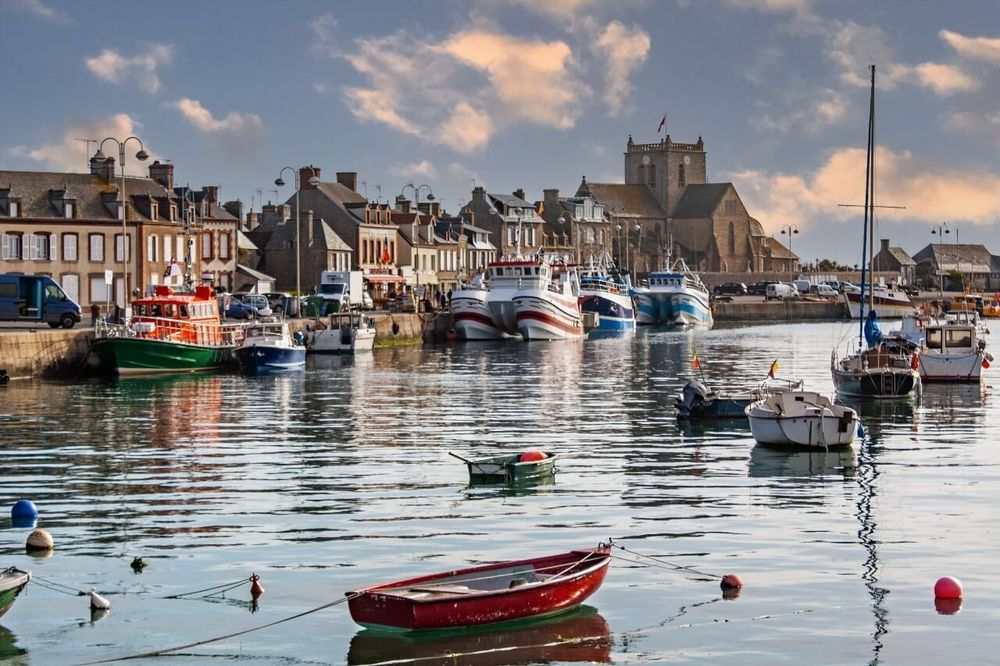
Barfleur (Quai Henri Chardon, 50760 Barfleur, rated 4.6/5 on Google with 1,200 reviews), in the Manche department, 130 km north of Caen, also features among the 'Most Beautiful Villages of France'. This is not a picture-postcard village in the polished sense: it is a working fishing port, with lobster pots stacked on the quay, grey granite boats moored opposite a 12th-century Romanesque church, and cobbled lanes winding down to the sea.
The history of Barfleur is intimately bound up with medieval Normandy. It was from this port that William the Conqueror set sail for England in 1066, and it was here that the Wreck of the White Ship in 1120 cost the life of King Henry I of England's son, durably altering the Anglo-Norman royal succession. These events are not communicated through tourist interpretation panels: they are felt while wandering along the quay at dusk, facing a sea that turns grey-green.
The lighthouse at Gatteville-le-Phare (3 km away) is the second tallest lighthouse in France at 75 metres and 365 steps — a climb that rewards the effort with a panoramic view over the Cap de la Hague and the Channel Islands on a clear day. Below, the Barfleur headland is a popular spot for locals gathering shellfish at low tide. Plan an overnight stay to enjoy the village without the summer crowds; accommodation remains affordable outside July and August.
3. Le Bec-Hellouin: The Abbey in the Valley
Located 45 km south-east of Caen in the Eure department, the village of Le Bec-Hellouin takes its name from the Benedictine abbey founded in 1034 by Herluin de Brionne, a former knight who became a wandering monk. This monastery exerted a considerable intellectual and religious influence on medieval Europe: three of its monks became Archbishops of Canterbury, including Lanfranc (1070) and Anselm of Canterbury (1093), one of the great theologians of the Middle Ages.
Still home to a community of Benedictine monks today, the abbey welcomes visitors every day except Tuesday morning. The guided tour (approximately 1h30) gives access to the 17th-century cloister, the abbey church and the cellars. The monks have diversified their activities: they breed horses and produce ceramics sold in the abbey shop.
The village itself is listed among the 'Most Beautiful Villages of France'. Its half-timbered houses line a stream, the Bec, nestled in a green valley where wild irises bloom in spring. The atmosphere is resolutely calm, almost monastic. A single main street, a few rural guesthouses and a gastronomic restaurant make this a restful stop. Allow at least two hours for the abbey visit and a walk around the village, or a half-day if you wish to have lunch on site.
4. Clécy: The Gorges of the Suisse normande
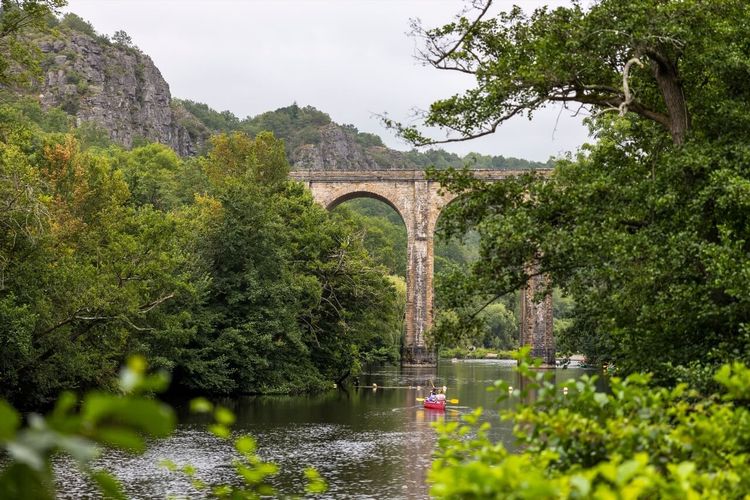
Clécy (Rue des Châtelets, 14570 Clécy, rated 4.4/5 on Google with 680 reviews) is the flagship village of the Suisse normande, a rugged territory carved by the Orne river through the Armorican massif between Caen (35 km to the south) and Falaise. The name 'Suisse normande' is a willingly exaggerated metaphor, but the gorges cut through schist, the meanders of the Orne, and the rocky viewpoints overlooking the valley from 100 to 120 metres above make up the most spectacular landscape accessible from Caen in under an hour.
The Pain de Sucre is the unmissable viewpoint: a ridge reached after a short climb (20 minutes from the village car park) that reveals a 180-degree panorama over the Orne meander. Outdoor sports enthusiasts are well catered for: kayaking on the Orne, via ferrata at the Rocher des Parcs, mountain biking on the many forest trails. The Pont-Érambourg leisure base (2 km away) rents water sports equipment from April to October.
The village of Clécy itself deserves a leisurely stroll: its 12th-century Romanesque church, its schist-stone houses and its small model railway museum (surprising but popular with families) complete the picture. To explore the region during your stay in Caen, find our Ryo audio-guided tour of Caen before heading south.
5. Lyons-la-Forêt: The Medieval Village Under the Beeches
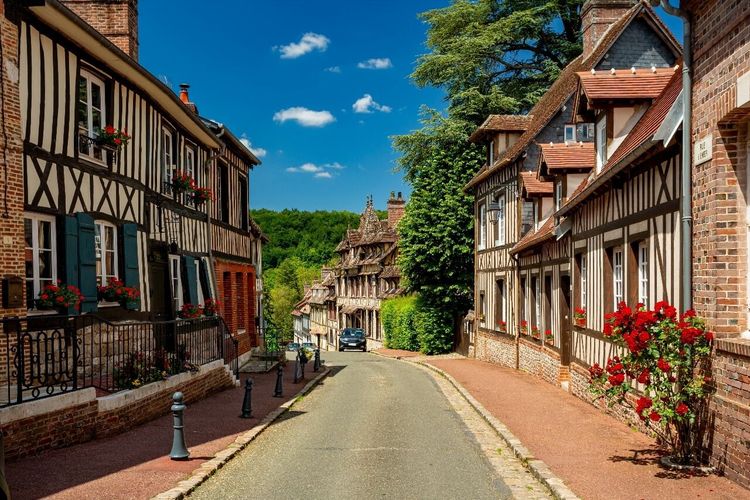
Lyons-la-Forêt (Grande Rue, 27480 Lyons-la-Forêt, rated 4.6/5 on Google with 1,900 reviews), in the Eure department, is located 90 km east of Caen, less than two hours by car via the A13. This village is officially listed among the 'Most Beautiful Villages of France', and it must be said that the concentration of 17th- and 18th-century half-timbered houses around a covered central market hall is hard to match.
The village owes its distinctive character to its setting at the heart of the Lyons forest, one of the finest beech forests in France with its 10,700 hectares of centuries-old trees. Forest paths leave directly from the village lanes, and in autumn the cathedral-like canopy of golden beech leaves is a spectacle that alone justifies the journey from Caen. Maurice Ravel stayed and composed in a house in the village; a discreet plaque marks it.
The central market hall, with its beams worn smooth by the centuries, still hosts a market on Saturday mornings. Take time for a coffee on the terrace facing the square: Lyons-la-Forêt has kept intact the village ritual that many Norman market towns have lost over the decades.
6. Veules-les-Roses: The Shortest River in France
Veules-les-Roses (Rue du Dr Girard, 76980 Veules-les-Roses, rated 4.6/5 on Google with 1,500 reviews) is as much a geographical curiosity as a charming village: it is crossed by the Veules, a river just 1,149 metres long from source to sea, officially the shortest river in France. This tiny fact neatly sums up the spirit of the place — everything here is on a human scale, almost miniature.
Located in Seine-Maritime, 110 km north-east of Caen, this village listed as a 'Most Beautiful Village of France' is nestled against white chalk cliffs typical of the Norman coastline. The ancient troglodyte caves carved into the cliff were long used to store watercress and mushrooms; some are still visible from the path that follows the Veules down to the beach.
The village attracted artists in the 19th century, including Victor Hugo, who stayed here on several occasions. Its low houses with gardens overflowing with rose bushes, its restored watermills and its church dating from the 11th and 16th centuries create an atmosphere visitors often describe as 'timeless'. The pebble beach is pleasant for a swim in summer, but it is out of season that Veules-les-Roses reveals its most authentic character.
7. Saint-Céneri-le-Gérei: A Living Painting in the Orne
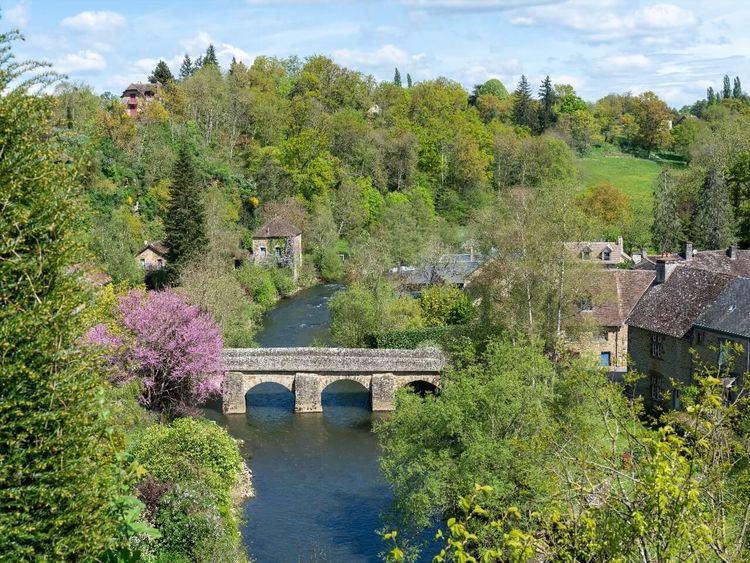
Saint-Céneri-le-Gérei (Le Bourg, 61130 Saint-Céneri-le-Gérei, rated 4.5/5 on Google with 890 reviews), in the Orne department, 85 km south of Caen, is listed among the 'Most Beautiful Villages of France'. This village of fewer than 150 inhabitants sits on a rocky spur encircled by lazy meanders of the Sarthe river — a setting that the painters of the 19th-century artists' colony established here captured on hundreds of canvases.
The 11th-century Romanesque church contains remarkably well-preserved medieval frescoes (12th–14th centuries), a rarity for the region. The Saint-Céneri chapel, perched on a rock overlooking the river, is accessible via a 10-minute path from the village centre. The view over the meanders of the Sarthe from this point is one of the most photographed scenes in the Orne.
The village has successfully resisted any intrusive modernisation: no housing estates on the outskirts, no commercial signage visible from the lanes. The visit is done entirely on foot, in 1h30 to 2 hours depending on your pace.
8. Blangy-le-Château: The Castle of the Pays d'Auge
Blangy-le-Château (Rue du Château, 14130 Blangy-le-Château, rated 4.2/5 on Google with 310 reviews), 55 km east of Caen in Calvados, is less well known than its Pays d'Auge neighbours, which makes it one of the most pleasant villages to visit without the crowds. The village is dominated by the ruins of its medieval castle, whose local-stone ramparts offer an open view over the wooded hills and surrounding apple orchards.
The village church houses a remarkable Romanesque doorway and some coloured stained-glass windows that filter the light through the nave in a striking manner on sunny mornings. The weekly Friday morning market brings together local producers and residents in a warm, unpretentious atmosphere typical of the Norman bocage.
Blangy-le-Château fits perfectly into a one-day itinerary combining Beuvron-en-Auge (15 km) and Beaumont-en-Auge (12 km) — three villages, three different atmospheres in the same part of Calvados.
9. Beaumont-en-Auge: The View Over the Seine Estuary
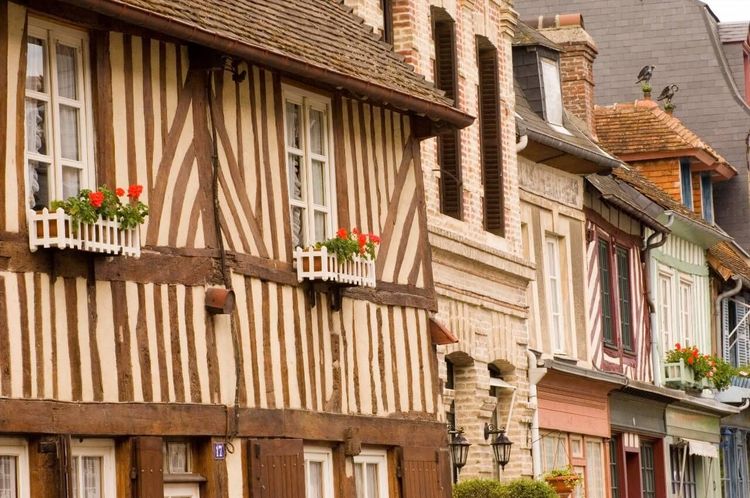
Beaumont-en-Auge (Place du Docteur Davout, 14950 Beaumont-en-Auge, rated 3.3/5 on Google with 9 reviews) does not hold the 'Most Beautiful Villages of France' label, but it deserves to. This village perched on a promontory 35 km east of Caen offers an unobstructed view over the Seine estuary, the Calvados beaches and, on a clear day, the coastline as far as Honfleur. It is one of the widest and least crowded panoramas in the entire region.
The village has retained its agricultural character: an old church, stately homes typical of the Pays d'Auge, a handful of food shops and an authentic Norman countryside atmosphere. The astronomer Pierre-Simon de Laplace, one of France's greatest 18th-century mathematicians, was born here in 1749; a plaque and a statue recall this local pride. Back in Caen, Ryo's Home of William and Matilda audio tour threads 23 stops over 4.6 km through the historic centre.
To continue your exploration of Calvados and plan your next getaway, find our selection in the article on the most beautiful villages in Calvados.
10. Port-en-Bessin-Huppain: The Authentic Fishing Port
Port-en-Bessin-Huppain (Quai Félix Faure, 14520 Port-en-Bessin-Huppain, rated 4.3/5 on Google with 760 reviews), 35 km west of Caen, is an active fishing port wedged between two white chalk cliffs — a cinematic setting that Georges Seurat painted in 1888 in two canvases now held at the Kröller-Müller Museum in the Netherlands. The Port-en-Bessin fish auction is still active: every weekday afternoon, trawlers return with John Dory, sole and lobster unloaded onto the quay.
The port holds no label and does not seek one. That is precisely why it attracts a discerning clientele: fish restaurants overlooking the boats, delicatessens, a fish market at weekends. The Second World War fortifications (blockhouses, batteries) dot the cliffs and recall the port's strategic role during the June 1944 D-Day landings — it was the only deep-water port between Cherbourg and Le Havre, and the Allies captured it within the first days of the battle.
11. Villerville: The Forgotten Seaside Resort
Villerville (Rue de l'Église, 14113 Villerville, rated 4.3/5 on Google with 410 reviews), 55 km east of Caen on the Côte Fleurie, is a Belle Époque seaside resort that managed to survive the 20th century without being transformed into a standardised resort. Its grand villas with turrets, wooden balconies and gardens overlooking the sea are a reminder that Villerville was, in the 19th century, a sought-after destination for wealthy Parisians.
The village is small — around 700 inhabitants — and it shows. A single shopping street, an old church, a sandy beach below and coastal paths leading to Honfleur (6 km to the east) on foot. This coastal walking trail is one of the most enjoyable on the Côte Fleurie, with direct views over the Seine estuary and the Pont de Normandie. Come on a weekday to avoid traffic jams on the D513 linking Deauville to Honfleur in summer.
12. Reviers: The Quiet Charm of the Bessin
Reviers (Rue de l'Église, 14470 Reviers, rated 4.1/5 on Google with 180 reviews), just 15 km north of Caen, is the closest village on this list, and yet one of the least visited. This small hinterland village in the Bessin stretches around a 12th-century Romanesque church whose steeple, visible from the road, remains one of the landmarks of the agricultural landscape between Caen and the sea.
Reviers is framed by the Seulles, a salmon river prized by fly fishermen. The village has no restaurant or hotel — which is precisely what makes it a spontaneous stop. Five kilometres away, the village of Courseulles-sur-Mer offers oysters directly from the oyster farmer and a D-Day museum.
13. Crèvecœur-en-Auge: The Manor House with Three Centuries of History
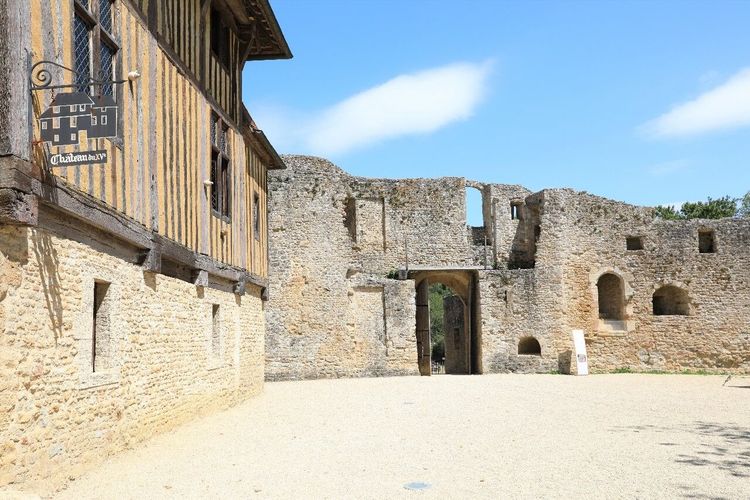
Crèvecœur-en-Auge is not a picture-postcard village, but its medieval manor house makes it an unusual stop 25 km east of Caen. The fortified complex — moats, keep, Romanesque chapel, lord's residence — spans several centuries of Norman architecture on a single site, from the 11th to the 16th century.
The manor also houses a museum dedicated to petroleum research, a surprising conversion linked to the Schlumberger Foundation, which restored and bequeathed the site. The Romanesque chapel retains a few carved capitals of exceptional quality for such a modest building. The visit lasts about an hour and appeals equally to medieval architecture enthusiasts and families with children. To discover other unusual day trips from Caen, the Ryo audio guide for Caen is a great starting point for organising your outings in the region.
14. Saint-Pierre-sur-Dives: The Abbey and the Medieval Market Hall
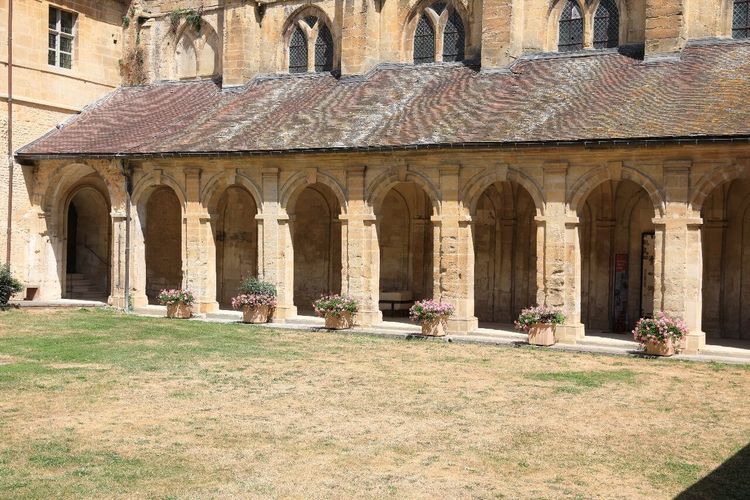
Saint-Pierre-sur-Dives, 35 km south-east of Caen, is not a village but a medium-sized market town — it nonetheless earns its place here for two exceptional monuments: its Benedictine abbey founded in the 11th century and its medieval market hall, one of the largest and best-preserved in Normandy.
The market hall displays its vast timber framework, reconstructed to the original design after the fire of 1944. A lively market is held there every Monday morning — and not a tourist market: vegetables from the Bessin, farm cheeses from the Pays d'Auge, seafood. Saint-Pierre-sur-Dives is as much a gastronomic stop as an architectural one.
15. Thury-Harcourt-le-Hom: The Gateway to the Suisse normande
Thury-Harcourt-le-Hom (Rue de Condé, 14220 Thury-Harcourt-le-Hom, rated 4.2/5 on Google with 290 reviews), 28 km south of Caen, is the gateway to the Suisse normande from Caen. The village itself is modest, but it provides direct access to the Orne gorges, the Boucle du Hom — a spectacular meander visible from the viewpoint in a 15-minute walk — and the ruins of the Harcourt dukes' castle, destroyed in 1944.
The castle park (free entry) is home to centuries-old rhododendrons in bloom from May to June and shaded paths along the Orne. It is a short stop — an hour is enough — but perfect before or after a day in Clécy.
FAQ
Which is the most beautiful village near Caen?
Beuvron-en-Auge is generally considered the most beautiful village near Caen, with its Norman half-timbered houses bearing the 'Most Beautiful Villages of France' label. Located 40 km east of Caen, it is easily reachable by car in 40 minutes. For a coastal village, Barfleur in the Manche department is the benchmark, though further away (130 km).
Which Villages Around Caen Hold the 'Most Beautiful Villages of France' Label?
Within a 150 km radius of Caen, six villages officially carry this label: Beuvron-en-Auge (Calvados), Barfleur (Manche), Le Bec-Hellouin (Eure), Lyons-la-Forêt (Eure), Saint-Céneri-le-Gérei (Orne) and Veules-les-Roses (Seine-Maritime). All can easily be visited over a weekend from Caen.
Which Village in Calvados Deserves a Half-Day Visit?
Le Bec-Hellouin and Beuvron-en-Auge are the two villages that easily justify a half-day: the first for the guided tour of the Benedictine abbey (1h30) and a stroll through the village, the second for the half-timbered square and a Norman lunch on site. The other villages on this list can be visited in 1 to 2 hours.
What is the Best Time of Year to Visit the Villages Around Caen?
Spring (April–June) is ideal. Autumn (September–November) offers superb light on the half-timbered houses and apple orchards, especially in the Pays d'Auge. In summer (July–August), Beuvron-en-Auge and Barfleur can be crowded on weekends. Winter suits travellers who accept that some sites close their doors.
Can You Visit Several Villages in One Day from Caen?
Yes, by car. Two itineraries work well. The Pays d'Auge route (Caen → Crèvecœur-en-Auge → Saint-Pierre-sur-Dives → Beuvron-en-Auge → Beaumont-en-Auge → Villerville → return) covers 5 villages in 180 km. The Suisse normande route (Caen → Thury-Harcourt-le-Hom → Clécy → Falaise → return) covers 3 sites in 120 km with time left for walking.
Are the Villages Around Caen Suitable for Families with Children?
Several sites are particularly well suited for families. Clécy offers kayaking, via ferrata and mountain biking. Crèvecœur-en-Auge features a medieval manor with moats and a keep. Thury-Harcourt-le-Hom gives access to the Orne gorges with trails accessible from age 6. Port-en-Bessin lets children watch the fishing unloading on the quay, an experience they remember for a long time.
Conclusion
From Beuvron-en-Auge to Barfleur, from the Suisse normande to the cliffs of Seine-Maritime, these villages cover a range of landscapes and atmospheres that few French regions can match within a similar radius. Each of these 15 places offers something the others cannot replace, and that is precisely what makes exploring rural Normandy so addictive.
Before setting out to discover them, take a few hours to explore Caen itself with the Ryo audio-guided tour of Caen: 22 audio stops, 4.6 km and 1h50 of narration to understand William the Conqueror's city before venturing out into its surroundings.
À lire également