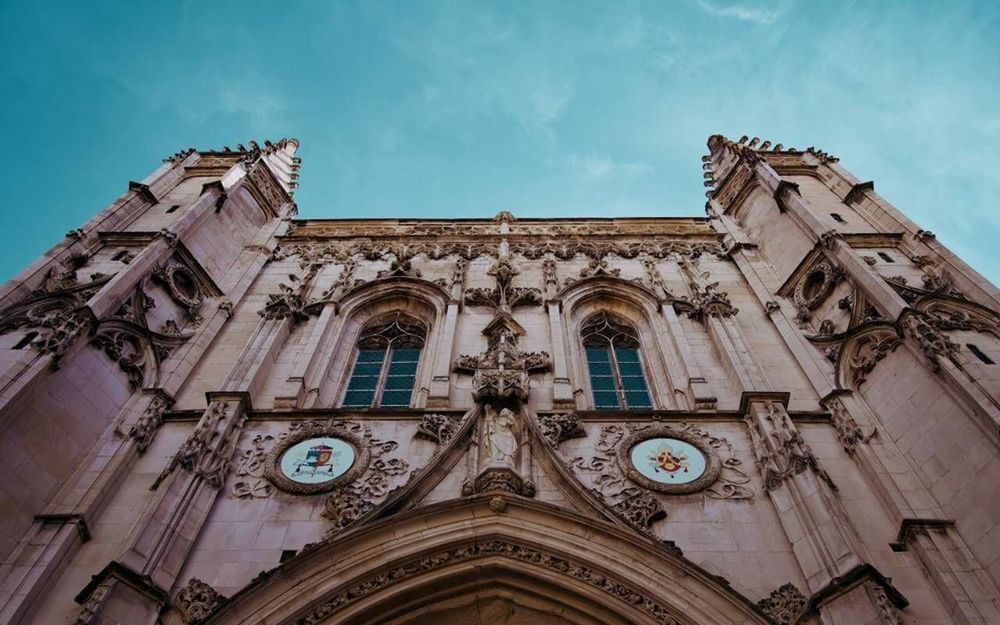
© Shutterstock
 Votre guide Ryo
Pont d'Avignon: Complete Guide to Visit the Pont Saint-Bénezet in 2026
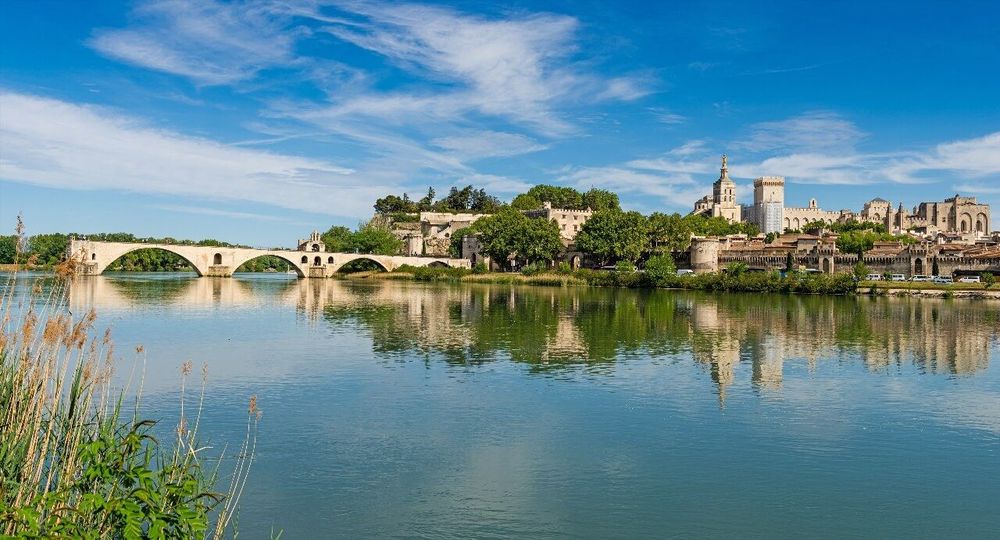
Four arches out of twenty-two. This is what remains of the Pont Saint-Bénezet, this pharaonic 12th-century construction that crossed the Rhône for nearly 920 meters. The Pont d'Avignon is one of the most photographed monuments in France, and probably one of the most misunderstood: people don't dance on it (the celebration took place under the arches, on a vanished island), you can't cross it from end to end (it has stopped above the river since the 17th century), and yet it attracts hundreds of thousands of visitors each year. This guide covers everything you need to know before visiting: the bridge's history, its updated prices for 2026, opening hours, how to see it for free from the banks, and what's worth a detour in the medieval quarter all around. To explore Avignon at your own pace with audio commentary, the Ryo audio tour of Avignon covers the bridge and 26 other historical stops in the city of the popes.
The History of the Pont Saint-Bénezet: 920 Meters Over the Rhône
In the 12th century, crossing the Rhône between Avignon and Villeneuve-lès-Avignon was a feat. The river was wide, unpredictable, and the ferries that provided the crossing remained slow and perilous. It was in this uncertain context that a young shepherd from Ardèche, Bénezet, arrived in Avignon around 1177 with, according to tradition, a divine mandate: to build a bridge.
The construction of the first wooden structure was completed around 1185. Its reconstruction in stone, much more ambitious, began shortly after and was completed in the early 13th century. The structure then measured 920 meters long, rested on 22 arches, and constituted one of the few stone bridges to cross the Rhône at that time. Its strategic position, on the border between the Kingdom of France and the Holy Roman Empire, immediately made it a military, economic and symbolic stake.
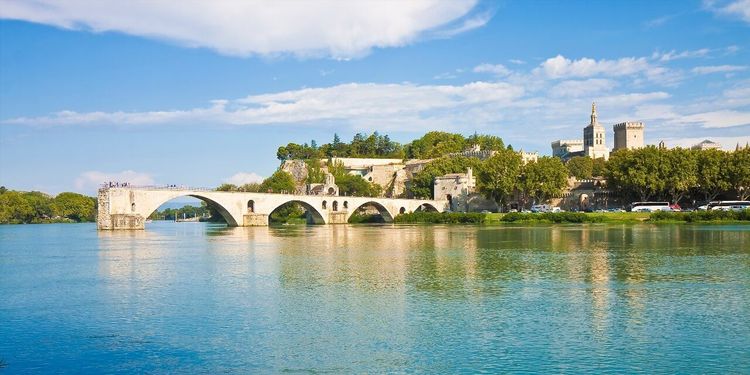
The popes, who settled in Avignon from 1309, made it an instrument of their temporal power. But the Rhône does not respect symbols. Repeated floods weakened the arches throughout the 14th century, and in 1669, an exceptional flood swept away most of the bridge. For lack of funds and political status to justify reconstruction, Avignon abandoned the structure. The four arches and the Saint-Nicolas chapel that survive today are what the river was willing to leave behind.
Since 1995, the bridge has been listed as a UNESCO World Heritage Site, as part of Avignon's historic ensemble which also includes the Palais des Papes and the Rocher des Doms.
The Legend of Bénezet: Shepherd, Angel and Rock
The official history of the bridge is based on a 13th-century text, the 'Legend of Saint Bénezet', written after the builder's death. According to this text, Bénezet was only a twelve-year-old boy when a divine voice ordered him to build a bridge at Avignon. He went to see the bishop, who took him for a madman. To prove his mission, Bénezet allegedly lifted a colossal rock, a stone that thirty men could not have moved, and threw it into the Rhône to form the first pier of the bridge.
The mythical part is obvious. But the archives attest to the existence of a brotherhood of the Frères Pontifes, a structured organization, financed by donations and placed under ecclesiastical protection, which actually supervised the construction and maintenance of the bridge. Bénezet would have been its founder. His remains were moreover preserved for centuries in the Saint-Nicolas chapel, on the bridge itself, before being transferred to the Saint-Didier church during the revolutionary destructions. His cult was officially approved by Pope John XXII in 1331, with a feast set for April 14.
What this legend reveals is the financing method of great medieval projects: mobilizing donors always went through a tutelary figure, a founding miracle, divine legitimacy. Bénezet is less the builder of the bridge than its retroactive patron saint.
What the Song 'Sur le Pont d'Avignon' Really Hides
Everyone knows the melody. Far fewer people know that the dancers in the song didn't dance on the bridge, but under the arches, on an island or sandbank of the Rhône that has since disappeared. The original medieval text explicitly says 'under the bridge', not 'on the bridge'.
The confusion was established through successive adaptations, until the children's version composed by Adolphe Adam in 1853, which definitively fixed 'on the bridge' in collective memory. The song describes a scene of popular celebration inherited from the Middle Ages: ladies, handsome gentlemen, cavaliers, each dancing in their own way under the arches, on this natural beach that bordered the bridge before the Rhône permanently covered it.
Ironically, it is this nursery rhyme that attracts thousands of visitors each year expecting something that the bridge never really offered. Disappointment is sometimes waiting. But the bridge itself remains there, suspended above the river, stranger in its reality than in all its representations.
What You'll See on the Bridge Today
Climb onto the bridge and you'll immediately understand why its silhouette is so striking: it launches over the Rhône, then stops abruptly, above the void, facing the Île de la Barthelasse. This sensation of a broken bridge, suspended between two banks that no longer meet, is one of the most singular that a medieval monument can offer.
The four preserved arches are in blond limestone, faithful to the 12th-century Romanesque style. Each is crossed by a paved path that follows a slight curve, not for aesthetics, but to better resist floods. The arches are not identical: the second, higher than the others, allowed the passage of masted boats.
The visit includes a multilingual audioguide included in the ticket price, available in French, English, Spanish, German, Italian and several other languages. An augmented reality tour allows you to visualize the bridge in its original state, with its 22 arches and medieval life animating its surroundings. From the end of the bridge, the view of the Rocher des Doms and the Palais des Papes is one of the most striking in Avignon.
The Saint-Nicolas Chapel: Two Superimposed Chapels
Halfway across the bridge, the Saint-Nicolas chapel deserves particular attention. It is actually a superposition of two distinct buildings: a Romanesque chapel at the lower level, a Gothic chapel at the upper level, two styles, two periods, built one on top of the other.
The Romanesque chapel is the oldest part of the bridge still standing. Its apse with cul-de-four and small round-arched windows are remarkably preserved despite eight centuries of exposure to floods and weather. The chapel successively served as a place of worship, residence for the bridge keepers, then warehouse, before a 19th-century restoration.
This is where Bénezet rested until the French Revolution. A slab on the floor still marks the location of his tomb.
The View from the Bridge: Palais des Papes and Rhône
From the end of the bridge, the view unfolds in two directions. On the Avignon side, the silhouette of the Palais des Papes dominates the Rocher des Doms with a majesty that has lost nothing in seven centuries. On the Rhône side, the river passes under the arches with the same indifference as in the Middle Ages.
This is a rare viewpoint in French medieval architecture: an unfinished monument that offers a perspective on another monument, in a dialogue of stones and water that no other site in France reproduces at this scale. Take time to rest at the end of the bridge, even five minutes, before going back down.
Tickets and Prices 2026
The visit to the Pont d'Avignon is managed by Avignon Tourisme. Admission is paid and includes the multilingual audioguide as well as access to the augmented reality application.
Individual prices 2026:
- Full price: €5
- Reduced price (students, groups, seniors under certain conditions): €4
- Children under 8: free
- Avignon residents: free every Sunday
Combined tickets:
- Bridge + Palais des Papes: €17 (full price)
- Bridge + Palace + Papal Gardens: €17
- Bridge + Papal Gardens: €8
- Avignon City Pass 24h (bridge, palace and transport included): €24
Last admission is 30 minutes before closing. It is strongly advised to book online in July and August, as queues can exceed 30 minutes at midday. Entry is via rue Ferruce, under the Rocher des Doms, on the Rhône side.
For school groups and company committees, special prices and conditions exist, inquire directly with Avignon Tourisme.
Opening Hours in 2026
The Pont d'Avignon's opening hours vary by season:
- January and February, November to mid-December: 10am - 5pm (last entry 4:30pm), 6pm during school holidays
- March 1st to November 1st: 9am - 7pm (last entry 6:30pm)
- July (Festival d'Avignon): hours sometimes extended, check the official site before visiting
The site is open 365 days a year, including public holidays. In winter outside holidays, attendance is very low and the visit is significantly more pleasant.
How to Get to the Pont d'Avignon
The Pont d'Avignon is located at the foot of the Rocher des Doms, at the northwest corner of the medieval ramparts. From Place de l'Horloge, allow 5 to 10 minutes on foot following the ramparts northward.
By car: Paid parking lots border the ramparts. The most practical is Île Piot parking, on the Île de la Barthelasse (accessible via Pont Daladier), with an additional 5 to 10 minutes walk. From this parking, you'll also have the most beautiful view of the bridge from the left bank.
By train: The Avignon Centre station (intra-muros station, TGV and intercity trains) is 15 minutes walk from the bridge. From Avignon-Courtine TGV station (outside the ramparts), take the TCRA shuttle to downtown, then walk 10 minutes.
By bike: Bike paths run along the ramparts to near the bridge. Vélopop stations (bike sharing service) are located within minutes of the site.
See the Bridge for Free from the Banks
If crowds or budget discourage you from entering, you should know that the Pont d'Avignon is very visible from outside, and that some free views are objectively more spectacular than the view from the bridge itself.
The left bank of the Rhône, accessible from Pont Daladier on foot or by bike, offers a frontal panorama of the four arches with the Palais des Papes and Rocher des Doms in the background. This is the classic postcard angle, and the light in late afternoon on the limestone is particularly beautiful. Allow 10 minutes walk from downtown Avignon.
From the gardens of Rocher des Doms (Montée du Moulin, 84000 Avignon, rated 4.5/5 on Google for 3,879 reviews) (free access), the bird's-eye view of the bridge and Rhône is equally striking, and the garden itself, with its rose garden and pond, is worth the walk. A third option: the free ferry that departs from Île Piot parking allows you to approach the bridge by water, as medieval boatmen did, without paying a cent. And if you prefer to understand what you're looking at, the Ryo app provides historical context for each viewpoint from the banks.
What to Do Around the Pont d'Avignon
The bridge is rarely an isolated visit. Avignon concentrates within a few hundred meters some of the most important medieval monuments in France, and the bridge naturally fits into a morning on foot.
A two-minute walk from the bridge, the Palais des Papes is unmissable. Residence of the popes from 1309 to 1377, it is the largest Gothic palace in the world: a labyrinth of halls, towers and inner courtyards that makes the power of the Avignon papacy concrete. Allow at least 1h30 for the visit, more if you opt for the augmented reality tour included in the ticket.
Right next door, Cathédrale Notre-Dame des Doms has overlooked the city since the 12th century. Its bell tower is topped with a golden Virgin visible from all over Avignon. The interior is sober, but the tomb of Pope John XXII (14th century) deserves attention.
Going down towards Place de l'Horloge, the Musée du Petit Palais offers one of the most remarkable collections of medieval paintings and Italian primitives outside Italy, free admission on the first Sunday of the month. Further into the city, the Collection Lambert (rue Violette) is one of the great French contemporary art collections, housed in an 18th-century private mansion.
The ramparts of Avignon form a medieval enclosure of 4.3 kilometers almost entirely preserved, one of the best-preserved sets of fortifications in Europe. The walk on foot or by bike all around the ramparts on the Rhône side is one of the most beautiful urban walks in southern France, and it's completely free.
Avignon in One Day: Organizing Your Visit
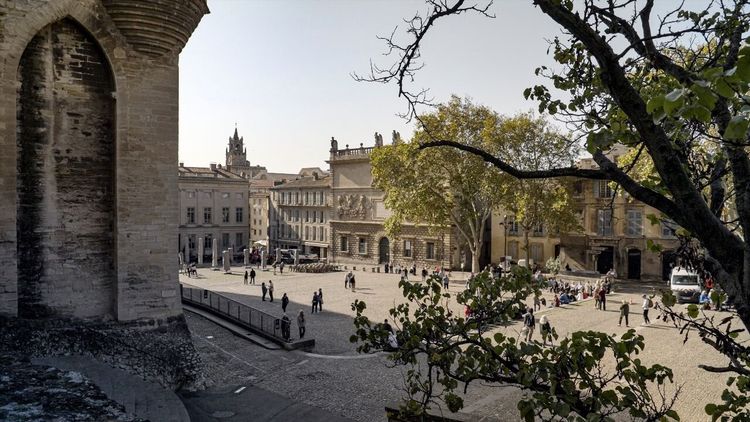
Avignon is compact. The entire historic center can be explored on foot, and the essentials can be visited comfortably in a well-organized day. Here's a sequence that works.
Morning (9am-12:30pm): Start with the bridge as soon as it opens, before the influx of visitors. The morning light on the Rhône and limestone arches is particularly beautiful. Allow 45 minutes to 1 hour for the complete visit with audioguide. Then go up to the gardens of Rocher des Doms to enjoy the panorama from the heights, it's free and the view is striking. Finally descend towards the Palais des Papes, allowing at least 1h30 on site.
Lunch: The Place des Corps Saints and the streets around rue des Teinturiers are much better than the tourist restaurants on Place de l'Horloge. Rue des Teinturiers, with its century-old plane trees and waterwheels in the canal, is one of the most pleasant and authentic corners of the city.
Afternoon (2pm-6pm): Dedicate it to the Cathédrale Notre-Dame des Doms, Musée du Petit Palais or Collection Lambert according to your interests. Finish with a walk along the ramparts on the Rhône side, or cross Pont Daladier to see the Pont Saint-Bénezet from the left bank at the end of the day, the light at this time is the best of the day.
Evening: Avignon comes alive in the evening in the cafés and restaurants around Place de l'Horloge and Place Pie. In July, the Festival d'Avignon transforms the entire city into a stage: streets, courtyards of private mansions, small squares. The festival's 'off' is largely free and often more surprising than the 'in'. Outside the festival, restaurants around the Halles d'Avignon are a safe bet for dinner.
To complete this day with an audio exploration, the Ryo audio guide of Avignon accompanies you through 27 stops across the historic center, from the Rocher des Doms down to the bridge and on to the least known streets of the city of the popes.
FAQ
Can You Cross the Entire Pont d'Avignon?
No. Of the original 22 arches, only 4 are still standing. The bridge stops in the middle of the Rhône, above the void, facing the Île de la Barthelasse. The visit takes you to this suspended end, a sensation that is, in a way, more impressive than if the bridge were complete.
Do People Really Dance on the Pont d'Avignon?
Not really, and not on the bridge. The nursery rhyme originally says 'under the bridge'. The medieval festivities described in the song took place under the arches, on an island or sandbank that has since disappeared. The 'on the bridge' version became established after an adaptation for children in 1853 and never corresponded to historical reality.
How Long Does It Take to Visit the Bridge?
Between 45 minutes and 1 hour for a complete visit with the audioguide included in the ticket. If you're content with a quick round trip, 25-30 minutes is enough. The audioguide is available in French, English, Spanish, German, Italian and other languages, it's really worth using to understand what you're seeing.
Is the Pont d'Avignon Accessible to People with Reduced Mobility?
Partially. The entrance and beginning of the route are wheelchair accessible. The paved and slightly inclined surface can make progression difficult in places. The Saint-Nicolas chapel at the lower level is accessible; the upper level is not. It is advisable to contact the site in advance for precise information according to your situation.
What Is the Best Time to Visit the Bridge?
Early in the morning from opening (9am in season), or late afternoon after 4pm to avoid crowds. In July and August, the site is very busy during midday. May, June and September offer the best compromise between weather and attendance. In winter, the site is almost empty and visiting conditions are excellent.
How to See the Pont d'Avignon for Free?
From the left bank of the Rhône, accessible on foot via Pont Daladier, you have a frontal view of the four arches with the Palais des Papes in the background, this is the postcard angle, and it's completely free. The gardens of Rocher des Doms offer a beautiful bird's-eye view (free access). The free ferry from Île Piot parking allows you to approach it by water.
Is It Better to Book the Ticket in Advance?
In July-August, yes, queues can exceed 30 minutes during midday and online booking is strongly recommended. The rest of the year, you can buy your ticket directly on site without waiting. The combined Bridge + Palais des Papes ticket (€17) is generally the best option if you visit both on the same day.
Conclusion
Four arches, a Romanesque chapel superimposed with a Gothic chapel, and eight centuries of history suspended above the Rhône. The Pont d'Avignon is a monument apart: too singular to disappoint, too steeped in history to be boring, and close enough to the Palais des Papes to naturally fit into a complete day in the city of the popes.
To extend the visit with historical commentary along the streets, Ryo's Avignon audio-guided tour accompanies you through 27 stops across the medieval center, from the bridge to the least frequented corners of the city.
À lire également