© Shutterstock
 Votre guide Ryo
Visiting the European Parliament in Strasbourg: Complete Guide 2026
Most first-time visitors to Strasbourg leave without setting foot in one of Europe's most powerful buildings. Yet entry is free, no reservation is required for individuals, and it is indeed possible to sit in the galleries while a vote takes place in the hemicycle. Visiting the European Parliament in Strasbourg is one of those experiences that surprises, because it's both more accessible and more impressive than you'd imagine. To complete your day in the European capital, the Ryo audio guide tour of Strasbourg covers 32 points of interest in 2h40 through Petite France, Neustadt and the Ill quays.
In a single well-organized day, here's what you can do: explore the 750-seat hemicycle, delve into the history of European construction at the Parlamentarium Simone Veil, try to attend a plenary session if the calendar permits, and tour the European quarter up to the facade of the European Court of Human Rights. This guide gives you the schedules, security rules, tips for getting a gallery seat, and everything the official websites don't clearly explain.
The Louise Weiss Building and Palace of Europe: Two Distinct Addresses
Many visitors arrive disappointed because they've searched for the wrong address or confused two institutions that have nothing to do with each other. The distinction is fundamental.
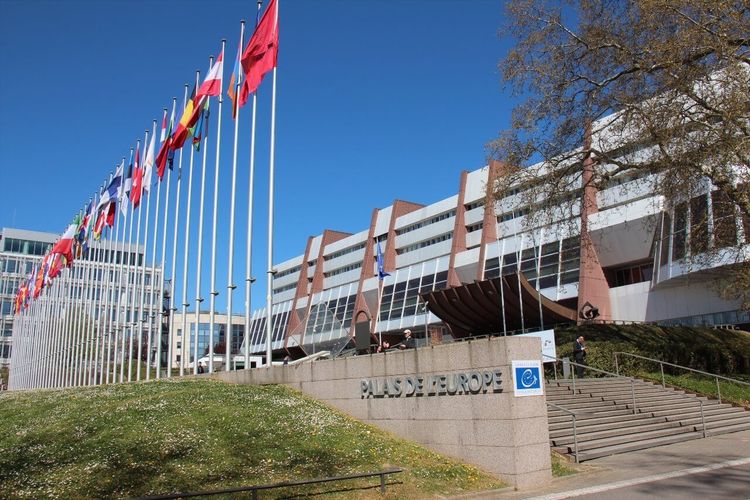
The Palace of Europe, inaugurated in 1977, is the seat of the Council of Europe, an intergovernmental organization distinct from the European Union, founded in 1949 and comprising 46 member countries. Its raw concrete and tinted glass architecture is massive, somewhat intimidating, but with a certain elegance at dusk. It's the Council of Europe that oversees the European Court of Human Rights.
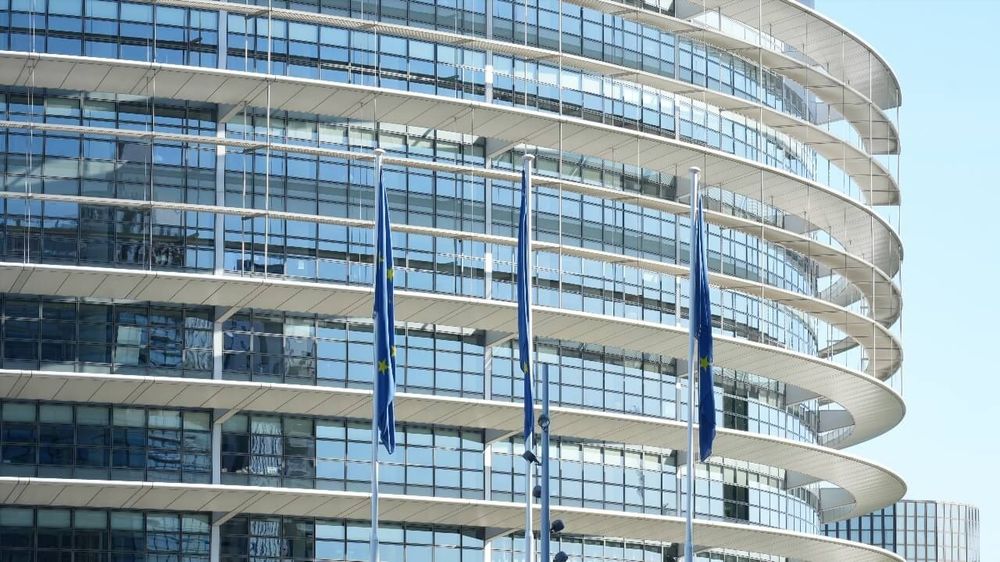
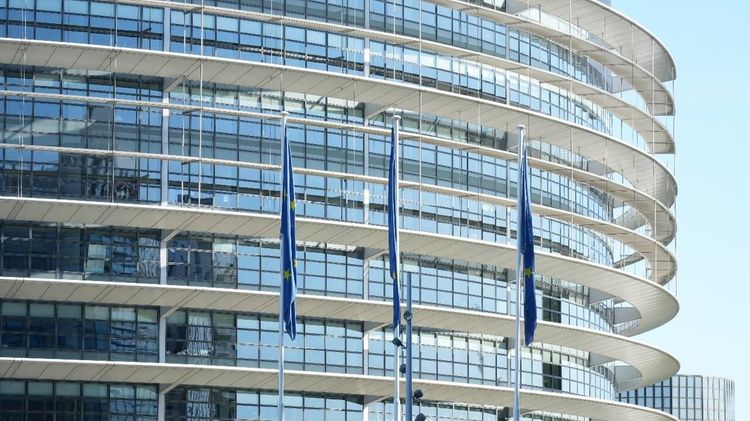
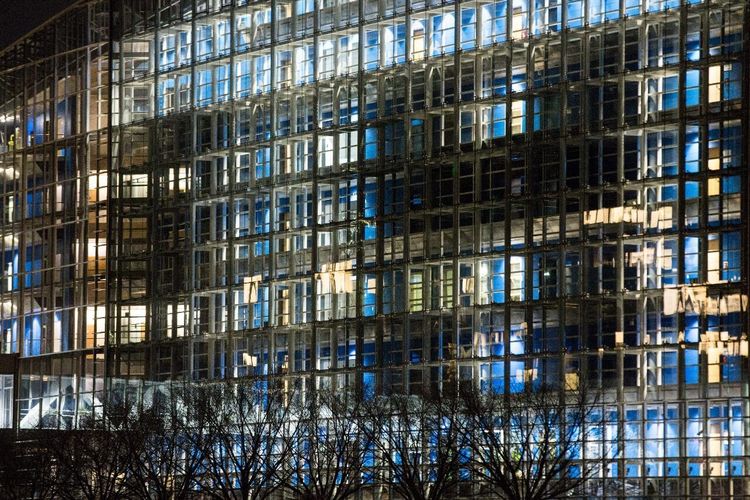
The Louise Weiss building, on the other hand, houses the EU institution of 27 members. Inaugurated in 1999, it owes its name to Louise Weiss, an Alsatian journalist and activist, a figure in the fight for women's suffrage in France and the first senior member by age of the assembly in 1979. Its silhouette is spectacular: a 60-meter semi-cylindrical glass tower surmounts a rotunda whose architecture is inspired, according to its designers, by an unfinished Tower of Babel, a deliberate symbol of a Europe in perpetual construction.
For visits, the address is 1 allée du Printemps, 67070 Strasbourg, esplanade side. This is where you'll find visitor reception, the hemicycle and the Parlamentarium.
The Hemicycle: The Grand Session Hall
This is what virtually all visitors come seeking. The session hall, monumental, horseshoe-shaped, has 750 seats for MEPs, these 750 places corresponding to the maximum number of parliamentarians the assembly can accommodate. Following the June 2024 election, 720 MEPs from the 27 member states sit there.
From the top of the tiers reserved for the public, the panorama is striking: rows of blue seats arranged in an arc, each equipped with a microphone, touch screen and electronic voting system. In the center, the presidential seat, flanked on both sides by the interpreters' glass booths. 24 official languages are interpreted simultaneously during sessions, a world record in a parliamentary institution.
Translation headphones are provided in the galleries. Reception staff present in the hall answer questions and can direct you to explanatory panels on how voting and political groups function.
Outside Plenary Sessions: Everything You Can Do
The assembly only sits in Strasbourg about 12 weeks per year, divided into 4-day sessions (Monday to Thursday) each month, except in August. Outside these periods, that is, most of the year, the building is open to the public according to the following hours:
- Monday to Friday: 9am to 6pm (last entry at 5pm)
- Saturday: 9:30am to 12pm and 1pm to 6pm
- Closed Sundays, public holidays and institutional closure periods
During these non-session periods, here's what's accessible:
Self-guided hemicycle visit: free access to the tiers, permanent exhibition spaces on the ground floor and the main hall. Explanatory panels mark the route in French and in the 24 EU official languages.
Free guided tour: guides, staff often very knowledgeable about current European politics, offer 45-minute tours at times posted at reception. No reservation for individuals, just be there at departure time.
Guided tours for groups: groups of more than 10 people can book via the official form on visiting.europarl.europa.eu. Minimum lead time of a few working days, up to several months in advance during high season. The languages offered are French, English and German.
Temporary exhibitions: the ground floor space regularly hosts photo or documentary exhibitions on European themes. Always free, no ticket, no reservation required.
On site, a café-restaurant is available in the building, convenient if you're combining the hemicycle and Parlamentarium without going outside.
Parliamentary Role-Playing: Deliberating in the Hemicycle
Among the activities offered, the educational role-playing game is the one that leaves the most lasting impression. Participants, school, association or university groups, play the role of MEPs and deliberate on a fictitious legislative proposal in the actual hemicycle, from the real seats, with the real microphones.
The simulation generally lasts two hours. It's led by an assembly staff member who guides exchanges and explains procedural rules. Voting is done on the electronic systems integrated into the desks.
This activity is reserved for organized groups and requires online booking several weeks in advance (often longer lead times for primary school groups, who benefit from versions adapted to their level). It's not available for individual visitors without affiliation to a constituted group.
During Plenary Sessions: Observing Live Debates
If your visit coincides with a plenary session week, the experience changes in nature. The hemicycle is active, MEPs are present, or at least some of them, block voting attracting the strongest presence, and you observe from the galleries debates that have direct bearing on European laws applicable in your countries.
Access to public galleries during sessions is free but subject to availability. Places are limited. Tuesdays and Wednesdays concentrate the busiest sessions, especially during important votes that pack the hall. Monday mornings and Thursday afternoons are calmer and more accessible.
The most interesting debates to follow if you can choose your time slot: Tuesday morning questions to the Council, Wednesday votes around 12pm, and Thursday emergency debates. A session lasts from 9am to 10pm with breaks; you're free to enter and leave as you wish. Translation headphones in 24 languages are available free in the galleries.
Check the plenary session calendar on the official website before planning your departure, it's published several months in advance.
How to Get a Gallery Seat During Sessions
Two routes exist to attend a plenary session.
The first, most direct: present yourself at visitor reception on the morning of a session day and request a place in the public galleries. If seats are available, which is the case most days outside highly publicized votes, access is granted on the spot, without formality.
The second, more reliable for important votes: contact your constituency MEP. French parliamentarians have a quota of seats in the official galleries and most offices respond positively to requests sent several weeks in advance. A simple email to the elected official's office suffices, specifying the desired date and number of people. This route gives access to different seating from the general public galleries, sometimes with a better view of the hemicycle.
For citizens of other EU countries, the procedure is identical with their home region's MEP.
The Parlamentarium Simone Veil
Located in the same complex as the hemicycle, the Parlamentarium Simone Veil is the visitor welcome and exhibition center. Opened in July 2017 in tribute to Simone Veil, assembly president from 1979 to 1982 and the first person elected to this position after the introduction of direct universal suffrage, it traces the history of European construction from the 1951 ECSC to contemporary challenges.
The scenography is well-crafted: immersive projections in a 360° cinema room, original audiovisual archives, touch tables and interactive installations. You can notably listen to excerpts from historical speeches, including Simone Veil's address when she became president in July 1979. An entire room is devoted to major legislative decisions: GDPR, the air quality directive, the Erasmus program, concrete examples that make the institution tangible.
For families, a youth pathway for 8-14 year olds offers interactive quizzes and games on how the EU works. Allow 45 minutes for this pathway. Children from 10-12 years old generally also appreciate the hemicycle visit, especially if reception staff can explain the voting system to them.
Access is entirely free, without reservation for individual visitors. Allow between 45 minutes and 1h30 depending on your pace. The exhibition is available in French and in the 24 EU official languages, via included audio guides at no extra charge.
Booking Your Visit: How To
For individual visitors, the procedure is simple: you present yourself directly at the Louise Weiss building reception during opening hours, pass security control, and freely access all public spaces, hemicycle, exhibitions, Parlamentarium. No reservation, no ticket, no prior registration required.
For groups of more than 10 people, booking is mandatory and done via the online form available at visiting.europarl.europa.eu. Allow a few working days lead time for a standard guided tour, and several weeks for the educational role-playing game. During high season (May to September), better to anticipate up to several months in advance for school groups.
If you wish to attend a plenary session with a personal invitation from your MEP, plan to contact the parliamentary office at least 3 weeks before the target date.
A practical tip: arrive on weekdays before 2pm. You'll have the choice between self-guided and guided tours, and enough time to combine the hemicycle and Parlamentarium. Saturday morning is possible but guided tours are not available then. Afterwards, Ryo's audio-guided walk From Petite France to Greater Europe threads 33 stops across 6.6 km through the old town.
Security and Entry Controls
Security control at the Louise Weiss building entrance is similar to an airport: detection gate, bag scanner, identity verification. Present your passport or national ID card, it's systematically requested from all visitors, regardless of nationality.
Note: cameras with large detachable lenses may pose problems. Liquids over 100ml and sharp objects are refused. Allow a few extra minutes in case of crowds, especially on session days when visitor and accredited person flow is higher than usual.
The building is fully accessible to people with reduced mobility. Magnetic loops for the hearing impaired are available at reception upon request.
The European Quarter: Council of Europe, ECHR and Neighboring Institutions
The Louise Weiss building is not alone in this corner of Strasbourg. Along quai Mekarski and allée Spach, several major European institutions form an architecturally remarkable ensemble, entirely accessible on foot from the visitor entrance.
The Palace of Europe directly adjoins the building, on the north side. Its 1970s functionalist architecture, designed by Henry Bernard, contrasts sharply with the neighboring rotunda's glass. Guided tours of the Council of Europe are possible with advance booking, completely separate from the others. Be careful not to confuse these three entities: the Council of Europe (46 members, founded in 1949, whose main competence is human rights protection) is neither the Council of the EU (27 members, brings together member state ministers), nor the European Council (brings together EU heads of state and government). Three very similar names, three totally distinct bodies.
The European Court of Human Rights (allée des Droits de l'Homme, 67000 Strasbourg, rated 3.5/5 on Google for 520 reviews) is immediately recognizable by its Richard Rogers architecture, inaugurated in 1995: large cylindrical glass and steel volumes whose lines follow the course of the Ill. Interior visits are reserved for legal professionals and academic groups on special request, but the riverside facade is well worth a detour. Allow 10 minutes walk from the visitor entrance.
For those wishing to extend the walk, the Ryo audio guide tour of Strasbourg, available on app, lets you explore the rest of the city at your own pace after the European quarter, with commentary on architecture, Alsatian history and hidden Neustadt anecdotes.
The Alsace-Moselle Memorial: Why Strasbourg
If you have an extra half-day and want to understand in depth why Strasbourg was chosen as the seat, the Alsace-Moselle Memorial (allée du Souvenir Français, 67130 Schirmeck, rated 4.6/5 on Google for 2,015 reviews) in Schirmeck is worth the trip. Allow 40 minutes drive from downtown.
This museum traces the history of the three departments annexed by Germany in 1871, then returned to France in 1918, annexed again between 1940 and 1944. The staging is sober and effective. Upon leaving, the choice of Strasbourg, symbolic city of Franco-German reconciliation, as Europe's parliamentary capital takes on a whole different resonance.
Paid admission (around 8 euros adult). Closed Tuesdays.
How to Get There
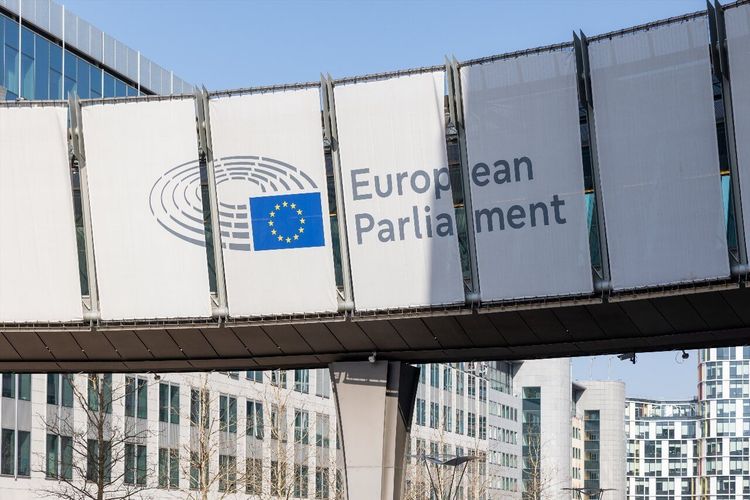
The European quarter is located east of the historic center, about 3 km from Notre-Dame cathedral.
By tram: line E (direction Robertsau Boecklin) serves the European Parliament stop, 2 minutes walk from the visitor entrance. From Strasbourg central station, allow 15 minutes. This is the simplest and fastest option, especially during session days when traffic around the quarter is heavy.
By bike: Strasbourg is one of the French cities best equipped with cycling infrastructure. From Petite France or the historic center, allow 15 to 20 minutes. Velhop stations (bike sharing) are located right near the entrance.
By car: paid parking is available in the quarter, but parking becomes difficult on plenary session days. If you have the choice, prefer the tram.
On foot from Neustadt: the walk from the Wilhelminian quarter takes 20 to 25 minutes along canals and grand avenues. It's a beautiful way to arrive, especially if you've already explored the center.
Extending Your Day in Strasbourg
From the European quarter, the tram takes you back in 15 minutes to Notre-Dame Cathedral of Strasbourg (place de la Cathédrale, 67000 Strasbourg, rated 4.8/5 on Google for 76,487 reviews), whose pink sandstone facade is one of Europe's most finely sculpted. The climb to the panoramic platform (330 steps) offers a panorama over Alsatian rooftops and, on clear days, the Vosges ridges and Black Forest in the distance.
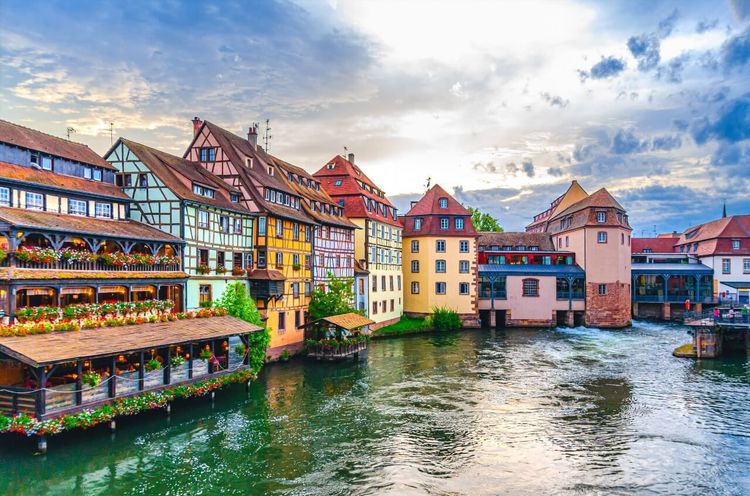
Ten minutes walk from the cathedral, the Petite France quarter groups together the 16th and 17th century half-timbered houses that made Strasbourg famous. The canals, covered bridges and Couverture gardens are among the most photographed images in Alsace. Even in high season, the secondary streets remain pleasant early morning or evening.
For lunch or dinner in the center, winstubs, typical Alsatian taverns, are the best option: sauerkraut, baeckeoffe and flammekueche in an unpretentious atmosphere. The best addresses are concentrated around place du Marché-aux-Cochons-de-Lait and in the streets adjacent to the cathedral.
Practical Info Summary
Address: 1 allée du Printemps, 67070 Strasbourg (visitor entrance, esplanade side).
Hours outside sessions: Monday-Friday 9am-6pm (last entry 5pm), Saturday 9:30am-12pm and 1pm-6pm. Closed Sundays and public holidays.
During plenary sessions: access to public galleries subject to availability, no reservation for individuals.
Entrance: entirely free, hemicycle, exhibitions and Parlamentarium included.
Recommended duration: minimum 1h30 (hemicycle + Parlamentarium); 3h if you include a guided tour and walking tour of the European quarter.
Accessibility: building fully accessible to reduced mobility, magnetic loops available at reception.

FAQ
Do You Need to Book to Visit the European Parliament in Strasbourg?
Not for individual visitors. You present yourself directly at the Louise Weiss building reception (1 allée du Printemps, 67070 Strasbourg) during opening hours, pass security control, and freely access the hemicycle, exhibitions and Parlamentarium. Booking is mandatory only for groups of more than 10 people, group guided tours, and educational role-playing activities.
Can You Attend a Plenary Session?
Yes, for free. Two ways: present yourself at reception on the morning of a session day and request a place in the public galleries (subject to availability), or contact your constituency MEP for a personal invitation with guaranteed seat. Sessions take place approximately 12 weeks per year, Monday to Thursday each month (except August).
What Is the Parlamentarium Simone Veil?
It's the visitor welcome and exhibition center, opened in July 2017 in tribute to the assembly president from 1979 to 1982. It offers a free permanent exhibition on the history of European construction, from 1951 to today, with immersive installations and a specific pathway for 8-14 year olds. Free access, no ticket required, during building opening hours.
What's the Difference Between the European Parliament and Palace of Europe?
They are two distinct institutions in two separate buildings. The Palace of Europe is the seat of the Council of Europe (46 member countries, founded in 1949), which notably oversees the European Court of Human Rights. The Louise Weiss building houses the EU assembly of 27 countries. For tourist visits open to the general public without formalities, go to the Louise Weiss building.
How Much Time Should You Allow for the Visit?
Minimum 1h30 for the hemicycle and Parlamentarium at your own pace. Allow 3 hours if you want to participate in a guided tour and explore the European quarter on foot. For a full day, European quarter in the morning, historic center in the afternoon, 6 to 7 hours is quite sufficient.
Strasbourg, Open Parliamentary Capital
There's something quite striking about the fact that one of the world's most influential assemblies is so accessible, so little known to the general public and so undervisited compared to what it deserves. Thousands of people pass through Strasbourg each year without knowing they could enter the 750-seat hemicycle, listen to a live debate in 24 languages, and leave without having spent a penny.
Whether you're curious about European politics, passionate about contemporary architecture or simply there to discover a facet of the city that classic guides ignore, this visit remains one of the most memorable experiences Strasbourg offers. Before or after, let the Ryo audio guide of Strasbourg take you through Petite France, Neustadt and the Ill quays, 32 stops to see the city differently.
À lire également