© Shutterstock
 Votre guide Ryo
20 of the Most Beautiful Villages in Alsace to Discover in 2026
The most beautiful villages in Alsace don't reveal their splendor in standard guides. To truly grasp what the search for "beautiful Alsace villages" really means, you have to venture into a narrow lane in Riquewihr where not a single building has changed since the 16th century, slip between the near-intact ramparts of Bergheim, or stroll through Hunspach — a village of 650 inhabitants so perfectly preserved that not a single overhead electric cable disturbs the view. To discover them from the capital of the wine route, the Ryo audio-guided tour of Colmar immerses you in its canals and half-timbered houses across 21 audio stops over 4.7 km.
This selection of the most beautiful villages in Alsace covers 20 villages from the north to the south of the region: a UNESCO-listed fortress whose plan forms a perfect octagonal star, a medieval town where a night watchman still makes his rounds every summer evening, a hamlet of 300 souls perched on a basalt hillock overlooking the Black Forest, and the birthplace of Albert Schweitzer with the only fortified bridge in all of Alsace.
1. Eguisheim, the Village That Goes Round in Circles
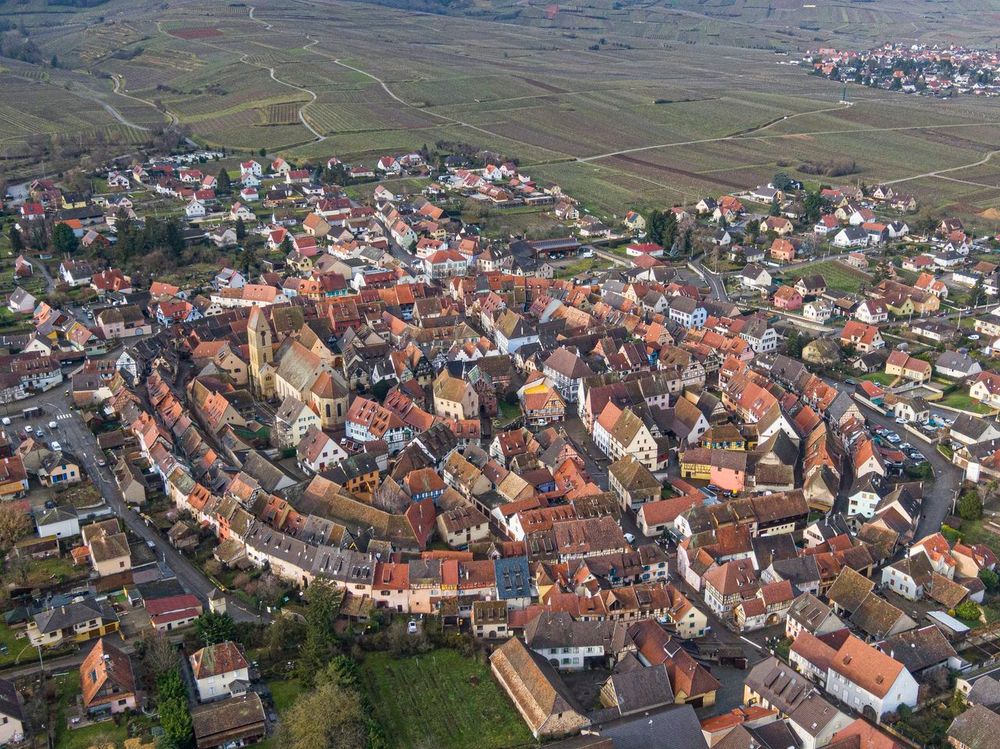
Eguisheim (68420 Eguisheim, rated 4.7/5 on Google from 12,000 reviews) is often cited as the most beautiful village in Alsace — a claim that is hard to dispute when you walk into its concentric lanes winding around the 8th-century comital castle. The village holds the "Most Beautiful Villages of France" label and was voted "France's Favourite Village" in 2013.
Colorful half-timbered houses line up in successive semicircles, forming perfect arcs around the former residence of the counts of Eguisheim. No cars in the center: only cobbled courtyards, geraniums on the windowsills, and, in summer, storks nesting on the rooftops. From the vineyards that border the village, three ruined castle silhouettes stand out on the ridge: the castles of Weckmund, Wahlenbourg, and Dagsbourg.
On the wine side, Eguisheim produces two recognized grands crus: the Eichberg and the Pfersigberg, two granite terroirs yielding Gewurztraminers of remarkable aromatic persistence. The Wolfberger cooperative winery, founded in 1902, offers tastings without reservation on weekdays.
Practical tip: avoid Saturdays in July and August. Tourist coaches block the village entrances from 10am. A weekday visit early in the morning will give you the lanes all to yourself.
2. Riquewihr, the Most Intact Medieval Town in the Region
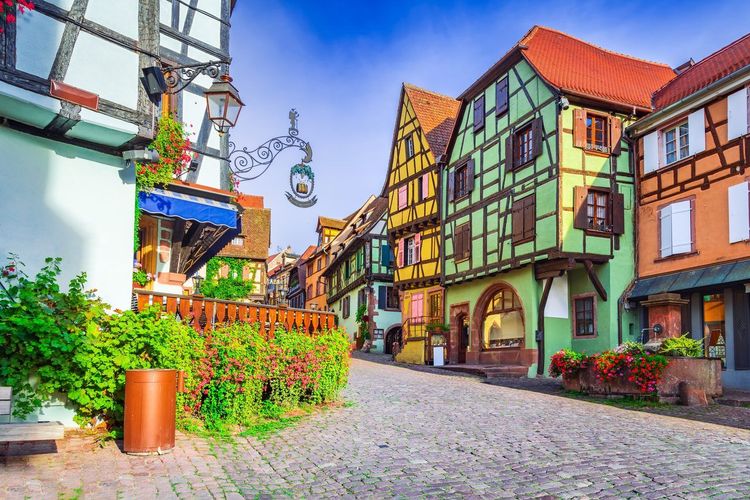
Riquewihr (68340 Riquewihr, rated 4.6/5 on Google from 15,000 reviews) has intact 15th-century ramparts, a Dolder Tower dating from the 13th century, and not a single 20th-century building to spoil the view. What sets the village apart from its neighbors is the density of architectural details per meter of street: period wrought-iron signs, carved wooden oriel windows, 16th-century wellheads, and inner courtyards accessible through vaulted passageways.
The main street concentrates 700 years of Alsatian architecture in less than 400 meters. The vineyard immediately surrounding the ramparts produces one of the region's most celebrated Rieslings: the Schoenenbourg, a granite grand cru cultivated on gentle slopes since the Middle Ages. The Hugel et Fils and Dopff au Moulin estates offer tastings in vaulted cellars directly accessible from the main street.
To visit without the crowds, two strategies work: arrive before 9am (groups don't show up until after 10:30am), or come in November, after the Christmas markets have ended. The town has around 1,200 permanent residents who maintain an authentic village life despite 700,000 annual visitors.
Parking is paid and limited to peripheral car parks: no cars circulate within the walls. Allow at least 2 hours for a thorough visit including the Dolder Tower, a wine cellar, and the hidden inner courtyards behind the facades. Riquewihr is 13 km from Colmar and 75 km from Strasbourg. On the Wine Route, combine it with Hunawihr (2 km away) and Ribeauvillé (5 km away) for a themed half-day focused on the vineyards.
3. Kaysersberg, the Fortified Bridge and Albert Schweitzer's Birthplace
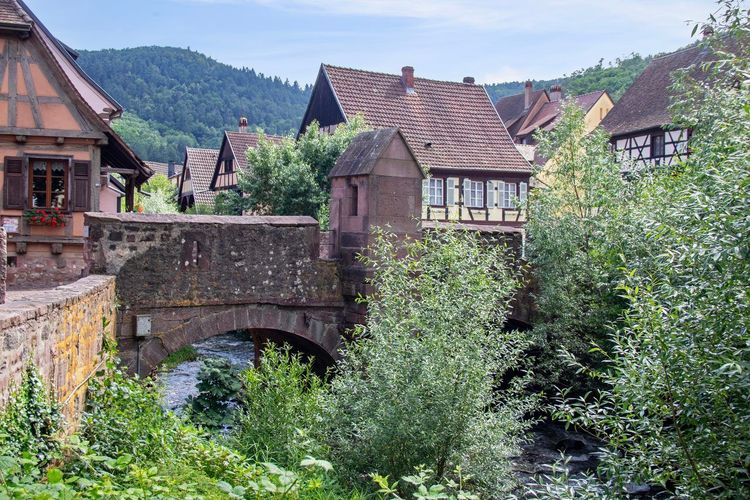
Kaysersberg (68240 Kaysersberg-Vignoble, rated 4.7/5 on Google from 9,000 reviews) takes its name from the Latin "Mons Caesaris" — Caesar's mountain — a hill occupied by the Romans before medieval lords built a castle there in the 13th century. The village is also the birthplace of Albert Schweitzer, winner of the 1952 Nobel Peace Prize, whose family home is open to visitors.
A Renaissance fountain from the 16th century stands on the Grand'Rue, surrounded by jettied houses and artisan shops. The fortified bridge over the Weiss is the only one of its kind in Alsace: a medieval walkway with an oratory built into its deck, an architectural feature unique to the region. From the ruined castle, the view over the village rooftops and the Schlossberg grand cru vineyards is among the most photographed on the Wine Route. The climb takes 15 minutes from the central square and requires no special equipment.
4. Ribeauvillé, Three Hilltop Castles in a Single Glance
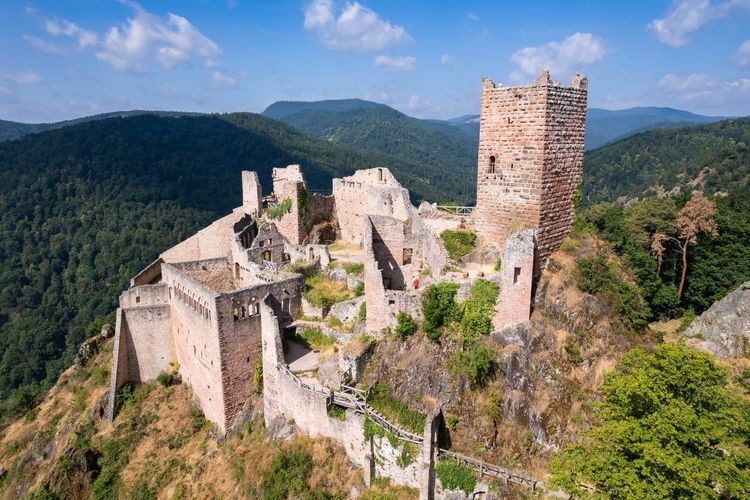
Ribeauvillé (68150 Ribeauvillé, rated 4.5/5 on Google from 8,000 reviews) has something its neighbors do not: three fortified castles simultaneously visible from the Grand'Rue. The Girsberg, the Saint-Ulrich, and the Ribeaupierre stand out on the Vosges ridge at different altitudes, offering a medieval panorama in three successive layers.
The town is livelier than other villages on the Wine Route, with a genuine everyday life: local shops, bakeries, a weekly market that caters as much to residents as to tourists. The pedestrianized Grand'Rue concentrates medieval houses and tasting cellars. In September, the Fête des Ménétriers (Pfifferdaj) recreates a 14th-century tradition: wandering jugglers and musicians would come to claim the lord's hospitality in exchange for music and acrobatics.
To reach the castles, allow 45 minutes of walking from the town center, with an elevation gain of 250 meters. The view from the ruins of Saint-Ulrich, the largest of the three, is one of the widest in the Alsatian Vosges.
5. Obernai, the Six-Bucket Well and the 14th-Century Ramparts
Obernai (67210 Obernai, rated 4.5/5 on Google from 10,000 reviews) is the first major stop on the Wine Route heading south from Strasbourg, just 30 km away. The 14th-century ramparts still encircle a town center where every square tells a different story.
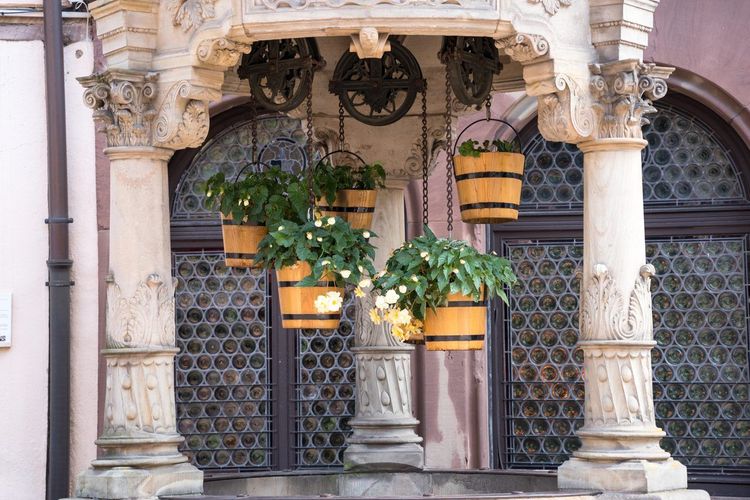
The Place du Marché is the beating heart of Obernai. The 16th-century Six-Bucket Well, unique in Alsace, stands at its center: a well sheltered by a wooden roof with six buckets, a symbol of the town's agricultural wealth. The Tour de la Chapelle, a 13th-century belfry converted into a bell tower, dominates the square at 60 meters tall. The Renaissance Corn Exchange and the Town Hall complete an architectural ensemble of rare coherence for a town of this size.
Beyond the monuments, Obernai is known for its breweries: Kronenbourg established its large production site here in 1969, one of the most important in France. Its Kirschthal vineyard stretches directly to the west of the center. For a full day, combine the visit with Mont Sainte-Odile (12 km), accessible on foot via the Mur Païen trail.
If you are coming from Strasbourg and would like to complement your trip with an exploration of the Alsatian capital, the Ryo audio guide of Strasbourg covers 32 points of interest over 6.6 km in 2h40.
6. Hunspach, the Village With No Signs and No Overhead Cables
Hunspach (67250 Hunspach, rated 4.7/5 on Google from 2,000 reviews) holds two rare distinctions: the "Most Beautiful Villages of France" label and the title of "France's Favourite Village", which it won in 2020. Its location in the Outre-Forêt, in the far north of the Bas-Rhin, sets it apart from the entire Wine Route.
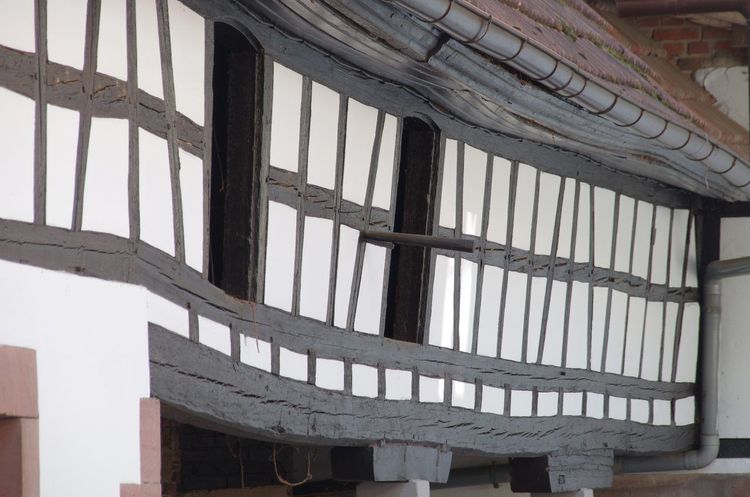
The white half-timbered houses with their characteristic bow windows are so well maintained that not a single overhead electric cable disturbs the view. No commercial signs, no advertising hoardings: Hunspach has opted for total architectural consistency. The village is home to around 650 inhabitants and can be walked in its entirety in under 30 minutes.
The visit pairs naturally with Seebach, 2 km away, which features the same Outre-Forêt architectural style in a slightly livelier atmosphere. From Strasbourg, Hunspach is 55 km via the D263. No direct public transport serves the village: a car is essential.
7. Hunawihr, the Fortified Church and the Storks
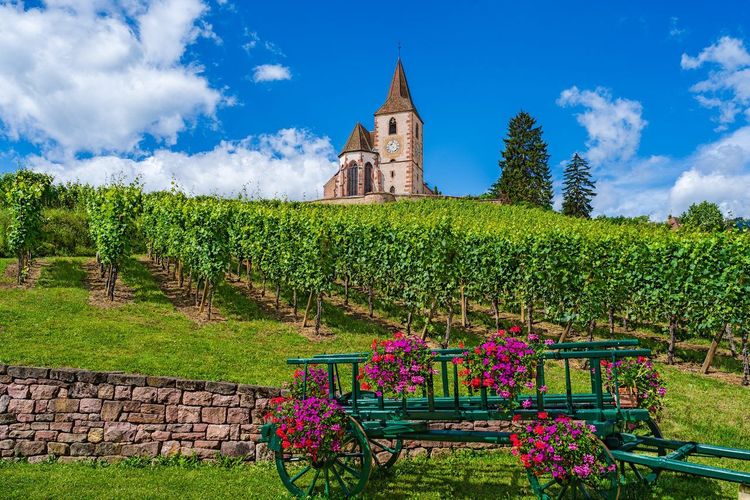
Hunawihr (68150 Hunawihr, rated 4.5/5 on Google from 3,000 reviews) is one of the smallest villages on the Wine Route, with barely 500 inhabitants, but its 15th-century fortified church alone is worth a stop. The cemetery surrounding the building is still used as a shared burial ground by three communes — an unbroken tradition since the Middle Ages.
The village is also home to the Centre de réintroduction des cigognes et des loutres (Stork and Otter Reintroduction Centre), which has helped repopulate Alsace with storks since the 1970s. In April and May, stork chicks can be observed directly in nests at eye level — an experience few sites in France can offer.
8. Bergheim, the Ramparts and the Witches' Tower
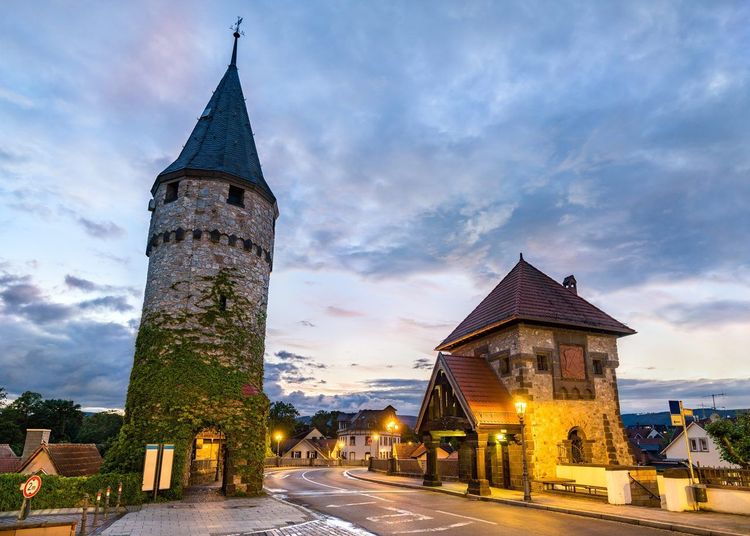
Bergheim (68750 Bergheim, rated 4.6/5 on Google from 3,000 reviews) is less visited than Riquewihr or Eguisheim, but its medieval ramparts rank among the best preserved in Alsace. The 14th-century wall almost completely encircles the village, with its original round towers and entrance gates still in place.
The Tour des Sorcières (Witches' Tower), at the northern corner of the ramparts, owes its name to the witchcraft trials held there between 1582 and 1683: Bergheim was one of the villages most severely affected by these persecutions in Alsace, with 40 people executed. A permanent exhibition inside the tower retraces this period.
The Tilleul de Sully, planted in front of the church in 1610 according to local tradition, is classified as a remarkable tree of France. Its twisted trunks form a natural canopy several meters in diameter. The central square, framed by the ramparts and the Gothic church, is one of the most peaceful on the entire Wine Route. Awarded the "Most Beautiful Villages of France" label, Bergheim was also voted "France's Favourite Village" in 2022.
9. Mittelbergheim, the Only Sylvaner Grand Cru in Alsace
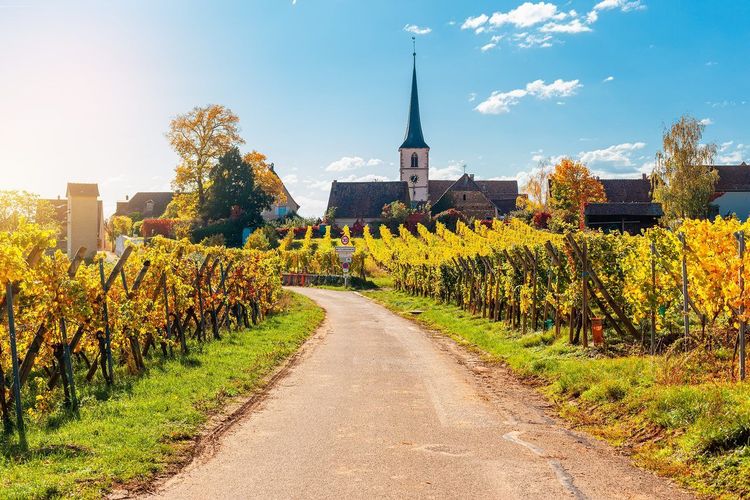
Mittelbergheim (67140 Mittelbergheim, rated 4.6/5 on Google from 800 reviews) has held the "Most Beautiful Villages of France" label since 1986. The village stands out for its intact Renaissance architecture: 16th-century houses that have undergone no major structural modifications. The small Place de la Mairie, with its well and sculpted facades, gives a sense of what Alsatian market towns must have looked like before the industrialization of the 19th century.
The Zotzenberg vineyard surrounding the village is the only Alsatian grand cru to produce Sylvaner, a grape variety that does not normally qualify for grand cru status in Alsace, but is recognized here for the particular minerality of its clay-limestone soil.
10. Neuf-Brisach, Vauban's Star Listed by UNESCO
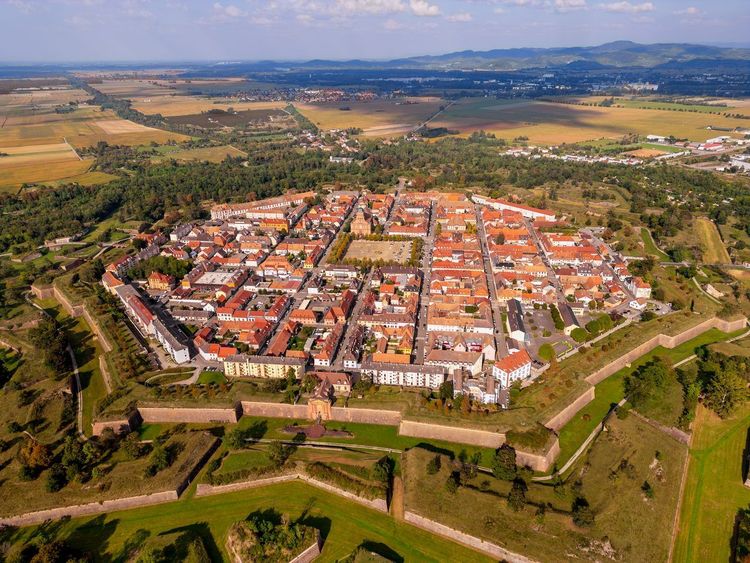
Neuf-Brisach (68600 Neuf-Brisach, rated 4.5/5 on Google from 5,000 reviews) is unique in France and Europe: a fortified town designed by Vauban in 1698, inscribed on the UNESCO World Heritage List since 2008. Its plan is a perfect octagonal star, visible from the air, surrounded by water-filled moats and geometrically interlocking bastions of mathematical precision.
The town is a lesson in military urbanism: the streets intersect at right angles, the central Place d'Armes is perfectly square, and every building originally adhered to a maximum height so as not to offer a target to besiegers. A 4 km path allows you to walk the full circuit of the ramparts in about one hour.
The Vauban Museum, housed in the Porte de Belfort, explains fortification techniques using scale models and period plans. Admission is free on the first Sunday of each month. Neuf-Brisach is 18 km from Colmar, which our audio-guided tour explores on foot: an ideal combination for a full day between the two sites.
11. Turckheim, the Night Watchman Still on Duty
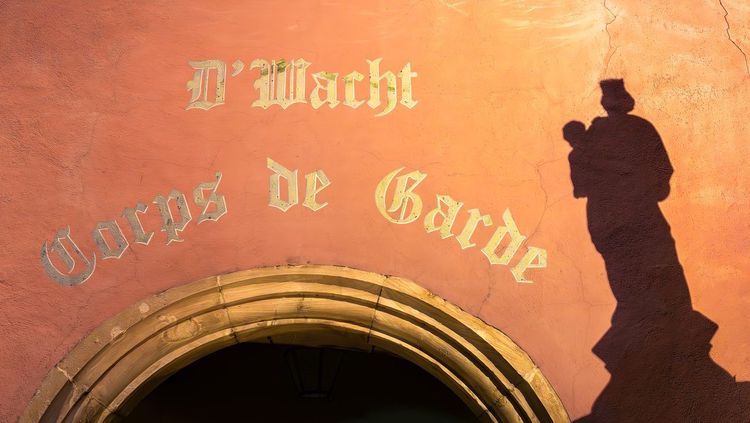
Turckheim (68230 Turckheim, rated 4.4/5 on Google from 4,000 reviews) maintains a tradition unique in Alsace: its night watchman, dressed in medieval costume, makes his singing rounds through the lanes of the old town every evening from May to October, at exactly 10pm. The ceremony lasts 45 minutes and brings together residents and visitors in a blend of authenticity and cherished tradition.
Architecturally, three medieval gateways are still standing, and the Brand vineyard (one of the region's most celebrated grands crus for its Rieslings and Pinot Gris) stretches directly above the village on south-facing granite slopes. In Strasbourg, our audio walking tour brings the same eye for detail across 33 stops.
12. Wissembourg, Discovering the North of Alsace
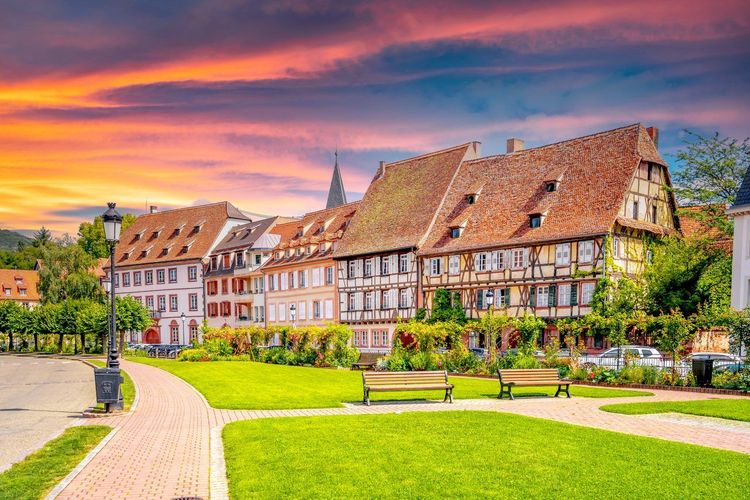
Wissembourg (67160 Wissembourg, rated 4.4/5 on Google from 6,000 reviews) is often overlooked by standard tourist circuits: it lies in the far north of the Bas-Rhin, 60 km from Strasbourg and just a few hundred meters from the German border. That is precisely what makes it one of the most authentic discoveries in the region.
The Maison de Wissembourg, dating from the 15th century, is considered one of the oldest half-timbered houses in all of Alsace. It stands on the banks of the Lauter, a river that runs through the town center and once served as a communal boundary between neighboring villages.
The Saints-Pierre-et-Paul abbey church is one of the largest Gothic churches in Alsace after Strasbourg cathedral — an imposing piece of architecture for a town of 8,000 inhabitants. The 14th-century nave houses a mural fresco of Saint Christopher, the largest medieval fresco preserved in situ in the region.
Wissembourg is also known for its Christmas market, less famous than those of Strasbourg or Colmar but more intimate: residents from nearby German border villages visit it regularly, giving it a distinctly Franco-German atmosphere.
13. Dambach-la-Ville, the Ramparts and the Frankstein
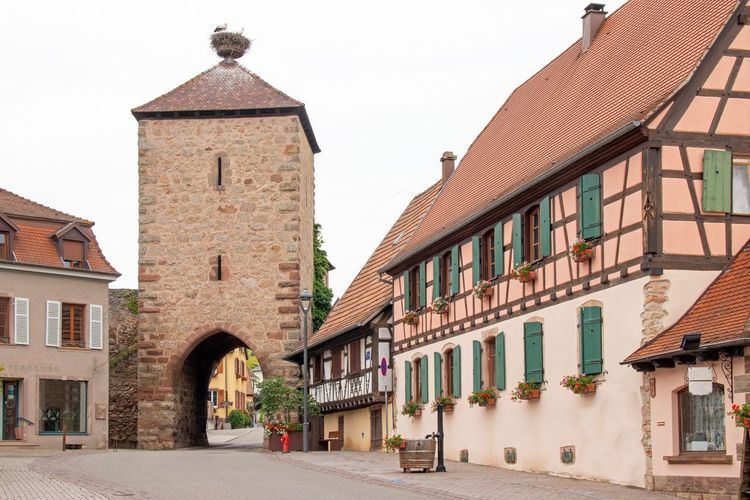
Dambach-la-Ville (67650 Dambach-la-Ville, rated 4.6/5 on Google from 2,000 reviews) earns its place among the beautiful Alsatian villages for two distinct reasons: its medieval ramparts with three preserved towers, and its Frankstein vineyard, a granite grand cru renowned for its Rieslings with a lively acidity and long aging potential.
The 14th-century wall with its three corner towers is in exceptional condition for a wine-growing village. The half-timbered houses on the Grand'Rue feature unusual sculpted details, notably vine motifs worked into the exposed timber beams of the facades.
The Chapelle Saint-Sébastien, 2 km from the center among the vines, is worth a walk. Built in the 15th century on a promontory, it offers an unobstructed view over the Rhine plain and the Vosges. From the village, allow 30 minutes on foot each way.
14. Andlau, the Bear Abbey Founded by an Empress
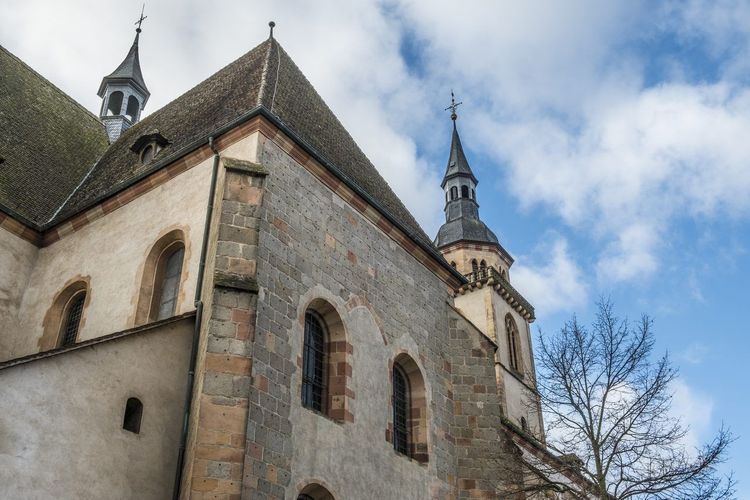
Andlau (67140 Andlau, rated 4.5/5 on Google from 1,500 reviews) is known above all for its Benedictine abbey, founded in the 9th century by the wife of Emperor Charles the Fat. The Romanesque portal of the abbey church, carved in the 11th century, is one of the masterpieces of Alsatian Romanesque art: a continuous frieze of 30 meters depicting animals, biblical figures, and scenes from medieval daily life.
According to the founding legend, the empress Richarde was searching for the site of her monastery. An angel told her to build where a bear would come to stop. The animal halted at Andlau, which explains the presence of bears in bas-relief throughout the abbey's architecture and the bear fountain that stands on the village square.
The two grands crus Kastelberg and Wiebelsberg, with their granite and argillaceous shale soils, produce distinctive terroir wines that local winemakers frequently pour directly at the vineyard, by appointment.
15. Rosheim, the Oldest Civil Tower in Alsace
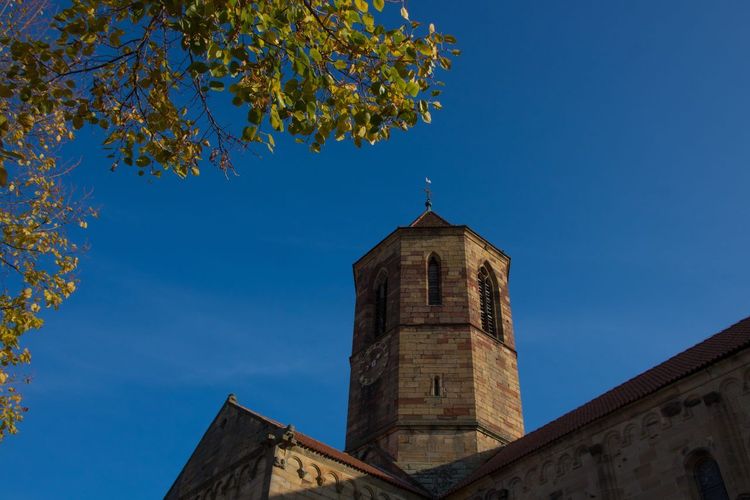
Rosheim (67560 Rosheim, rated 4.5/5 on Google from 2,000 reviews) holds the double distinction of being home to both the oldest medieval dwelling in Alsace and the oldest civil tower in the region. The Romanesque house (12th century, built around 1154) is a pink sandstone building preserved almost intact for more than 850 years. The Heidentürmle tower dates back to the early Middle Ages. The Romanesque church of Saints-Pierre-et-Paul (12th century), with its carved monsters and angels on the capitals, is a third rarity in a village of 5,000 inhabitants. For lovers of pre-Gothic medieval architecture, Rosheim remains one of the most overlooked stops, best explored alongside our Ryo guide to villages around Strasbourg.
16. Barr, the Baroque Town and the Great Harvest Festival
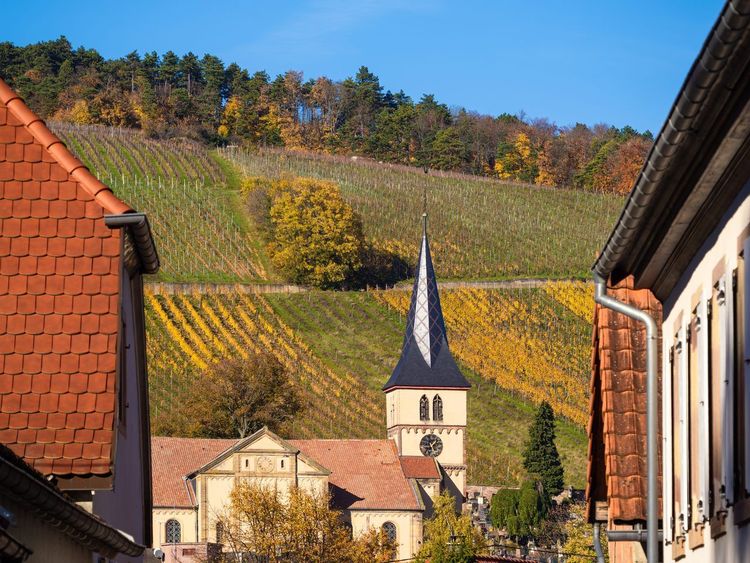
Barr belongs more to the category of historic wine towns than picture-postcard villages. Its old town concentrates 16th- and 17th-century houses along a lively central street, with food shops and a weekly market that serves locals as much as tourists.
The Folie Marco, an 18th-century baroque mansion built by a wealthy tanner, houses the municipal museum with its collections of Strasbourg faïence and period Alsatian furniture. The spiral staircase and the listed interior woodwork are alone worth the visit.
The Kirchberg de Barr, a grand cru on clay-limestone soils, produces Rieslings, Gewurztraminers, and Pinot Gris noted for their complexity. In October, the Barr Harvest Festival is one of the largest in Alsace: a cavalcade, flower-decked floats, and public tastings draw thousands of visitors each year.
17. Kientzheim, Birthplace of Alsace's First Classified Grand Cru
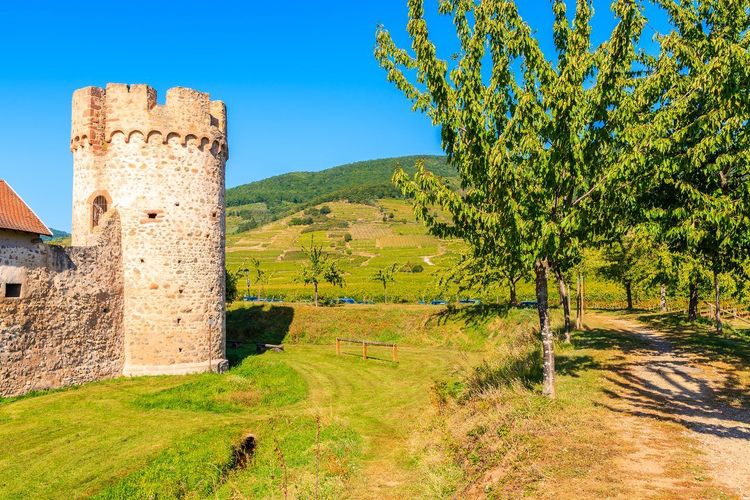
Kientzheim (68240 Kientzheim, rated 4.5/5 on Google from 1,000 reviews) is a village of around 800 inhabitants, but its heritage far exceeds its size. The medieval wall is nearly intact, with its main gate and corner towers. The Château de Kientzheim (Koïfhus) now houses the Alsace Vineyard and Wine Museum, dedicated to the region's wine history, as well as the headquarters of the Confrérie Saint-Étienne, one of the oldest wine brotherhoods in France.
Kientzheim is 5 km from Colmar and 2 km from Kaysersberg, making it a natural stop between the two. The Schlossberg vineyard overlooking the village was the first grand cru to be classified in Alsace, in 1975: its Rieslings are celebrated for their tension and exceptional aging potential.
18. Zellenberg, the Balcony over the Rhine Plain
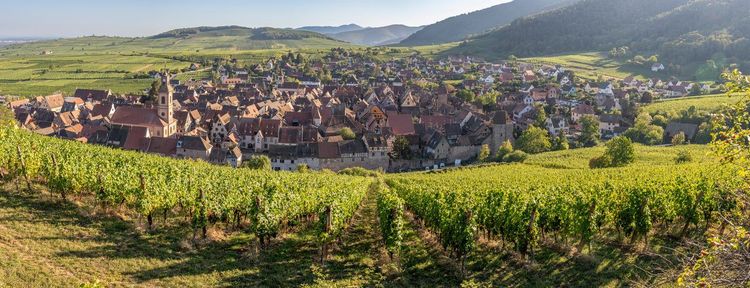
Zellenberg (68340 Zellenberg, rated 4.5/5 on Google from 600 reviews) sits on a basalt hillock at 300 meters altitude that dominates the Rhine plain. This spur position offers a 360-degree view over the vineyards, the Vosges, and, on a clear day, the Black Forest on the far side of the river. The village has around 300 inhabitants and no tourist trade whatsoever: a handful of wine estates sell directly on the property. Its compact medieval layout, with its sloping lanes, is recognizable from the valley below.
19. Ferrette, the Village of the Counts Linked to the Habsburgs
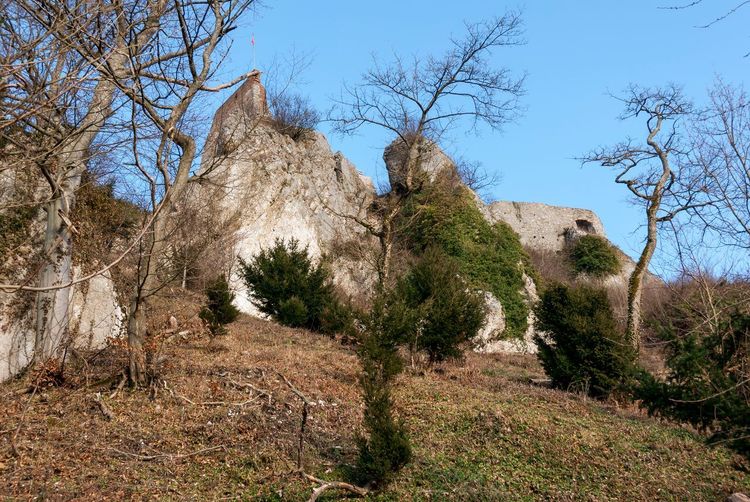
Ferrette (68480 Ferrette, rated 4.5/5 on Google from 2,000 reviews) is Alsace's least expected discovery. This town of 1,000 inhabitants in the Alsatian Jura (the southern part of the Haut-Rhin, away from the Wine Route) possesses one of the most historically significant ruined castles in Alsace. The counts of Ferrette, who ruled this territory from the 11th to the 14th century, are closely linked to the rise of the Habsburgs: it was through the marriage of Jeanne de Ferrette to Albert II of Austria in 1324 that their county passed to the House of Habsburg, which retained it for more than three centuries.
The ruins of the double castle (two separate keeps on the ridge) rise 300 meters above the village and are reached by a marked path of 20 minutes from the main square. The view over the first foothills of the Jura and the Alsatian plain is one of the widest in the south of the region.
The village itself deserves time. The houses built in white Jura limestone, quite different from the half-timbered style of the Wine Route, give Ferrette a singular character. The 18th-century Église Sainte-Catherine and the fountain on the central square complete an architecture that is understated and exceptionally well preserved.
In the surrounding area, the Wolschwiller waterfalls (8 km away) offer accessible hikes in a little-visited Jurassic setting. The waterfall trail from Ferrette takes 1h30 round trip with 200 meters of elevation gain. Located 15 km from the Swiss border (Basel) and 25 km from the German border, Ferrette also lends itself to a cross-border stay.
20. Munster, the Gateway to the Vosges and the PDO Cheese
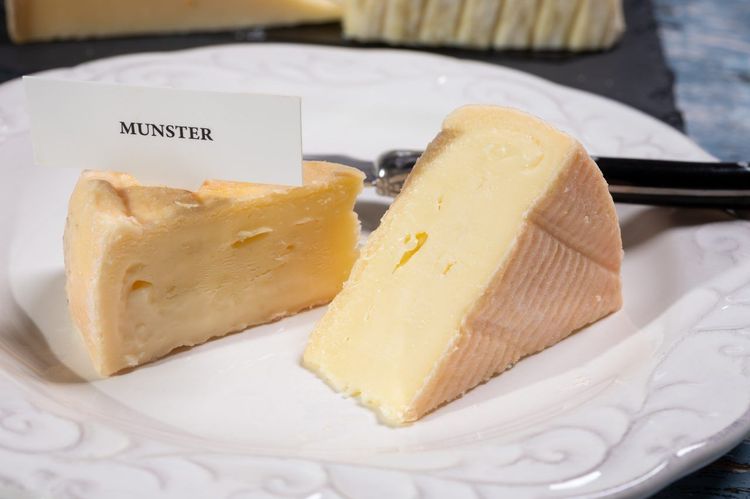
Munster (68140 Munster, rated 4.3/5 on Google from 4,000 reviews) gave its name to one of France's most emblematic cheeses: the PDO Munster-Géromé, produced in the Vosges mountain pastures using techniques dating back to Benedictine monks of the 7th century. The Saturday morning market is the largest in the valley, with farm producers selling their cheeses at different stages of ripening directly to customers.
The village is also the gateway to the Parc naturel régional des Ballons des Vosges, which covers 300,000 hectares between Alsace and Lorraine. From Munster, mountain roads give access by car to the Markstein (skiing in winter, hiking in summer) or to the Grand Ballon (1,424 meters, the highest point in the Alsatian Vosges). The old town was partly destroyed in 1944 and rebuilt in the 1950s, but the former tanners' school and a few 18th-century half-timbered houses survived.
FAQ
Which Alsace villages carry the "Most Beautiful Villages of France" label?
Five Alsatian villages hold this official label: Eguisheim, Hunspach, Bergheim, Mittelbergheim, and Hunawihr. Riquewihr and Kaysersberg, although frequently cited among the region's most remarkable villages, are not part of it. The label is awarded by the national association according to strict criteria for heritage preservation and local quality of life.
When should you visit Alsatian villages to avoid the crowds?
Spring (April–May) offers green vineyards and nesting storks, with manageable visitor numbers. Autumn (October–November) coincides with the grape harvest and new wines in golden light. Avoid July–August weekends in Riquewihr and Eguisheim, where tourist coaches begin arriving as early as 10am.
How do you travel between Alsatian villages without a car?
The train connects Strasbourg to Colmar with stops at Sélestat, Obernai, and Barr. Seasonal shuttle services reach certain villages in summer from Colmar (Riquewihr, Eguisheim, Kaysersberg). However, the most remote villages such as Hunspach in the Outre-Forêt or Ferrette in the Alsatian Jura require a vehicle.
Can you visit several Alsatian villages in a single day?
Yes, by car. From Colmar, a circuit easily covers Eguisheim, Turckheim, Kientzheim, Kaysersberg, and Riquewihr in one day. From Strasbourg, Obernai, Barr, Andlau, and Dambach-la-Ville form a loop of roughly 80 km that is very well suited to a full day out.
Are the historic centers of Alsatian villages wheelchair accessible?
The cobbled historic centers of Riquewihr, Eguisheim, and Kaysersberg present difficult surfaces for people with reduced mobility. Obernai and Wissembourg have better-equipped pedestrian zones. Neuf-Brisach, with its straight streets and flat pavements inherited from the Vauban plan, is the most accessible of the 20 villages in this selection.
These beautiful Alsatian villages concentrate, within less than 200 km from north to south, a density of medieval villages unmatched anywhere in France. Whether you are looking for the most beautiful villages in Alsace for a weekend or for a week-long road trip, each one has its own character: the Outre-Forêt architecture of Hunspach has nothing in common with the vineyards of Riquewihr, and the Jura stonework of Ferrette contrasts sharply with the half-timbered houses of Kaysersberg.
To plan your stay and explore the region from its two main cities, the Strasbourg audio-guided tour covers 33 points over 6.6 km, and the Colmar audio walking tour is the perfect introduction to central Alsace before venturing out to the wine-route villages.
À lire également