© Shutterstock
 Votre guide Ryo
Romantic Weekend in Alsace: 14 Unique Ideas for 2026
A romantic weekend in Alsace is unlike any other French getaway. The half-timbered houses clustered along the canals, the vineyards tumbling down the Vosges ridges toward the Rhine plain, the villages frozen in a storybook setting — everything here naturally invites slowness and togetherness. Yet most guides stop at the same images: Strasbourg at Christmas, Colmar as a postcard. This couples' getaway goes further: a night in a treehouse cabin in the Vosges, dinner in a 16th-century cellar in Riquewihr, a Nordic bath facing the fir trees, a guided walk through Strasbourg with the Ryo Strasbourg audio guide to discover hidden courtyards that few visitors ever suspect. Two days are enough to collect lasting memories, provided you choose the right places.
Strasbourg for Two: Getting Lost in Petite France
Strasbourg is the city that naturally comes first on an Alsatian weekend, not out of obligation, but because its historic center — a UNESCO World Heritage Site — offers something rare: a density of beauty on a human scale. You can spend two days here without a car and never feel like you're going in circles.
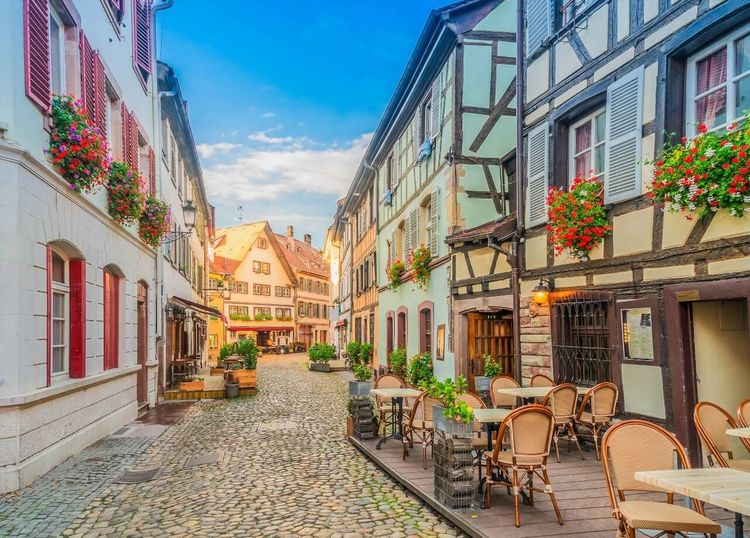
The Petite France district forms the historical heart of the city. The cobbled lanes run alongside the Ill, the corbelled houses reflect in the green water of the canals, and the covered bridges — three medieval towers linked by walkways — create a backdrop that even hurried tourists stop to photograph. In the morning, before 9 a.m., these lanes are almost deserted. It is here, in that relative silence, that Strasbourg reveals its most intimate side.
From Petite France, make your way toward Notre-Dame Cathedral along the rue du Vieux-Marché-aux-Poissons. The Vosges pink sandstone façade changes color depending on the hour: golden in the morning sun, deep burgundy at dusk. The spire, long the tallest in Europe at 142 meters, has dominated the city since the 15th century. Inside, the 16th-century astronomical clock puts on a mechanical "show" at 12:30 p.m. every day — the apostles file past Christ while death tolls its bell.
To explore Strasbourg beyond the postcards, the Ryo Strasbourg audio guide tour offers 32 listening points across 6.6 km in 2h40. It leads you to the Neustadt, the Wilhelmian district inscribed on the UNESCO list in 2017, whose Belle Époque façades rival those of Vienna. Few visitors venture there alone: the decorative panels, the neo-Gothic interior courtyards, and the Art Nouveau skylights on apartment buildings remain invisible if you don't know where to look up.
For dinner, two contrasting options. The Maison Kammerzell at the foot of the cathedral is the city's most famous address — a 15th-century carved façade, an interior laden with painted woodwork, classic Alsatian cuisine. If you prefer something less touristy, the winstubs (Alsatian taverns) on rue des Moulins or the Grand'Rue serve the same choucroute garnie and baeckeoffe in a rawer setting, among regulars.
The evening stroll through Petite France is a moment apart. The illuminated houses reflect in the still canals, the background noise of the city fades away, and you understand why this city so often appears on Europe's most charming destination lists. The Ryo audio-guided tour runs through the same lanes, from the Covered Bridges to Notre-Dame Cathedral, at whatever pace you set.
A Night on the Water in Strasbourg
Strasbourg is an island in the strictest sense: the historic city is surrounded by the arms of the Ill. This distinctive geography has given rise to an accommodation offering that few French cities can match: hotel barges.
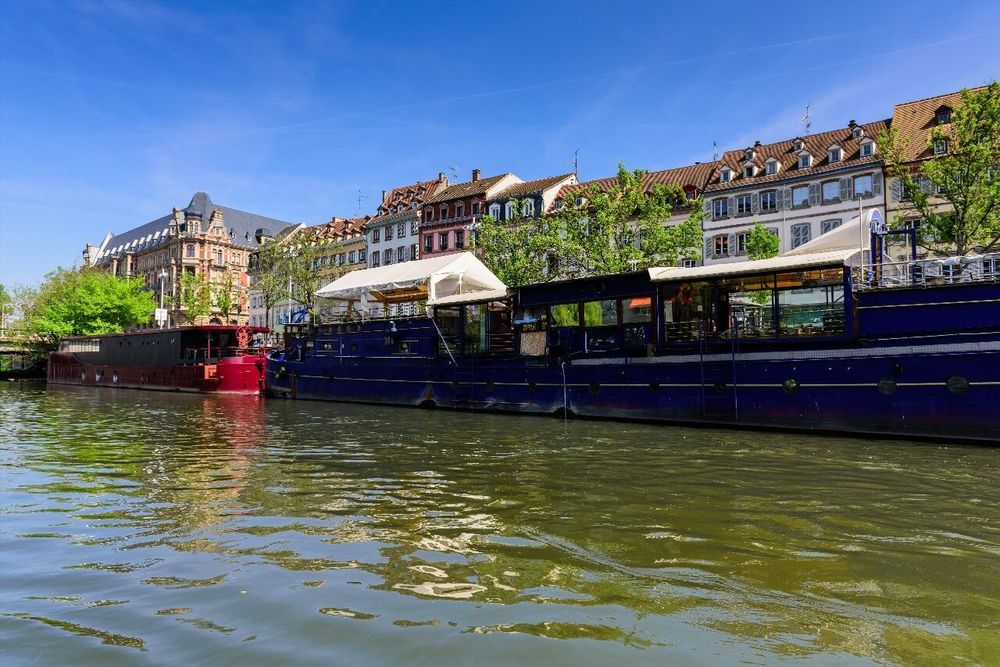
Barges moored in the commercial port or along the quays near Petite France offer double cabins on board, sometimes with a terrace on the upper deck opening directly onto the canal. Waking up to the sound of water lapping against the hull, watching the sightseeing boats drift past from your bed — it is a way of experiencing Strasbourg like no other.
The Escale Royale at the port of Saverne offers an even more elaborate version: a floating suite with hydrotherapy, a king-size bed, and a view of the lock. For those who want to stay in the heart of the city, several hotel barges are moored within easy walking distance of the historic district, less than ten minutes from the cathedral.
To round out the day before boarding, a boat ride along the canals of Strasbourg from the Palais Rohan embarkation point lets you see Petite France from the water — the half-timbered houses take on a whole new dimension when viewed from the Ill.
Colmar, the Most Photographed City in Alsace
Colmar rewards those who make the effort. The city, 70 km south of Strasbourg, is often reduced to its canals and the multicolored houses of the Krutenau Quarter (nicknamed Little Venice) — and that summary is not wrong, just incomplete. Colmar hides museums of disproportionate richness for a city of 70,000 inhabitants, a gastronomy that is the pride of the Haut-Rhin, and the feel of a lived-in city that sets it apart from the museum villages of the Wine Route.
The Little Venice district is the neighborhood that justifies the nickname. The ochre, red, and blue 17th-century houses reflect in the Lauch river; fishermen still set their traps here in the 19th century, and today you can rent a rowboat to drift between the flower-adorned façades in summer. At dusk, when the day visitors leave, the canals regain a calm that makes the stroll especially peaceful.
In the heart of the old town, the Maison Pfister (1537) is one of the best-preserved civic buildings in Alsace. Its two-story loggia, frescoes, and sculpted medallions make it a must-see stop. Nearby, the covered market (Markthalle) offers local produce every morning: farmhouse munster, artisan pretzels, and bredele cookies outside the festive season.
The Unterlinden Museum, housed in a former 13th-century Dominican convent, holds Grünewald's Isenheim Altarpiece, regarded by many as one of the most powerful works of art in Europe. Ten panels painted in the early 16th century to comfort patients suffering from Saint Anthony's fire: the anatomical detail of the crucified figures, colors of an almost hallucinatory intensity, pain rendered physically palpable. Allow at least an hour to take it all in.
To discover Colmar methodically without a paper guide or a group headset, the Ryo Colmar audio guide tour covers 21 listening points across 4.7 km in 2h10. It includes the quieter streets of the Tanners' Quarter and stories about the medieval guilds that shaped the city's architecture.
On the question of accommodation, Colmar offers several charming hotels in historic buildings in the center. Expect to pay between €120 and €250 per night for establishments in the old town; boutique options outside the walls remain more affordable.
Cabins and Unique Accommodations in the Vosges
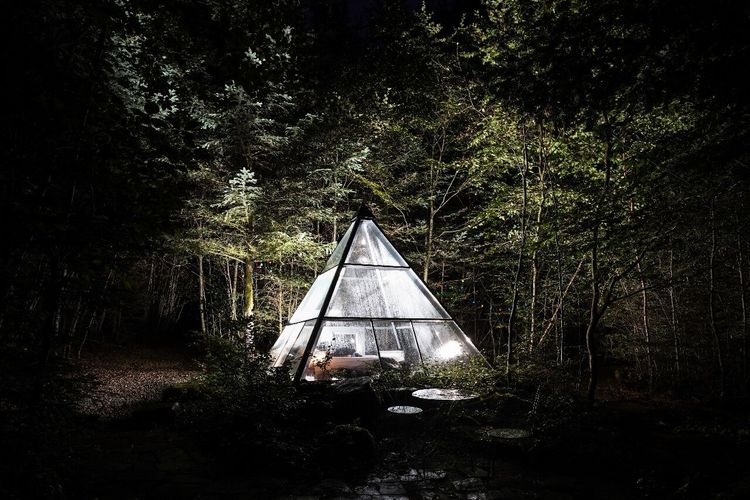
The real shift in an Alsatian weekend begins when you leave the plain for the Vosges. Less than an hour from Strasbourg or Colmar, the massif offers a concentration of atypical accommodations that make Alsace one of France's top destinations for unique overnight stays as a couple.
The treehouse cabins in the fir forests of the Haut-Rhin have flourished over the last decade. The concept: a wooden cabin on stilts at 4–8 meters above the ground, glazed on one or two sides to open onto the tree canopy, with a Nordic bath on the terrace. The Domaine des Constellations (119 Route de Gunsbach, 68370 Orbey, rated 4.8/5 on Google with 166 reviews) in Orbey is the best-known example: five houses named after stars (Céphée, Petite-Ourse, Pégase, Cassiopée, Orion), each with its own wood-heated outdoor hot tub. A night among the fir trees, with the clear sky of the Vosges massif above, is worth the journey in itself.
For a different experience, geodesic domes set up in forest clearings allow you to sleep under the stars without the constraints of camping. L'Orangerie du manoir in Oberhaslach offers one perched in the trees with views over the Bas-Rhin. The glass and steel structure creates a bubble of absolute seclusion amid the oaks.
The Scandinavian kotas represent a third option. These Finnish-inspired octagonal tents, fitted with a central stove and a private sauna, are multiplying in the Vosges foothills. Kota Évasion & Spa in Mollkirch offers two formats: the "Sous-bois" kota with a private sauna and the elevated "Canopée" kota. The combination of a wood fire, forest silence, and a cold dip in the neighboring stream makes for quite a radical digital detox.
Another category worth noting: the gingerbread cabins. In Ruederbach in the Haut-Rhin, La Cabane Pain d'Épices is a warm-toned wooden structure nestled in a private garden. Carefully chosen details, high-end bedding, a wood-burning stove — all for two people, with complete privacy.
For the more adventurous, Les Cabanes perchées du Grand Ballon in Goldbach-Altenbach combine suspended accommodation with an Icelandic spa: an open-air geothermal bath with views over the Rhine valley from 900 meters above sea level.
Booking: plan 3 to 6 months ahead for autumn and winter weekends, which are the most in demand. Rates range from €180 to €380 per night depending on the offering.
The Wine Route for Two
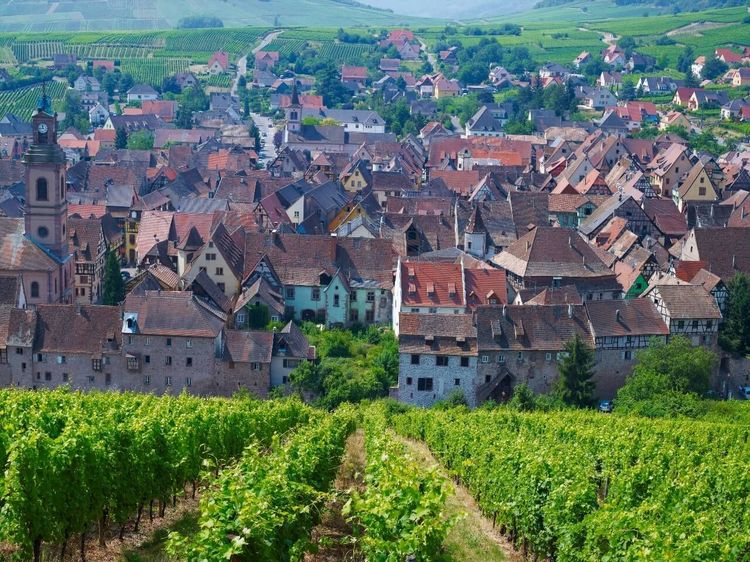
The Alsace Wine Route stretches for 170 km between Marlenheim in the north and Thann in the south. It is France's oldest tourist route (inaugurated in 1953) and one of its most beautiful: to the east, the Rhine plain; to the west, the vine-covered foothills; in the background, the ruined castles punctuating the Vosges ridge line.
For a weekend, it is better to focus on one section rather than trying to do everything. The Ribeauvillé–Colmar stretch (approximately 25 km) brings together the most beautiful villages and the most renowned appellations. It is easy to cycle along the secondary roads that wind between the grape varieties.
The seven Alsatian grape varieties authorized under the controlled designation of origin offer very different tasting itineraries. Riesling, dry and mineral, suits lovers of acidic whites; gewurztraminer, aromatic and lightly sweet, appeals to a broader audience; pinot gris falls somewhere in between. Alsace crémants, sparkling wines produced using the traditional method, make for good bubbles at a reasonable price — between €8 and €15 a bottle direct from the cellar.
In Turckheim, a fortified village 5 km from Colmar, the cooperative cellars open for visits with tastings included. The virtually intact medieval ramparts and the 15th-century Brand gate make a stop here obligatory. In Eguisheim (see the following section), several estates offer private tastings in the village's vaulted cellars — a more intimate experience than the cooperatives.
For those who are not driving (or do not want to keep an eye on their glasses), e-bike circuits departing from Colmar allow you to connect five or six villages in a day. Bike rental shops in the city center offer mapped itineraries with a list of open cellars.
Wine Villages: Riquewihr, Eguisheim, Kaysersberg
Three villages concentrate most of the charm of the Wine Route. Each has its own personality.
Riquewihr, about twenty kilometers north of Colmar, is often called the "most beautiful village in Alsace." The label is debatable, but the reality speaks for itself: an almost intact medieval enclosure, half-timbered houses from the 16th century, some leaning slightly under the weight of centuries, wrought-iron wells, and a defensive tower (the Dolder, 13th century) that you can climb for a view over the vineyards. Riquewihr has no parking in the old town; you must park outside the ramparts and enter on foot, which preserves an atmosphere that cars would have destroyed.
Eguisheim is the birthplace of Pope Leo IX (born in 1002). The circular plan of the medieval village is unique in Alsace: concentric rings of half-timbered houses surrounding the octagonal comital castle. The walk follows the rampart path — 45 minutes for the full circuit, punctuated by vines growing right up to the façades. The village was voted "Favorite Village of the French" in 2013. The Eichberg and Pfersigberg grand crus come from local terroir: two appellations to taste directly from producers in the village.
Kaysersberg (Fortified Bridge, 68240 Kaysersberg, rated 4.8/5 on Google with 122 reviews) completes this triptych. The birthplace of Albert Schweitzer (Nobel Peace Prize 1952) is nestled in the Weiss valley, at the foot of the Col du Bonhomme pass. The ruined imperial castle has dominated the rooftops since the 13th century. Heading down from the castle, Albert Schweitzer's birthplace — now the Centre Schweitzer on rue du Général-de-Gaulle — is open to visitors: a moving journey through the Nobel laureate's life and thought. The medieval fortified bridge over the Weiss, complete with its integrated chapel, is one of the rare remaining structures of this type still standing in Alsace.
If you would like to explore further, our article on the Alsatian villages around Colmar highlights a dozen other towns worth a stop depending on your itinerary.
Wellness and Spa in Alsace
Alsace has developed a thermal and wellness offering that naturally complements a winter or autumn stay. Outdoor Nordic baths and forest spas are the two formats that work best for couples.
In Saverne, 40 km west of Strasbourg via the A4, the Escale Royale on the canal offers on-board treatments. The hydrotherapy-and-floating-night combination makes for a self-contained weekend package for two.
In the Vosges, private Nordic baths are often included with the unique accommodations already mentioned. For those who want a day spa without an overnight stay, the Strasbourg Municipal Baths (6 Rue des Bains, 67000 Strasbourg, rated 4.2/5 on Google with 2,352 reviews) are a historic address: an Art Nouveau building from 1908, a main pool with a gallery, a hammam, and private bathing cabins. Very affordable rates.
On the spa resort side, Niederbronn-les-Bains in the Bas-Rhin is the only Alsatian thermal resort with naturally sparkling waters. The thermal center offers 2-to-5-day treatments, but a day session is also possible for passing visitors. The iron-rich waters of the Roman spring have been known since antiquity, and the resort traces its roots back to the Gallo-Roman era.
For more urban treatments, Strasbourg and Colmar have several high-end spa facilities in 4-star hotels in the center. Book duo massages well in advance, as they are particularly in demand on weekends.
Alsatian Gastronomy: Dining as a Couple
Alsace is one of the French regions with the highest density of Michelin stars relative to its surface area. Alsatian cuisine, built on centuries of Franco-German cultural layering, combines the precision of French sauces with the generosity of German portions.
The baeckeoffe is the emblematic weekend dish. Prepared the day before (the meats — beef, pork, lamb — marinate overnight in riesling), it then slow-cooks in a sealed earthenware terrine. The result is meltingly tender, aromatic, and hearty. This is not an ordinary restaurant dish: it must be ordered in advance at traditional winstubs.
The tarte flambée (flammekueche) works as a starter or evening dish alongside white wine. The classic version — thin crust, crème fraîche, onions, bacon lardons — is sometimes eaten standing up in certain wine caves along the Wine Route. Alsace also produces excellent sweet versions (apple, cinnamon, brown sugar) to finish the meal.
For a more gastronomic dinner, several Alsatian chefs hold Michelin stars in settings suited to an intimate meal. In Strasbourg, the Buerehiesel (4 Parc de l'Orangerie, 67000 Strasbourg, rated 4.6/5 on Google with 1,011 reviews) in the Parc de l'Orangerie offers contemporary Alsatian cuisine inside a 17th-century farmhouse transported from the Kochersberg. The setting — a glass conservatory overlooking the park, a vaulted cellar, antique objects — goes well beyond that of a simple restaurant.
In Colmar, restaurant JY's (Jean-Yves Schillinger), a brasserie reimagined in contemporary design, offers fusion cuisine blending Alsatian produce with Japanese influences. Expect €75–120 per person with food and wine pairings.
For a less formal but equally memorable meal, the farm inns of Alsace in the Vosges heights serve fixed-price local meals (between €20 and €35 per person) in alpine chalets. No menu: you eat whatever the farm produces that day — warm munster, house-made charcuterie, tourte de la vallée.
The Vosges Massif: Hiking and Nature
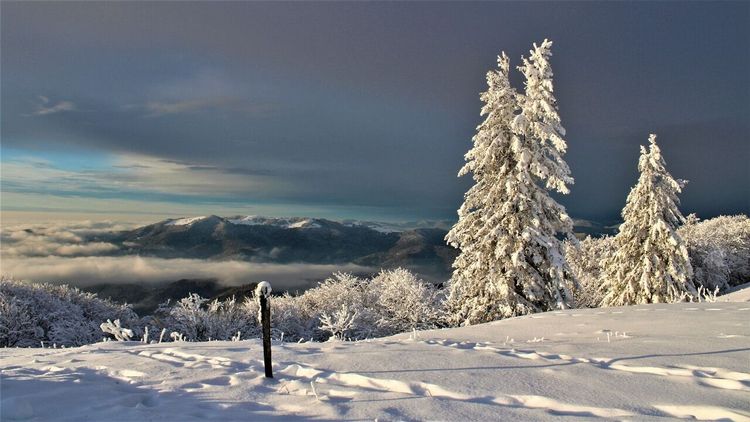
The Vosges massif forms the natural backdrop of all of Alsace. A 30-minute drive from Colmar or Strasbourg, the ridges reach 1,424 meters at the Grand Ballon (Haut-Rhin), the highest point of the Vosges. The panorama from the summit extends over the Alsatian plain, the Rhine, the Black Forest on the far side, and on clear days as far as the Bernese Alps.
For a weekend, two types of hike stand out. Ridge walks along the Sentier des Crêtes (GR5) offer open views over both slopes: on the Alsatian side, the vineyards below; on the Lorraine side, deep forests and the chaumes (the characteristic high-altitude pastures). The Markstein–Grand Ballon section (8 km round trip, moderate elevation gain) is accessible without any specific preparation.
The Vosges lakes offer a gentler alternative. The Lac Blanc (Route du Lac Blanc, 68370 Orbey, rated 4.6/5 on Google with 282 reviews) and the Lac Noir in Orbey are accessible via the D48. Lac Blanc, the larger of the two (29 hectares), is bordered by a fir forest that turns russet and gold in autumn. A full loop around the lake takes 1h30. Lac Noir, wilder, is set in a glacial cirque.
If the Vosges inspire you to go further, our article on the most beautiful hikes in Alsace details around fifteen itineraries categorized by level and duration.
Ruined Castles and Panoramic Views
Alsace has more than 60 ruined fortresses on its Vosges ridges — a concentration unique in France. Most are accessible on foot from the villages of the plain and offer panoramas over the vineyards and the Rhine plain without requiring any special equipment.
The Haut-Koenigsbourg, at 757 meters above sea level, is the only restored and habitable castle in Alsace. Kaiser Wilhelm II had it rebuilt between 1900 and 1908 in a neo-historicist medieval style that blends the authentic (the original enclosure walls) with the reconstructed (the entirely refitted interiors). Jean Renoir used it as a setting in La Grande Illusion (1937). The view from the battlements drops on one side toward the Alsatian plain, on the other toward the Vosges forests.
The castles of Ribeauvillé (Route des Châteaux, 68150 Ribeauvillé, rated 4.7/5 on Google with 1,674 reviews) — the Girsberg, the Saint-Ulrich, and the Haut-Ribeaupierre — form a set of three ruins along the same ridge line, reachable from the village in a 45-minute climb. The contrast between the crumbling walls and the panorama of vineyards below is striking.
Another suggestion: the three castles of Eguisheim (Wahlenbourg, Weckmund, Dagsbourg) on the hill above the village. The ruins are less spectacular than those of Ribeauvillé, but the walk through the vineyards to reach them is well worth it.
Things to Do as a Couple: 7 Memorable Experiences in Alsace
Beyond the classic itineraries, here are seven experiences that leave a lasting impression on an Alsatian stay for two.
1. Dinner in a vaulted cellar in Riquewihr. Several restaurants in the old town occupy medieval cellars whose stone vaults date from the 16th century. Candles, riesling by the carafe, baeckeoffe served in its original terrine: the setting is there, and it is entirely genuine.
2. Sunrise over the vineyards from Eguisheim. Leave the hotel around 6 a.m., climb the grand cru slopes in 20 minutes, and watch the raking light color the rows of vines — an experience that costs nothing and stays with you for a long time.
3. Cruise along the Ill in Strasbourg. The sightseeing boats departing from the Palais Rohan circle the central island in 70 minutes, passing under the covered bridges and skimming along Petite France by canal. In the evening, the illuminated buildings create a theatrical backdrop.
4. Nordic bath in the Vosges forest. Choose an accommodation with a private bath (see the cabins section), order a cheese and charcuterie platter from the estate, and spend two hours in the hot water while it freezes outside. The alternative is accessible even without an overnight stay at several day spa establishments.
5. An evening visit to the Strasbourg Christmas Market. The Christkindelsmärik of Strasbourg, first mentioned in 1570, spreads across several squares in the historic center from late November to late December. It is among the oldest Christmas markets in Europe. To enjoy it without the crowds, come on a Sunday after 8 p.m. — most visitors leave before then. For more details on the winter season, see our guide to the Christmas markets in Alsace.
6. Private tasting at an independent winemaker. Book a tasting in advance at a family estate on the Wine Route — Domaine Weinbach (25 Route du Vin, 68240 Kaysersberg, rated 4.6/5 on Google with 179 reviews) in Kaysersberg, Domaine Zind-Humbrecht in Wintzenheim, or any of a dozen other properties offering cellar visits by appointment. Unlike cooperatives, the tasting takes place with the winemaker in person, in their chai, with the vats as a backdrop.
7. Discovering Strasbourg's culinary specialties on a guided walk. The city hides its best addresses in side streets. For an introduction to the culinary specialties of Strasbourg — kouglof, bredele, artisan pretzel, aged munster — a stroll through the market and the winstubs of the center makes for a very pleasant afternoon program.
When to Go and How to Plan Your Stay
Alsace works year-round, but the seasons have very different characters.
Spring (April–May): cherry trees blossom in the plain orchards, the vines begin to bud, and the villages shed the winter crowds. It is the season of mild temperatures, with occasional showers.
Summer (June–August): peak tourist season, especially in July and August. Colmar and Strasbourg are packed, and unique forest accommodations fill up as early as March. The upside: hiking in the Vosges and picnics among the vines are perfect. Prefer weekdays to avoid weekend saturation.
Autumn (September–October): the grape harvest and the colors of the Vosges forests make this the most recommended period for a couples' getaway. The vines turn russet, the cellars reopen after the harvest with new primeurs, and the crisp air calls for Nordic baths and slow-cooked dishes. Book 3 months in advance.
Winter (November–December): the Strasbourg Christmas market transforms the city into a fairy-tale setting, but hotels charge the highest rates of the year during this period. January–February offers the same snowy landscapes at half the price.
How long? A classic 2-night weekend allows you to cover Strasbourg (1 full day + evening) and either Colmar or a village on the Wine Route (1 day). To add the Vosges and the castles, plan for a minimum of 3 nights.
Indicative budget for 2 people over 2 nights:
- Classic accommodation (charming hotel in the city center): €180–280 per night
- Unique accommodation (cabin, barge): €200–380 per night
- Dinner at a winstub (with wine): €50–80 for two
- Gastronomic dinner (Michelin-starred): €150–240 for two
- Transport between cities (Strasbourg–Colmar train): €10–14 per person
Alsace is very well served by the TER rail network from Paris (TGV to Strasbourg in 1h50 from Paris-Est, then TER to Colmar in 30 minutes). Renting a car remains essential for the Vosges and the Wine Route, as public transport does not reach most villages.
FAQ
What is the best season for a romantic weekend in Alsace?
Autumn (September–October) offers the best balance: grape harvests along the Wine Route, spectacular colors in the Vosges, cabins with Nordic baths in full season, and smaller crowds than in summer. The Christmas market (late November–December) creates a unique atmosphere in Strasbourg, but prices rise and the city becomes saturated on weekends. Spring (April–May) is an excellent second option for hiking and cycling enthusiasts among the vineyards.
Is it better to stay in Strasbourg or Colmar for an Alsatian weekend?
Strasbourg offers more diversity: a larger city, more varied gastronomy, canal cruising, the European quarter, and architecture ranging from medieval to contemporary. Colmar is more compact, more "picture-postcard", and better positioned to explore the Haut-Rhin Wine Route. For a 2-night weekend, one night in Strasbourg and one night in Colmar (or in a unique accommodation between the two) is the combination that reveals the most facets of the region.
Where can you find the most renowned unique accommodations in Alsace?
Le Domaine des Constellations in Orbey (cabins with Nordic bath) and Les Cabanes perchées du Grand Ballon in Goldbach-Altenbach consistently appear on the best lists. For geodesic domes, L'Orangerie du manoir in Oberhaslach is highly rated. For Scandinavian kotas, Kota Évasion & Spa in Mollkirch. Most of these places are fully booked several months in advance for autumn and winter weekends: be sure to book online.
How do you plan the Wine Route by car over two days?
Day 1: Start from Colmar, head north toward Riquewihr via Turckheim and Kaysersberg. Lunch in a winstub in Kaysersberg. Afternoon tasting in Riquewihr, evening in Colmar. Day 2: Head south toward Eguisheim, visit the village in the morning, tasting at a winemaker, picnic among the vines if weather permits, return to Colmar in the late afternoon. Total distance: approximately 50 km over two days. Avoid July–August weekends when roads between villages are very busy.
Is Strasbourg easy to explore on foot?
Yes, and it is actually the best way to do it. The central island (Grande Île) is a UNESCO World Heritage Site and can be covered entirely on foot in a day. The main attractions — the cathedral, Petite France, the covered bridges, and Neustadt — are within a 2 km radius of the center. To structure the walk and not miss any architectural details, the Ryo Strasbourg audio guide tour offers a 2h40 itinerary with 32 commented stops, downloadable on your smartphone.
Are there activities to do in Alsace outside of Strasbourg and Colmar?
Yes, and they are often the most memorable. The Vosges offer hiking, glacial lakes, mountain farm inns, and modest ski resorts (Gérardmer on the Lorraine side, Bussang, and the Grand Ballon area on the Alsatian side). Saverne, west of Strasbourg, is worth a stop for its Rohan castle and the Marne-Rhine canal. Sélestat, between Strasbourg and Colmar, has a 16th-century humanist library housing one of Europe's most precious manuscripts. For military history enthusiasts, the Maginot Line (the Schoenenbourg fortification, Bas-Rhin) can be explored on an underground guided tour.
Conclusion
Alsace makes for a couples' getaway that is hard to replicate elsewhere: the beauty of its medieval architecture, its viticultural richness, the Vosges forests within easy driving distance, and a gastronomic culture that turns every meal into an occasion. From Strasbourg to Colmar, from the vineyards of Eguisheim to the treetop cabins of Orbey, the region lends itself to tailor-made stays depending on the season and the pace you choose.
To explore Strasbourg and Colmar without missing the essentials, the Ryo audio-guided tours of both cities — Strasbourg (33 audios, 2h40) and Colmar (23 audios, 1h10) — offer two commented walks at your own pace, on your smartphone, with no guide and no group.
À lire également