© Shutterstock
 Votre guide Ryo
Activities in Strasbourg and Surroundings: Complete Guide 2026
Activities in Strasbourg and its surroundings are not to be counted but curated. Strasbourg needs no introduction: the Alsatian capital, sitting at the crossroads of France and Germany, packs within a few square kilometres a UNESCO-listed medieval heritage, major European institutions, and a geographical position few French cities can claim. Exploring these activities means embracing both the richness of the city itself and the wider hinterland — half-timbered Alsatian villages, the Vosges massif, the German bank of the Rhine — all reachable within under an hour's drive. Before venturing into the region, starting with the Ryo audio guide of Strasbourg is the most effective way to grasp the soul of the city: 32 stops, 6.6 km, 2h40 of discovery from Petite France to the European quarter.
This guide covers the must-sees — the cathedral, Petite France, Palais Rohan — but also some lesser-known gems: the imperial Neustadt district, Vosges vineyards and hilltop castles, Karlsruhe and Baden-Baden within easy reach by train. With or without a car, with family, as a couple or solo, there is always something to do in Strasbourg and its surroundings.
Petite France: the Medieval Heart
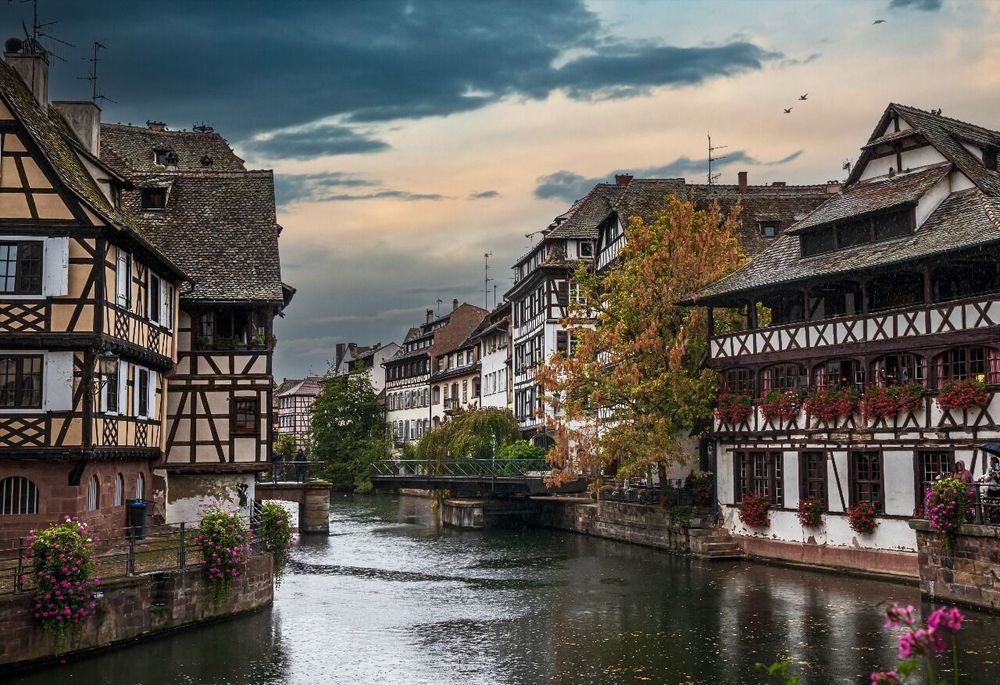
There is no better place to start. Petite France is the most photographed neighbourhood in Alsace, and probably one of the most architecturally coherent in Europe. Its 16th-century half-timbered houses reflect in the canals of the Ill with an almost implausible precision — yet the whole ensemble is entirely authentic: UNESCO inscribed the Grande Île on its list in 1988 precisely because no reconstruction was ever needed.
From Place Benjamin Zix, the view over the former tanners' and millers' houses — recognisable by their tall pitched roofs, designed to air-dry hides — is the one found on every postcard of the city. Continuing towards the Ponts Couverts, three 14th-century medieval towers marking the former city ramparts, you reach the Barrage Vauban: a completely free panoramic terrace over the Strasbourg rooftops, taking five minutes to visit and never forgotten.
Our Strasbourg audio-guided tour covers this area in detail with audio commentary on the history of the medieval guilds, the transformation of the neighbourhood under the Empire, and the legends still circulating about certain houses. If you have the Ryo app, activate it before turning into Rue du Bain-aux-Plantes — the context transforms the entire experience.
On weekday mornings, Petite France is almost quiet: the canals wind between private gardens, craftsmen's workshops dot the lanes, and the morning light on the half-timbered facades is worth the visit in itself. At weekends during high season, crowds build quickly — arrive before 10am or after 5pm.
Nearby, Place Gutenberg is worth a detour: it was here that printer Johannes Gutenberg perfected his movable-type press in the 15th century. The statue dedicated to him has stood since 1840 at the centre of this rectangular square, lined with historic shops, some dating back to the 18th century.
Notre-Dame Cathedral and Its Iconic Landmarks
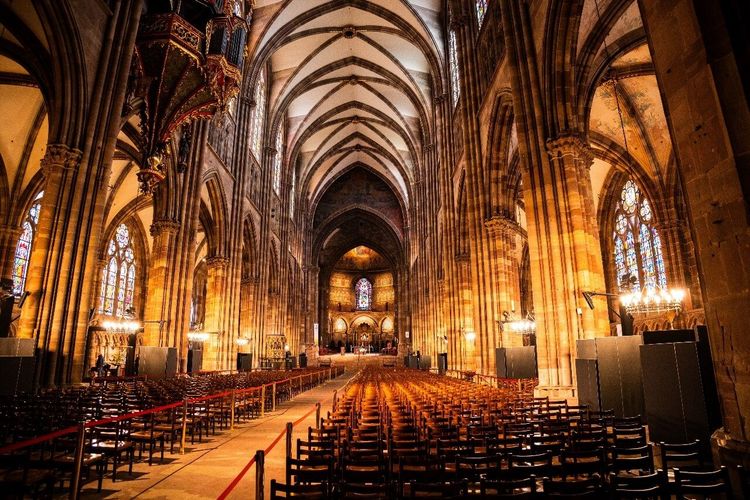
Strasbourg's Notre-Dame Cathedral is one of the most impressive Gothic structures in Europe, and for two hundred and twenty-seven years — between 1647 and 1874 — it was simply the tallest building in the world, with its 142-metre pink sandstone spire. Even today, it dominates the Alsatian plain from dozens of kilometres away.
The west facade is an open-air sculpted history textbook: Old Testament prophets, Wise and Foolish Virgins, scenes from the Passion, allegories of Virtues and Vices — all rendered with an iconographic density that takes hours to decipher. Inside, the central nave soars to 32 metres and houses the astronomical clock, a mechanical masterpiece whose current mechanism, signed by Jean-Baptiste Schwilgué, dates from 1842: its famous procession of apostles before Christ takes place every day at 12:30pm (except Sundays and feast days). If you wish to see the spectacle, arrive around noon with the dedicated ticket, purchased separately from the standard entrance ticket.
To prepare your visit with all the practical and historical details, our guide to Strasbourg Cathedral covers opening hours, prices, and the highlights not to miss inside.
The Palais Rohan, right next to the cathedral, houses three museums within its 18th-century salons: the Archaeological Museum (Roman and prehistoric collections), the Museum of Decorative Arts (Strasbourg faience, silverware, goldsmithery) and the Museum of Fine Arts (paintings from the 15th to the 19th century). A combined ticket gives access to all three at a modest price. The residence of the prince-bishops, built to rival Versailles in 1731, impresses as much for its neoclassical architecture as for its collections.
The Place de la Cathédrale and the Place du Marché-aux-Cochons-de-Lait surrounding it are lively throughout the day. In the evening, the cathedral's illuminations create an atmosphere that photographs never quite capture.
Strasbourg Museums: from Modern Art to Deep Alsace
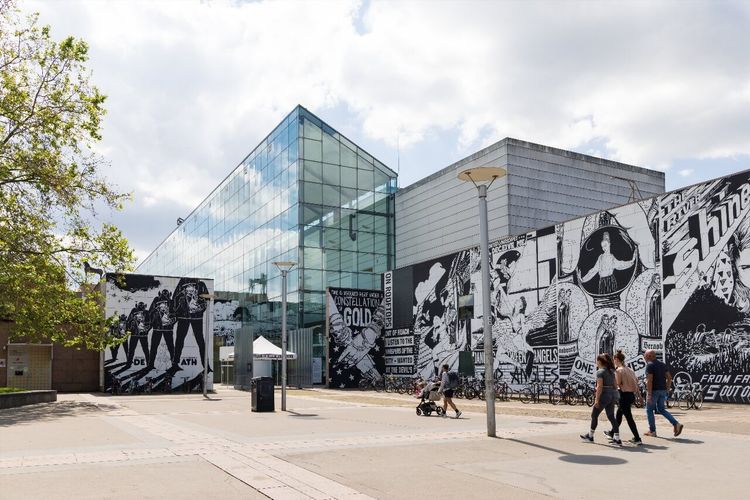
Strasbourg is a city of serious museums, often under-visited relative to what they deserve.
The MAMCS, open since 1998, occupies a glass building on the banks of the Ill with a permanent collection spanning Art Nouveau, German Expressionism, Surrealism, and international contemporary art. The Gustave Doré holdings — the Strasbourg-born engraver and painter — and the Hans Jean Arp collection are particularly remarkable. Allow at least 2 hours to do it proper justice.
The Alsatian Museum (23 Quai Saint-Nicolas, 67000 Strasbourg, rated 4.5/5 on Google based on 2,934 reviews), on Quai Saint-Nicolas, may be the most charming: housed in several 16th- and 17th-century Alsatian buildings connected by wooden galleries, it reconstructs daily life in Alsace from the Middle Ages to the early 20th century. Regional costumes, rural furniture, antique toys, traditional Alsatian nativity scenes — it is the ideal museum to visit before heading out to explore the villages of the plain.
The Historical Museum of Strasbourg, housed in the 16th-century medieval Grande Boucherie, traces two millennia of the city's history with a recently renewed scenography. For those interested in natural sciences, the Zoological Museum and the university's Botanical Garden offer an affordable alternative that families particularly enjoy.
Boat Trip on the Ill
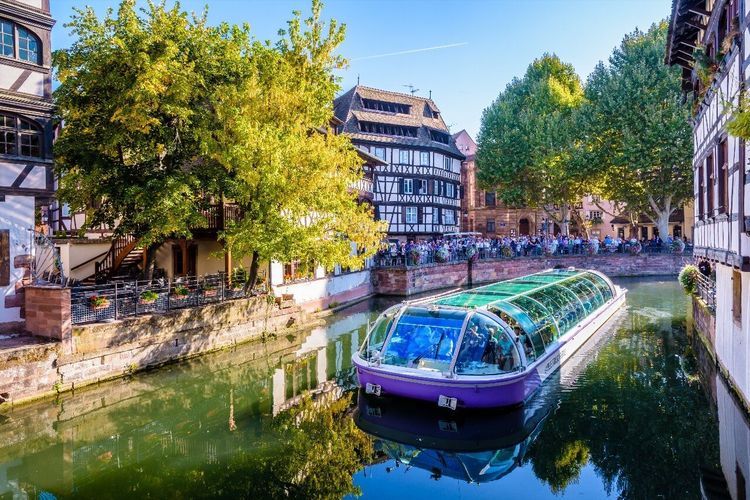
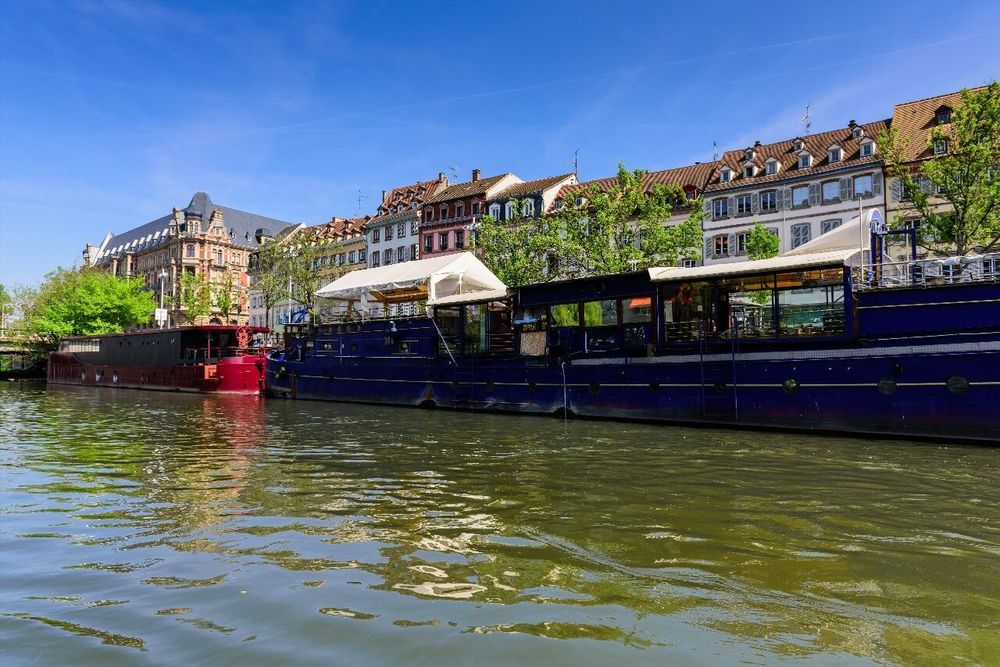
Strasbourg can also be discovered from the water. Sightseeing boats cruise the Ill and the city's canals; the journey lasts between 1 hour and 1h10, passing Petite France, the Ponts Couverts, Palais Rohan, and the European quarter. The company Batorama (15 Rue de Nantes, 67000 Strasbourg, rated 4.1/5 on Google based on 4,214 reviews) is the best-known operator, with regular departures from April to December and commentary available in several languages.
For a more active experience on the water, our guide to canoeing and kayaking in Alsace lists paddling spots across the region, from the Rhine's backwaters to the Vosges rivers, with required skill levels and local providers. The boat trip remains the most accessible option, ideal if you are travelling with children or people with reduced mobility.
Neustadt: the German Imperial District
Ten minutes' walk from the cathedral, the Neustadt is the most underrated neighbourhood in Strasbourg. Built between 1880 and 1918 under German administration, following the annexation of Alsace-Lorraine by the German Empire, it constitutes a unique Wilhelminian architectural ensemble in France: wide boulevards, neo-Gothic, neo-Renaissance and Art Nouveau facades, symmetrical squares. The ensemble was inscribed on the UNESCO World Heritage List in 2017, as an extension of the Grande Île.
The Place de la République (Place de la République, 67000 Strasbourg, rated 4.5/5 on Google based on 4K reviews), the heart of the district, is encircled by monumental buildings: the Palais du Rhin (former imperial residence), the National and University Library, and the National Theatre of Strasbourg. The contrast with the medieval Petite France is striking every time.
The European Parliament stands at the northern end of this district. Visits are possible with prior registration and give access to the hemicycle, the corridors, and the terrace overlooking the European quarter. Strasbourg has hosted the Parliament's plenary sessions since 1952, and this European dimension — unique for a city of 280,000 inhabitants — profoundly shapes the city's identity.
Our article on the German quarter of Strasbourg offers a detailed itinerary with the buildings not to miss, their history, and the anecdotes that accompany them.
Alsatian Villages: Hidden Gems Within 1 Hour
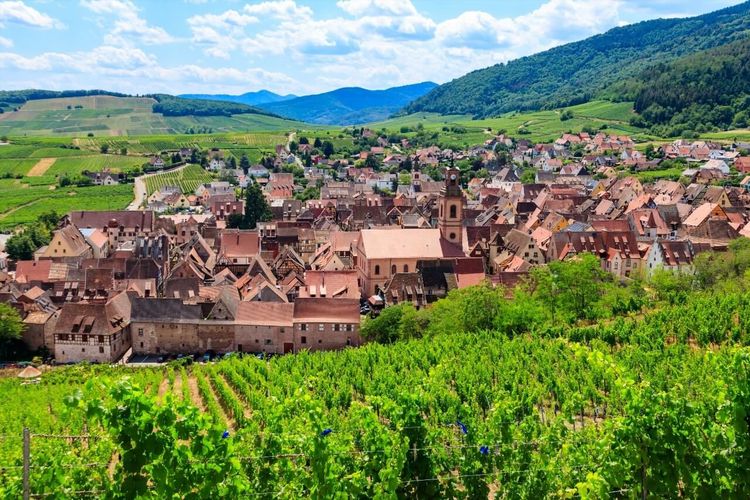
Venturing from Strasbourg into the Alsatian plain means stepping back in time within just a few kilometres. The Alsace Wine Route, stretching 170 km from Marlenheim (25 km from Strasbourg) to Thann, passes through villages so well-preserved they would make any film set designer envious.
Obernai, 30 km to the south, is one of the best-preserved Alsatian small towns: its market square, ringed by 16th-century half-timbered houses, its former grain hall, and its Renaissance well form a perfectly coherent ensemble. Sélestat, 45 km away, is often overlooked on tourist itineraries, yet its Humanist Library holds one of the most significant documentary collections in Alsace, including 15th-century incunabula and works annotated by Rhenish humanists.
Ribeauvillé, 65 km away, retains an authentic character despite the tourist numbers, with three hilltop castles looming in the background: Girsberg, Saint-Ulrich, and Haut-Ribeaupierre. Riquewihr (Rue du Général de Gaulle, 68340 Riquewihr, rated 4.7/5 on Google based on 8K reviews) has a reputation as the most visited village in Alsace — its intact medieval ramparts and flower-lined lanes justify it, even if tourist density is very high in July and August.
To avoid the crowds, head to Andlau (its 12th-century Romanesque abbey church and hillside vineyards), Dambach-la-Ville (medieval walls with three towers, fewer than 2,000 inhabitants) or Hunawihr (its fortified church shared between Catholics and Protestants for four centuries). Our selection of the most beautiful villages in Alsace around Strasbourg offers practical advice for each stop, including public transport timetables.
The farm inns scattered across the Vosges and the Wine Route deserve a special mention. Here you eat choucroute, baeckeoffe, and munster cheese made directly on the premises, often in exceptional mountain settings overlooking the plain. Our guide to Alsatian farm inns lists the best ones with prices and opening periods.
The Vosges: Hiking, Lakes, and the Route des Crêtes
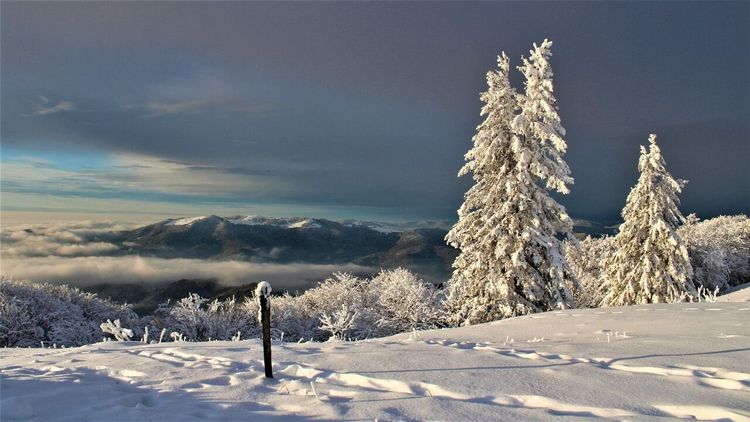
Less than an hour's drive from Strasbourg, the Vosges massif reveals another face of the region. No Alpine peaks here — the Vosges are gentle mountains, covered in fir and beech forests, dotted with chaumes (highland meadows) and small glacial lakes that warm up enough in summer for swimming. Hiking here is accessible to everyone, from families to seasoned walkers.
Mont Sainte-Odile, at 764 metres altitude and 35 km from Strasbourg, is the most visited religious site in Alsace. The convent at the summit, founded in the 7th century by Odile of Alsace, commands the plain from a vertiginous terrace with views of the cathedral on clear days. The Pagan Wall encircling the massif for 10 km — a Bronze Age rampart whose origins remain partially mysterious to archaeologists — adds an enigmatic dimension to any hike.
The Route des Crêtes follows the Vosges ridgeline for approximately 73 km, from Sainte-Marie-aux-Mines in the north to the outskirts of Cernay in the south, passing through the Col de la Schlucht, Hohneck, Markstein and Grand Ballon. By car, it is a one-day road trip with panoramic views over the Alsatian plain to the east and the Black Forest to the west on clear days (the road is closed to traffic from mid-November to mid-April). On foot or by mountain bike, it can be broken into sections of 10 to 30 km depending on the desired level.
The Vosges lakes are particularly enjoyable in summer: Lac Blanc (Route du Lac Blanc, 68370 Orbey, rated 4.5/5 on Google based on 5K reviews) (1,052 m, crystal-clear water, natural beach with minimal facilities), Lac Noir 3 km away, or the lakes of Gérardmer and Longemer in the Lorraine Hautes-Vosges. Cool water even in August, forest surroundings, little concrete infrastructure — a welcome contrast after days of urban sightseeing.
For detailed information on routes by difficulty level, our guide to the best hikes in Alsace lists trails with elevation profiles, durations, and starting points accessible by public transport.
Across the Rhine: Kehl and the Black Forest
One of Strasbourg's most tangible geographical advantages is being situated 300 metres from another country. Kehl, its German twin city, can be reached on foot or by bicycle across the Pont de l'Europe (Pont de l'Europe, 67100 Strasbourg, rated 4.5/5 on Google based on 731 reviews), a cycle and pedestrian bridge spanning the Rhine in about ten minutes from Neustadt. Weekly market, German supermarket, quiet town centre — Kehl is a light excursion that appeals equally to the curious and to cross-border shoppers.
Further afield, the Black Forest (Schwarzwald) begins 45 minutes by road. Baiersbronn, a spa village 1h15 from Strasbourg, is home to several Michelin-starred restaurants among the most celebrated in German gastronomy. It is a top-tier culinary destination if a same-day return trip does not put you off.
Baden-Baden, 1 hour by road (or 45 minutes by train), remains one of the most elegant spa towns in Central Europe. Its Roman baths discovered in the 19th century, its Belle Époque arcades, its historic casino (built in 1824, the oldest in Germany), and the Lichtentaler Allee park make it a very well-rounded day trip. For hikers, the marked trails of the northern massif start directly from the city's outlying districts.
Freiburg-im-Breisgau, 1h30 to the south, is the Black Forest's major university city: a historic centre with a Gothic cathedral, open-air canals running through pedestrian streets (the Bächle, remnants of a medieval irrigation system), and a cycling culture that would put many French cities to shame. Back on the Alsatian bank, our audio walking tour links Petite France to the European quarter.
Karlsruhe: the Cultural Surprise 1 Hour Away
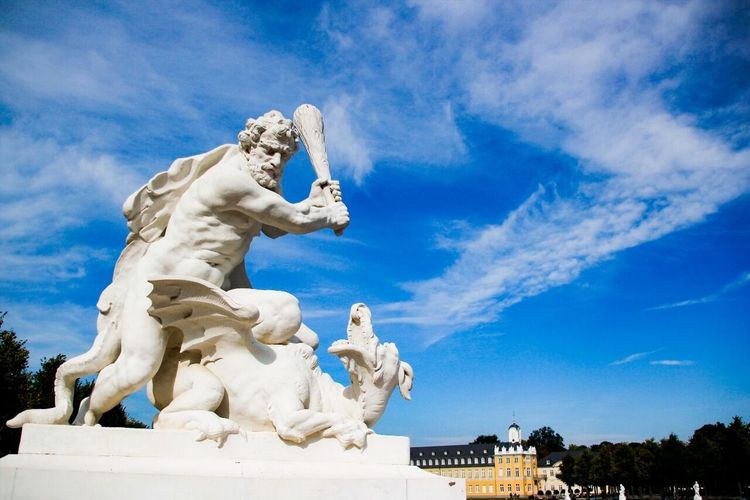
Karlsruhe is probably the most underrated destination within an hour of Strasbourg. Founded in 1715 according to a uniquely fan-shaped urban plan — 32 streets radiating from the central castle like sunbeams — it offers a surprising museum density for a city of 300,000 inhabitants.
The Badisches Landesmuseum in the castle traces 200,000 years of regional history with collections covering prehistory, Roman antiquity, and the Ottoman treasures brought back by Margrave Louis William after his military campaigns. The ZKM (Zentrum für Kunst und Medien), housed in a converted munitions factory, is one of the world's most important centres for digital and media art — a destination worth the trip on its own if you are interested in the intersection of technology and contemporary art.
In summer, the castle terrace overlooks an immaculate French-style park, and the Rhine banks on the Karlsruhe side offer lively cycling paths. The train from Strasbourg station (20 Place de la Gare, 67000 Strasbourg, rated 4.2/5 on Google based on 12K reviews) (45 min to 1 hour depending on the timetable) is often faster than driving at peak hours.
Sports and Outdoor Activities
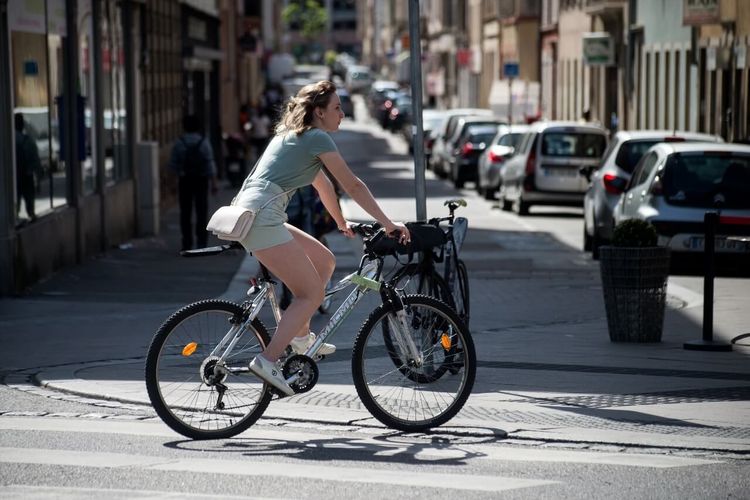
The region rewards outdoor enthusiasts in virtually every discipline.
Cycling is everywhere: the EuroVelo 15 network (the Rheinradweg, Rhine Cycle Route) follows the river for 1,230 km from the Swiss Alps to the North Sea. The stretch between Strasbourg and Colmar (approximately 65 km, flat and well-signposted) is comfortably doable in a day, passing through Rhine forests and Alsatian villages along the way. Within Strasbourg itself, the Vélhop scheme offers self-service bicycles from several stations across the city.
Canoeing and kayaking can be enjoyed on the Ill within the city, on the Bruche river in the Vosges, or on the former Rhine channels in natural surroundings. For a more relaxed day on the water, pedal boats on the Ill or stand-up paddleboard introductions can be booked through local providers.
For families looking for a memorable wildlife experience, the Parc animalier de Sainte-Croix in Lorraine (1h30 from Strasbourg) is home to over 1,500 animals from some 130 species, including European bison, lynx, brown bears, and several wolf packs, in semi-natural enclosures. Closer to home, the Stork and Otter Park in Hunawihr (70 km) offers otter fishing displays and stork reintroduction programmes featuring the emblematic Alsatian bird.
In the Vosges, via ferrata routes are available at several sites around Wangenbourg and Saverne. Difficulty levels range from easy to highly challenging depending on the route; equipment is available to rent at most sites.
Alsatian Gastronomy: Winstubs, Markets, and Vineyards
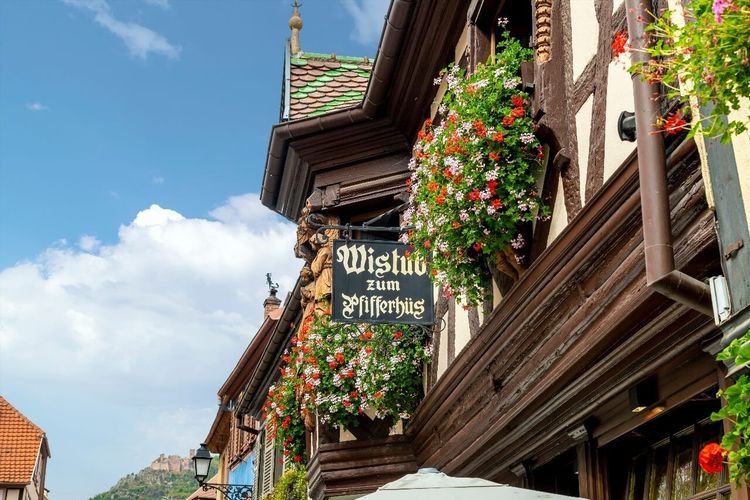
Strasbourg is as much to be eaten as it is to be visited. The winstub, literally a 'wine parlour', is the quintessential local gastronomic institution: solid wooden tables, chequered tablecloths, a short menu, no-fuss service. Here you eat choucroute garnie (with smoked pork, sausages and potatoes, cooked in riesling), baeckeoffe (a three-meat stew marinated overnight in Alsatian wine), tarte flambée (crème fraîche base, onions, bacon lardons) and presskopf (home-made brawn). Prices remain reasonable: expect €15 to €25 per main course at most establishments in the centre.
The Wednesday and Saturday market on Place du Broglie is one of Strasbourg's oldest. Munster cheese from Vosges producers, artisan pain d'épices, biodynamic Alsatian wines, mirabelle and quetsche plum jams — a complete circuit in itself before you even set foot in a restaurant.
Alsatian wines deserve their own exploration. The seven Alsatian grape varieties — riesling, gewurztraminer, pinot gris, muscat, pinot blanc, pinot noir and sylvaner — each have their own preferred terroir. Tastings are offered at virtually every cellar along the Wine Route, often free of charge or for a nominal fee.
To explore the gastronomy in depth before your trip, our article on the culinary specialities of Strasbourg details recipes, winstub addresses, and markets by neighbourhood.
Strasbourg with Children
Children get plenty out of Strasbourg, as long as you do not string together two solid days of museums.
The Parc de l'Orangerie, with its 26 hectares right in the city centre, houses a small free zoo (storks, ducks, deer, monkeys), a lake with pedal boats, recently updated playgrounds, and a rose garden. It is the green lung of the European quarter, walkable from the Parliament.
Le Vaisseau (1 Rue Philippe Dollinger, 67100 Strasbourg, rated 4.5/5 on Google based on 4,931 reviews), an interactive science centre for ages 2 to 15, offers hands-on experiences around technology, the environment, and the human body in a remarkable building. Allow 2 to 3 hours — children easily spend an entire afternoon without getting bored.
For ages 10 and up, the cathedral crypt, the dungeons of Haut-Koenigsbourg castle 60 km away (one of the best-preserved medieval fortresses in Alsace, restored under Wilhelm II), and the falconry displays at Fleckenstein castle near Wissembourg create memories that last.
Practical Information
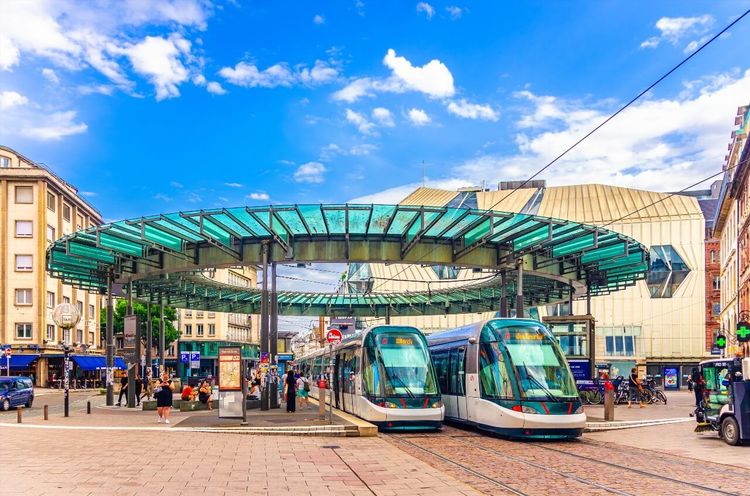
Getting around Strasbourg: six tram lines cover most of the city. The CTS 24h Solo pass (€4.60) gives unlimited access to tram and bus for 24 hours; for groups, the 24h Trio pass (€10.20) covers 1 to 3 people, including line D to Kehl. By bicycle, Vélhop offers bikes by the hour or by the day from several stations across the city — ideal on entirely flat terrain.
Exploring the region: the TER regional train serves Colmar in 24 min, Obernai in 20 min and Sélestat in 23 min from the central station. For more remote villages and the Vosges, a car remains virtually essential. Several rental agencies are located at the station.
To Germany: tram line D connects central Strasbourg directly to Kehl in 15 minutes. For Karlsruhe and Baden-Baden, the train (45 min to 1 hour) is often faster than driving at peak times. The Eurotram runs every 10 to 15 minutes.
Recommended duration: a minimum of two days for the city, one day for Alsatian villages, one day for the Vosges or Haut-Koenigsbourg, one day for a German excursion. A 4- to 5-day stay covers the essentials without rushing.
FAQ
What is the best time to visit Strasbourg and its surroundings?
Every season has its merits. Spring (April–May) brings mild temperatures and the first blooms across the vineyards. Summer (June–August) is peak season: pleasant warmth, lively terraces, the Strasbourg Jazz Festival in July, and open-air farmers' markets. Autumn may be the most beautiful season for the Wine Route, as vineyard leaves turn red in September–October and the harvest is in full swing. Winter has a special dimension: Strasbourg has hosted one of Europe's oldest Christmas markets since 1570, and the illuminated city takes on an entirely different character. One caveat: weeks coinciding with European Parliament plenary sessions cause hotel prices to spike sharply — check the calendar before booking.
How many days do you need to visit Strasbourg and its surroundings?
A two-day weekend covers the city's highlights: Petite France, the cathedral, Neustadt, and an evening in a winstub. To include excursions into the surrounding area, allow at least 4 to 5 days: one day for Alsatian villages, one day for the Vosges or Haut-Koenigsbourg castle, one day for a German getaway (Karlsruhe or Baden-Baden). A full week lets you combine everything at a leisurely pace.
Which day trips are most recommended from Strasbourg?
The Wine Route between Obernai and Ribeauvillé remains the classic Alsatian excursion: villages, wine cellars, and hilltop castles in the background. Haut-Koenigsbourg castle at 60 km is the go-to for medieval enthusiasts. Colmar, 45 minutes by train, deserves a full day to explore its own historic districts. On the German side, Karlsruhe and Baden-Baden are reachable in under an hour by train. For nature lovers, the Vosges ridges around Mont Sainte-Odile offer hiking trails for all levels just 35 km from the city.
Can you visit the Black Forest from Strasbourg in a day?
Yes, easily. Kehl is 15 minutes by tram from the city centre. Baden-Baden is 1 hour by train or car. Baiersbronn, known for its Michelin-starred restaurants, is 1h15 by car. The border is very permeable: many Strasbourg residents make regular trips for walks, thermal baths, or shopping. For the southern Black Forest (Freiburg-im-Breisgau), allow 1h30 depending on traffic.
Which Alsatian villages should you visit from Strasbourg?
The most accessible by public transport: Obernai (TER, 20 min), Sélestat (TER, 23 min), Colmar (TER, 24 min). The most picturesque by car: Riquewihr, Ribeauvillé, Eguisheim (listed among France's most beautiful villages), Kaysersberg (birthplace of Albert Schweitzer). To avoid the tourist crowds: Andlau, Dambach-la-Ville and Hunawihr are well worth the detour.
What can you do in Strasbourg when it rains?
Museums are the obvious choice: MAMCS for modern and contemporary art, the Alsatian Museum for regional history, Palais Rohan for decorative arts and fine arts. The cathedral easily fills an hour even in the rain. Le Vaisseau is an excellent option with children. And in the winstubs of the Petite France district, you can easily spend an entire afternoon over a choucroute and a gewurztraminer while waiting for the sky to clear — there are worse ways to pass the time.
Conclusion
Strasbourg and its surroundings form one of Europe's richest and most accessible areas to explore: a world city set within a medieval frame, a wine-growing plain dotted with villages from another era, the Vosges within easy weekend reach, and Germany a tram ride away. There is always a good reason to come back.
To start your exploration with the best possible context, the Ryo audio guide of Strasbourg accompanies you across 32 stops through the Grande Île, Petite France, and Neustadt — the ideal way to find your footing in the city before venturing into the wider region.
À lire également