© Shutterstock
 Votre guide Ryo
Château de Villandry and Its Gardens: Complete Visitor Guide for 2026
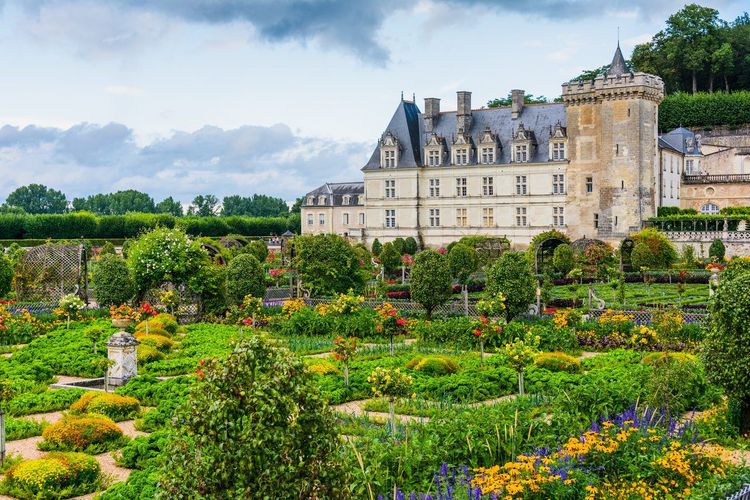
The Château de Villandry and its gardens form one of the most singular Renaissance estates in the Val de Loire. Most visitors passing through Touraine stop at Chambord or Chenonceau. Few venture as far as Villandry, and that is precisely why the site is worth the detour. Listed as a UNESCO World Heritage Site as part of the Val de Loire, the estate owes its reputation not to the grandeur of its apartments, but to something far rarer: an ornamental kitchen garden where red cabbages grow alongside hollyhocks, laid out in geometric parterres that resemble a living painting more than a working garden.
In this guide you will find the history of the château, a key to understanding its four garden levels, the best seasons to plan your visit, and everything you need to know before you go: opening hours, 2026 prices, and access options from Tours. A few timing tips will help you avoid the busiest moments and enjoy the belvedere in the best light. And if historic gardens captivate you beyond Touraine, our Ryo audio-guided tour of the Jardins du Luxembourg in Paris naturally extends the experience.
A Renaissance Château at the Heart of the Loire
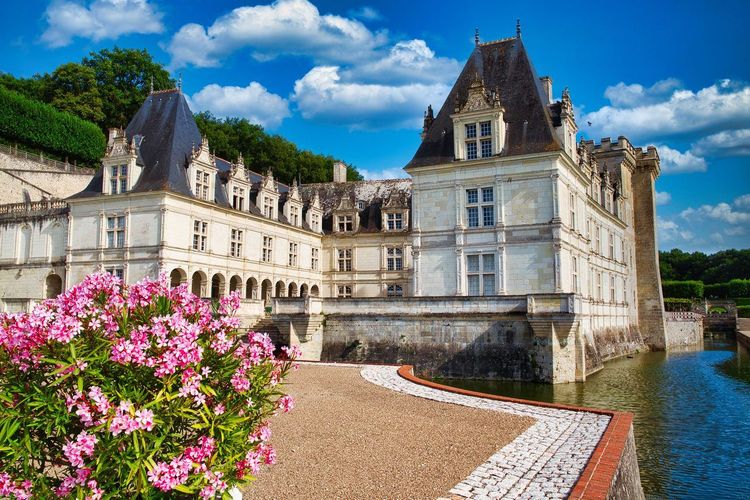
The Château de Villandry (3 rue Principale, 37510 Villandry, rated 4.7/5 on Google across 20,655 reviews) is the last of the great Renaissance châteaux built on the banks of the Loire, a distinction that speaks volumes about its state of preservation and the ambition of its designers. Built in 1536 by Jean le Breton, secretary of finances to François I and superintendent of royal works, the building adopts the horizontal rigour and sober elegance that define the late French Renaissance style: regular façades with mullioned windows, steeply pitched slate roofs, and corner towers with corbelled round turrets.
Jean le Breton had already overseen the construction of the Château de Chambord for the king. He brought that experience to bear on his own residence, purchasing the ruins of a medieval château and retaining its keep, which is still visible today. At his death in 1543, the building was unfinished. His heirs completed the work, after which the property changed hands several times over the following two centuries, falling into a long period of neglect.
It was in 1906 that a Spanish doctor, Joachim Carvallo, acquired the estate with his American wife Ann Coleman, heiress to a large industrial fortune. Finding the château in poor condition and the gardens overgrown, he undertook a meticulous restoration, drawing on Renaissance horticultural treatises and eighteenth-century engraved plans to restore the gardens to their supposed historical form. Four generations of the Carvallo family have run the estate ever since, a rare family succession for a monument of this scale.
The château is listed as a historic monument, and the Val de Loire has been inscribed on the UNESCO World Heritage List since 2000, placing Villandry within this exceptional ensemble.
The Gardens of Villandry: Four Levels to Explore
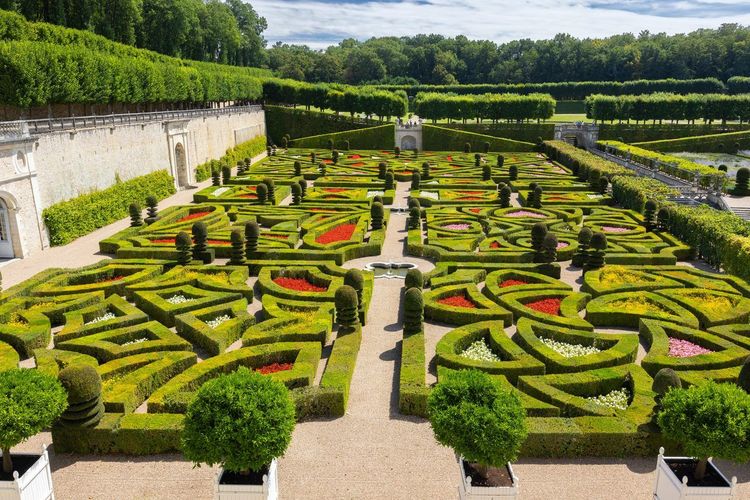
What sets Villandry apart from all other Loire châteaux is the organisation of the gardens across four terraced levels spanning a drop of approximately 16 metres. The whole covers six hectares and follows a north–south axis, typical of formal French gardens. Each level has its own logic, its own colour palette, its own rhythm of discovery.
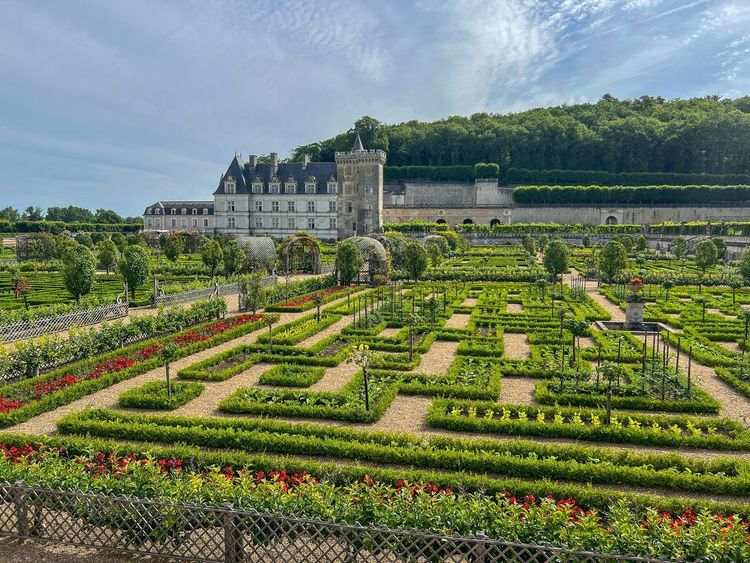
The natural way to visit the gardens of Villandry is to start at the top, from the belvedere and the water garden, then descend gradually through the ornamental garden, the herb garden, and finally the ornamental kitchen garden. This descending approach allows you to understand the overall composition from above before discovering its details at ground level. From the belvedere, the view takes in all four levels simultaneously, the château's rooftops, and the distant meanders of the Cher.
The figure that best conveys the scale of work involved: 120,000 plants are replanted every year by the gardening team. The kitchen garden vegetables are entirely renewed twice per season to maintain the chromatic density of the parterres. Some of the box hedges along the central paths are several centuries old. The coexistence of these centuries-old plants with entirely renewed seasonal plantings gives the garden its simultaneously timeless and living character.
The Ornamental Kitchen Garden: Villandry's Signature Work
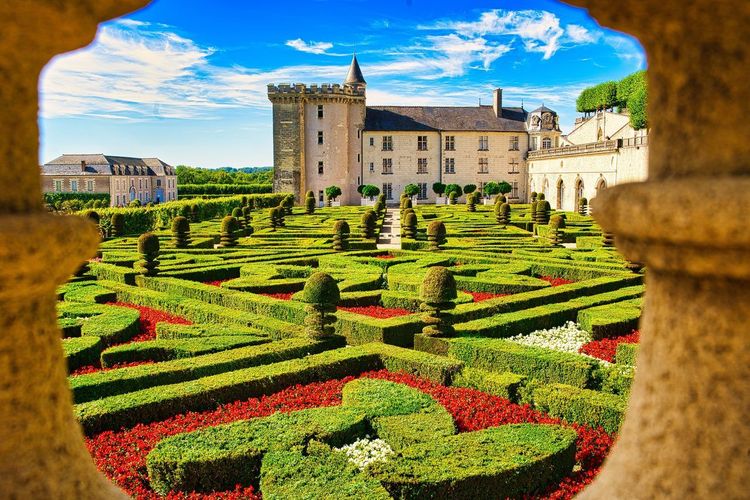
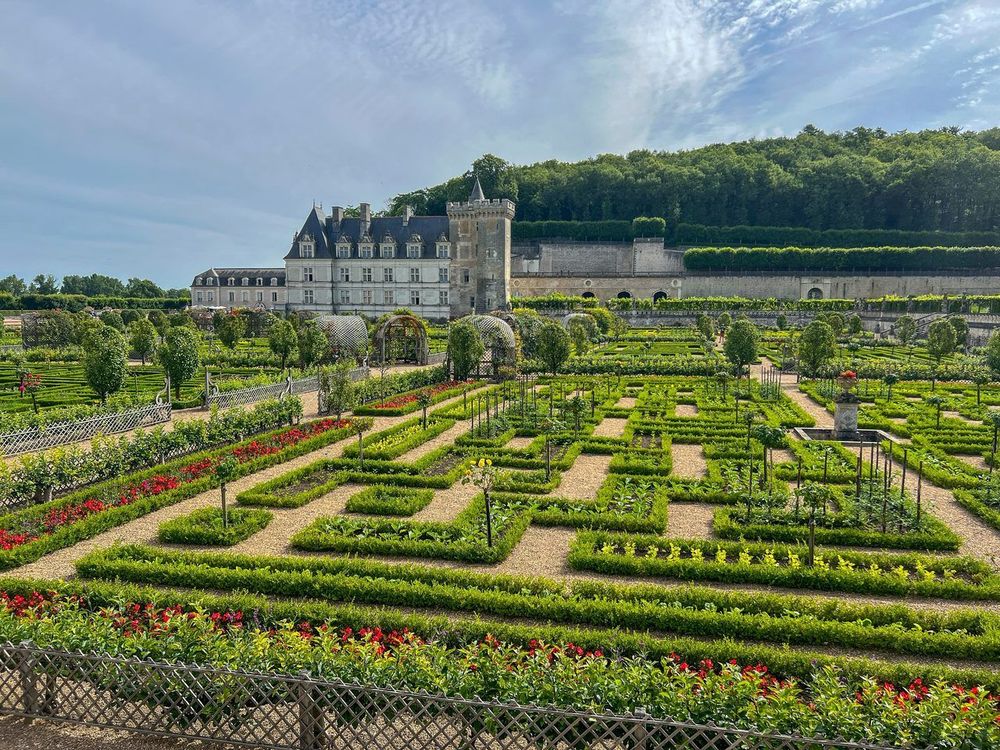
It is the ornamental kitchen garden that built Villandry's international reputation. Nine planting squares divided into geometric parterres where each vegetable is chosen as much for its colour as for its decorative value: red and purple cabbages, blue-green leeks, silvery artichokes, dark aubergines, golden and orange squashes. Each square traces a different pattern according to the arrangement of rows (crosses, diamonds, checkerboards), and the whole forms, seen from the belvedere, an embroidered carpet of startling precision.
The ornamental dimension of the kitchen garden is not a contemporary invention. Joachim Carvallo drew on Renaissance horticultural treatises, notably those of Olivier de Serres, to restore a kitchen garden such as those found in the great aristocratic residences of the sixteenth century. At that time, the working garden was also a garden of prestige: the care taken with the symmetry of the beds and the diversity of species reflected the refinement of the owner. Villandry revives this tradition by placing the kitchen garden at the heart of the estate rather than treating it as a functional annex.
Today, a portion of the vegetables grown is used in the château's restaurant. This concrete detail grounds the kitchen garden in an agricultural reality that goes beyond pure aesthetics: the carrots and beans do indeed end up on a plate served just a few metres away.
Two periods stand out for visiting the kitchen garden. July and August first, when the summer crops reach maturity and the chromatic contrasts are at their peak. Then September and October, when squashes and root vegetables take over with their highly photogenic orange tones. In May and June, the kitchen garden has just emerged from its spring replanting and presents a lighter, greener, less spectacular version than midsummer. If you are choosing between two periods, July remains the safest choice for colour.
The Ornamental Garden and the Garden of Love
The ornamental garden occupies the second terrace, directly in front of the château's façade. It comprises two sections with very different symbolism.
The first is the Garden of Love, divided into four parterres illustrating different forms of love according to Renaissance iconography:
- Tender love: hearts cut from box hedging, filled with pastel-toned flowers
- Passionate love: fragments evoking blades and arrowheads, dominated by vivid reds and oranges
- Fickle love: masks and fans clipped into the vegetation, symbols of emotional inconstancy
- Tragic love: swords and horns cut from dark box, an unambiguously dramatic register
This symbolic reading of the garden, documented in the Carvallo family archives, reflects the medieval and Renaissance tradition of a philosophical approach to gardening in which the planted space becomes a support for moral reflection. Each parterre can be read as a self-contained tableau, but it is the four together that give the whole its coherence.
The second section is more solemn: a parterre of cross-shaped clipped box, arranged around a central fountain, drawing inspiration from medieval monastic gardens. It contrasts with the colourful exuberance of the Garden of Love through its deliberate austerity and its plant palette reduced to green and grey.
A practical note: the ornamental garden works best when viewed from the first floor of the château or from the upper terrace, where the geometry of the parterres is fully revealed. At ground level, the height of the clipped box hedges conceals much of the design.
The Herb Garden, the Sun Garden, and the Maze
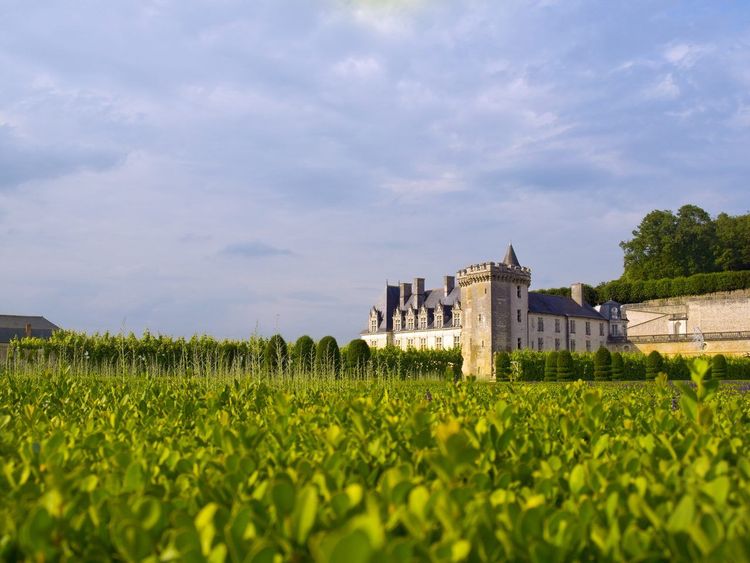
The herb garden holds a distinctive place within the Villandry estate. 'Simples' is the medieval term for aromatic and medicinal plants: thyme, sage, lavender, lemon balm, borage, nasturtium, and around a hundred other species. Laid out according to the principles of medieval monastic gardens, each plant is positioned according to its botanical family or its traditional therapeutic use.
Less spectacular than the kitchen garden or the Garden of Love, it is one of the most fragrant spaces on the site. The signage includes the Latin name and traditional properties of each species. In July, lavender and sage dominate the paths. Take the time to linger here rather than passing through quickly.
In the north-western corner of the estate, the Sun Garden is a more recent creation, designed in 2008 based on a sketch left by Joachim Carvallo. It features plants in warm tones (yellows, oranges, bordeaux) arranged in parterres inspired by solar symbolism. Right beside it, a hornbeam maze covers a modest area but is more than enough to keep children entertained while adults linger over the neighbouring parterres. The exit is signposted but not immediately obvious: allow around ten minutes.
The Water Garden: Calm and Reflections at the Top of the Estate
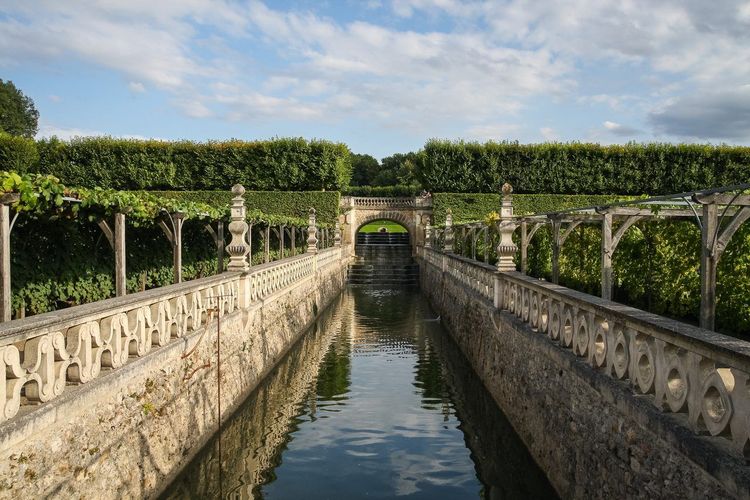
The water garden occupies the highest terrace of the estate, forming a striking contrast with the dense planting of the levels below. A large ornamental pond in the shape of a Languedoc Cross, bordered by weeping willows and carefully clipped topiaries, reflects the sky at different times of day. The water feeds the fountains and canals of the lower gardens in a cascade, via a hydraulic circulation system inherited from the eighteenth century.
It is from the adjacent belvedere that the most complete view over the entire estate is enjoyed. In the morning, the raking light across the kitchen garden parterres creates a play of shadows that emphasises the geometry of the paths. In the late afternoon, the reflections in the ornamental pond shift every twenty minutes with the movement of the sun. If you can only choose one moment in the day to come up here, opt for two hours before closing time.
Inside the Château: Renaissance Apartments and the Spanish Collection
Unlike Chambord or Cheverny, the Château de Villandry is visited in a fairly intimate way. Only a handful of rooms are open to the public, but each is carefully furnished and documented.
On the ground floor, a gallery displays a collection of Spanish paintings from the sixteenth and seventeenth centuries, a direct testimony to the Iberian origins of the Carvallo family. Masters of the Castilian school hang alongside anonymous canvases in gilded frames that clash elegantly with the French Renaissance coffered ceilings. This blending of heritages is unique to Villandry: no other Loire château presents a collection as resolutely Iberian in its apartments.
The main spiral staircase is one of the most elegant of the Touraine Renaissance. The mullioned windows of the first-floor apartments offer a direct plunging view over the ornamental garden, a perspective found nowhere else but from inside the building itself. Seeing the Garden of Love from this height, with its parterres in full bloom, is alone worth the price of the combined ticket.
The great hall on the first floor displays the original garden plan, reconstructed by Joachim Carvallo from archival sources and eighteenth-century engraved plans. This document conveys the scale of the restoration work carried out and the historical fidelity claimed by the family.
To plan a day among the Loire châteaux, Ryo offers practical guides: the Ryo guide to the Château de Chambord, just 45 km from Villandry, can easily be combined into the same day from Tours.
When to Visit Villandry: the Garden Calendar
The gardens of Villandry have no bad season, but each period offers a radically different experience.
April–May: the gardens emerge from their spring replanting. The kitchen garden is young and green, while the tulips and ornamental garden display their most vivid colours. Visitor numbers remain moderate, making this the favourite period for photographers and those seeking uncrowded paths.
June–August: the full season. The kitchen garden reaches its maximum chromatic density in July and August, with summer vegetables at their most intense. The gardens stay open until 7:30 pm in midsummer. Visitor numbers are high at weekends: opt for weekday mornings to avoid organised groups and tourist coaches.
September–October: squashes, root vegetables, and dahlias take over. The autumn light is particularly beautiful across the parterres, and the paths regain their calm from mid-September onwards. This is often the favourite season for local visitors.
November–March: the gardens remain open in a reduced form, with shorter hours and lower prices. The kitchen garden is dormant and certain areas are closed; the château interior itself closes for a few weeks around mid-November. The visit then focuses on the architecture and the clipped box topiaries, which are visible all year round.
One exception well worth the trip: the Nuits des Mille Feux, held on certain Saturday evenings in July and August, illuminate the estate with thousands of candles. A night-time experience radically different from a daytime visit, worth watching out for in the château's programme from the start of the season.
How to Get to the Château de Villandry
Villandry is located 17 km west of Tours, at the confluence of the Cher and the Loire.
By car: from Tours, the D7 follows the Loire along a scenic, well-signposted route. Free parking at the entrance to the estate. From Paris, allow 2h30 via the A10 motorway towards Bordeaux (exit Tours Centre, then the D7).
By train and bicycle: Tours station is served by TGV trains from Paris Montparnasse in 1h10. Bicycle hire is available at the station to follow the Loire à Vélo route, which is signposted and entirely flat all the way to Villandry. Allow 1h30 to 2 hours of cycling depending on your pace.
By tourist shuttle: seasonal shuttles connect Tours to the main châteaux from April to October. Timetables and operators change each season: check with the Tours tourist office at the start of the year. Tours station is also the starting point of our audio-guided city walk, which then heads for the Basilique Saint-Martin.
By taxi or private hire: from Tours station, approximately 30 to 35 minutes, costing between €35 and €45 depending on the operator.
Prices and Tickets for 2026
The estate offers two main options depending on what you wish to visit.
| Option | Adult | Child (under 8) | |---|---|---| | Château + gardens | ~€14 | Free | | Gardens only | ~€8.50 | Free |
There is no 'château only' ticket: access to the interior of the building always includes the gardens. Children under 8 enter free, and a reduced rate applies to those aged 8–17 and to students under 26 (approximately €8 for the château + gardens ticket, €5.50 for gardens only). Group rates are also available from 20 people.
Online booking is available in advance, which is recommended on July and August weekends when visitor numbers are high. The gardens are open every day of the year, except December 25; the château interior closes for a few weeks around mid-November (in 2026, it is accessible from February 7 to November 11, then from November 28 to January 3, excluding December 25). Opening hours vary by season: from 9am in summer to 10am in winter, with closing times between 5pm and 7:30pm depending on the month. For exact prices and up-to-date opening hours, consult the official Château de Villandry website before your visit.

FAQ
How much time should I allow for visiting Villandry?
Allow a minimum of two to three hours for a complete visit. The gardens alone can easily fill two hours if you take the time to descend all four levels, climb to the belvedere, and return via the side paths. The interior of the château adds forty-five minutes to an hour depending on your pace. If you arrive by car from Tours in the morning, you can easily combine Villandry with another château in the afternoon.
Is the Château de Villandry open year-round?
The gardens are open 365 days a year, except on December 25. The interior of the château, however, closes for a few weeks around mid-November: in 2026, it is accessible from February 7 to November 11, then from November 28 to January 3 (excluding December 25). Opening hours and accessible areas vary considerably by season. In winter, certain parts of the gardens are dormant and opening hours are reduced. The full season runs from April to October, with the longest opening hours in July and August.
Can you visit the gardens at Villandry without entering the château?
Yes. The 'Gardens only' ticket gives access to all four levels, the belvedere, and the outer paths without entering the building. This is often the option chosen by visitors returning for a second or third time. For a first visit, the combined ticket is recommended: the Renaissance apartments and the Spanish collection complement the outdoor experience well.
What is the best month to see the gardens in bloom?
It depends on what you want to see. May for the tulips and the ornamental garden at their peak. July and August for the ornamental kitchen garden in full chromatic density. September for a quieter atmosphere and autumnal tones. Note that the team replants the kitchen garden twice a year (early April and late June): the first weeks after each replanting offer a less spectacular display, so it is better to wait two or three weeks.
Is there parking at the Château de Villandry?
Yes, a large free car park is located directly at the entrance to the estate, accessible from the D7. Its capacity handles the usual crowds even in high season, except during special events such as the Nuits des Mille Feux. Additional parking is available in the village of Villandry, a few minutes' walk from the château.
Can you combine Villandry with other Loire châteaux in one day?
Absolutely. Several combinations are achievable in a single day:
- Villandry + Langeais: just 10 km away, both châteaux can be visited comfortably in a morning and an afternoon.
- Villandry + Azay-le-Rideau: at 14 km, this Renaissance gem on an island in the Indre is a natural companion for a Renaissance-themed day.
- Villandry + Cheverny: at 45 km, a busier day but entirely doable with an early start. The Ryo guide to the Château de Cheverny will help you plan your visit to this manor and its famous decorated apartments.
Villandry is one of those rare sites that reveal something different with each season. A first visit gives you the overall structure and the logic of the terraces; a second, in July or September, shows the gardens of Villandry looking almost unrecognisable compared to May. To continue discovering the great historic gardens of France, Ryo has put together a Ryo guide to the most beautiful parks and gardens of Paris and, for lovers of prestigious French formal gardens, a Ryo guide to the Château de Vaux-le-Vicomte whose Le Nôtre gardens offer a fascinating parallel with the Renaissance parterres of Villandry.
À lire également