© Shutterstock
 Votre guide Ryo
The Most Beautiful Villages to Discover around Tours in 2026
Touraine is more than the grand tuffeau façades of royal châteaux. The beautiful villages around Tours form a different, more discreet heritage: within thirty minutes of the Ryo audio-guided tour of Tours, a network of villages stretches along the Loire, the Cher and the Indre, each with its caves carved into the cliff face, its cobbled lanes and its gardens that have survived the centuries. A troglodyte village where houses burrow into the rock, a medieval town whose château has dominated the river since the eleventh century, a hamlet entirely covered in roses in June: this is what you find within a 60 km radius of the city.
This guide covers eleven villages, from the nearest to the farthest, with real distances from the city centre, what to see on the spot, and how to combine several stops in the same day. Some hold the 'Most Beautiful Villages of France' label; others are simply remarkable without having sought official recognition. All are worth more than an hour of your time.
Villages within 30 km of Tours: Where to Begin?
The first ring around Tours concentrates some of the most accessible sites, often served by public transport or easy to chain together by bike along the Loire à Vélo greenways. Vouvray and Rochecorbon are less than 15 km to the east; Villandry is 18 km to the west. These three villages make for a full day if you take the time to visit a cave, tour the château and have lunch on a terrace.
Beyond 30 km, the density of remarkable villages remains high, particularly to the southeast (Chédigny, Crissay-sur-Manse) and the northwest (Lavardin). The 'Most Beautiful Villages of France' label, which groups around 170 communes nationwide, has three representatives in Indre-et-Loire: Candes-Saint-Martin, Crissay-sur-Manse and Montrésor. Lavardin, just across the departmental boundary in Loir-et-Cher, carries the same label and naturally completes this selection within reach of Tours.
For a weekend based in Tours, a geographical logic makes sense: combine Vouvray and Rochecorbon on Saturday morning, then Chédigny and Montrésor in the afternoon, before heading to Candes-Saint-Martin on Sunday by following the Loire westward. During the week, the villages are noticeably quieter; farmers' markets are often held on Wednesday or Saturday mornings, which changes the atmosphere of a visit considerably.
Before you set off, check out the Ryo audio guide for Tours: the route connects several stops between Tours and Blois and provides a useful itinerary logic even if your goal is the villages rather than the grand châteaux.
There is no unified bus network linking all these villages to one another. The car remains the most flexible option. Some connections exist from Tours (Fil Bleu towards Vouvray, Amboise or Chinon), but schedules are limited at weekends. Cycling is a serious option for Vouvray, Rochecorbon and Villandry from Tours; the cycle path is continuous and well signposted.
Rochecorbon: The Troglodyte Village on the Loire Cliffs
Just 12 km east of Tours, Rochecorbon is the village that surprises visitors most who stumble upon it unexpectedly. The commune runs along the north bank of the Loire for several kilometres, with the river and its sandy islands on one side and a tuffeau cliff carved since the Middle Ages on the other. Several hundred caves burrow into this soft rock; some are still used to produce Vouvray appellation wines, while others have been converted into troglodyte dwellings that are still inhabited today.
The old village clusters around the church of Saint-Georges and an isolated medieval tower on a rocky spur, the lanterne de Rochecorbon, which once served as a lighthouse for the Loire boatmen. The climb to the lantern (a few dozen steps cut into the cliff) offers a panorama over the river and the wooded islands spread out below. The ascent takes less than ten minutes but the viewpoint is well worth the effort.
Several wine estates offer tastings directly in their troglodyte caves. The Domaine des Basses Rivières (Rochecorbon, 37210 Rochecorbon, rated 4.9/5 on Google from 32 reviews) and a few other Vouvray appellation properties welcome visitors without a reservation outside the harvest period. A visit to a cave carved into the tuffeau gives a good sense of why this material shaped local architecture for so long: the rock maintains a constant temperature of 12 to 14 °C year-round, ideal for wine storage.
Rochecorbon pairs naturally with Vouvray, the neighbouring village 3 km away, for a half-day dedicated to the white wines of the Loire.
Vouvray: Caves, Vines and Bubbles on the Banks of the Loire
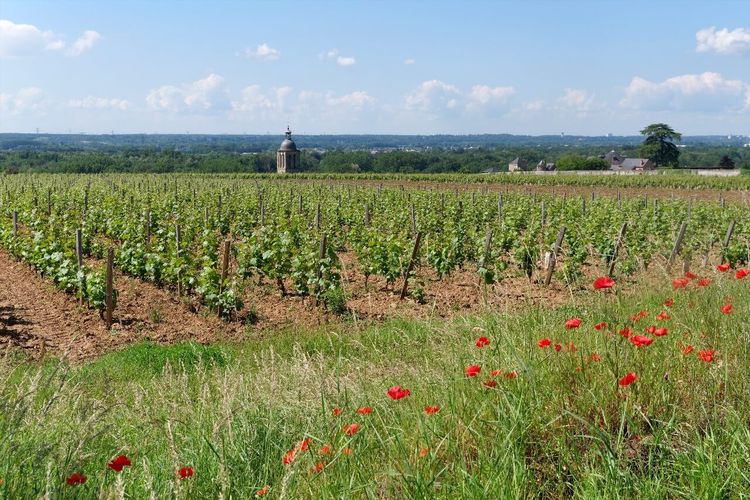
Vouvray is one of the best-known names in Loire winemaking, yet the village itself remains surprisingly understated. The town spreads between the north bank of the Loire and a succession of slopes covered with vines, mainly the chenin blanc grape variety, which produces dry, off-dry and sparkling wines here depending on the vintage and the winemaker's intentions.
The village centre is small — a square, a church, a few shops — but the caves that burrow into the surrounding cliff are the main attraction. Around ten estates open to the public dot the hillside roads: Domaine Huet (11-13 Rue de la Croix Buisée, 37210 Vouvray, rated 4.7/5 on Google from 117 reviews), one of the appellation's benchmark producers, offers guided visits with tastings by appointment. The Clos Naudin cave is also regularly accessible.
What sets Vouvray apart from other villages in the appellation is the density of inhabited caves and troglodyte dwellings still in good condition. Along the D46, which runs along the hillside towards Vernou-sur-Brenne, several houses simply have no back wall — the rock serves as wall, cellar and larder, as it has for several centuries. An architectural detail you rarely notice from the road, but one you immediately appreciate on foot.
Villandry: The Village of Royal Gardens
Villandry lies 18 km southwest of Tours, at the confluence of the Cher and the Loire. The château de Villandry is one of the most visited monuments in the region, but it would be a shame to limit the stop to the estate alone. The village itself, with its twelfth-century Romanesque church of Saint-Étienne and its white tuffeau houses, deserves a leisurely stroll before or after visiting the gardens.
The château de Villandry gardens (3 Rue Principale, 37510 Villandry, rated 4.7/5 on Google from 20,422 reviews) are often described as the finest formal French gardens in the Loire, a reputation that draws around 300,000 visitors a year. They are laid out on three levels: the water garden at the top, the ornamental gardens and the kitchen gardens, reconstructed in the early twentieth century by Dr Joachim Carvallo based on Renaissance depictions by Abbot Androuet du Cerceau. The geometric precision of the parterres, the changing colours through the seasons and the quality of the upkeep make this ensemble a benchmark for historic gardens.
To go deeper into the visit, the Ryo article on discovering the château de Villandry and its gardens gives full details on opening hours, admission prices and the best times to see the kitchen gardens in full bloom.
The church of Saint-Étienne de Villandry, right across from the château entrance, dates in part from the twelfth century and retains some interesting Romanesque capitals in the chancel. The visit is free and quick — about twenty minutes — but it offers a useful architectural counterpoint after immersion in the Renaissance gardens.
Crissay-sur-Manse: The Most Medieval Village in Touraine
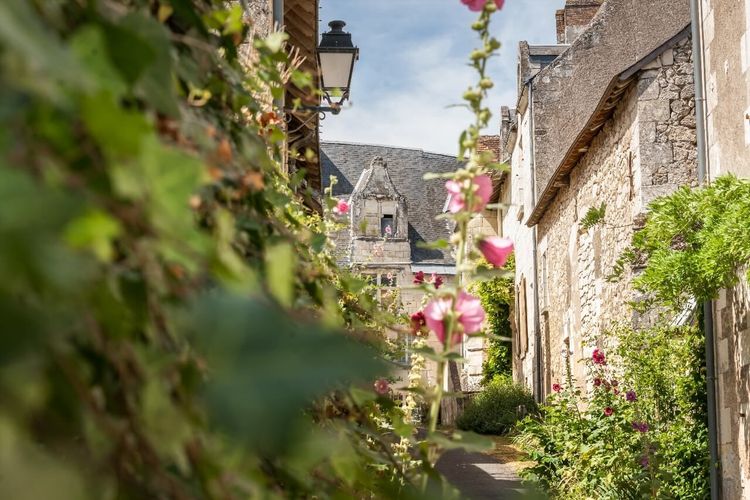
Some 40 km southwest of Tours, Crissay-sur-Manse has been listed among the 'Most Beautiful Villages of France' since 1993, a belated recognition for a village that few guides mention with the precision it deserves. The commune has fewer than 200 inhabitants and spreads across a hill overlooking the Manse valley, a quiet river that joins the Vienne a few kilometres further on.
What strikes you in Crissay is the architectural coherence of the whole. The medieval white tuffeau houses, some dating from the fifteenth century, have remained virtually intact. The façades display mullioned windows, carved lintels and stone wells — details found in textbooks on Flamboyant Gothic architecture but standing here, in a rural village, freely accessible. The château de Crissay (Crissay-sur-Manse, 37220 Crissay-sur-Manse, rated 3.1/5 on Google from 8 reviews), partially in ruins since the seventeenth century, dominates the village from its limestone spur and presents a recognisable silhouette from the approach road.
A walk through the village takes less than an hour on foot. No museum, no ticket office, no souvenir shop: Crissay is one of those rare villages where the interest lies entirely in the stone and the atmosphere. There is no formal market as such, but a few craftspeople and a small inn allow you to linger.
From Tours, allow 40 to 45 minutes by car, taking the D760 towards Chinon before turning off towards the Manse valley. The stop pairs well with Candes-Saint-Martin, about twenty kilometres further west.
Chédigny: When Roses Take over the Façades
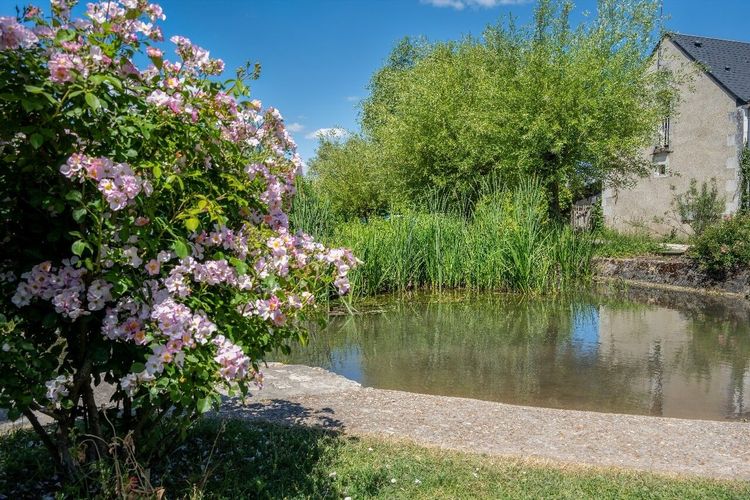
Chédigny (Chédigny, 37310 Chédigny, rated 4.6/5 on Google from 420 reviews) is probably the most surprising village on the list — not for its medieval architecture or its hilltop position, but for its rose bushes that climb by the thousand over house façades, low walls and gateways: close to 1,000 climbing roses alongside thousands of perennials and bulbs. It was the residents themselves, inspired by a former mayor in the 1990s, who planted and tended this living décor over the years, earning Chédigny its Remarkable Garden label, awarded in 2013: it is the only village in France to hold this distinction, which usually applies to enclosed parks and gardens.
The best time to visit runs from mid-May to the end of June, when the flowering reaches its peak. More than two hundred varieties coexist on the walls, from old roses to modern cultivars, and the entire village is blanketed in colours and scents that make the stroll feel almost surreal. Outside this period, Chédigny remains charming but loses much of its distinctive character. Entry to the village is free all year round.
The village is located 35 km southeast of Tours, in the Indrois valley. The access road runs alongside vineyards and the damp meadows typical of inland Touraine. Chédigny combines easily with Montrésor, 20 km further east, for a half-day in this part of Indre-et-Loire that standard tourist circuits often overlook.
Candes-Saint-Martin: At the Confluence of the Vienne and the Loire
Candes-Saint-Martin (Candes-Saint-Martin, 37500 Candes-Saint-Martin, rated 4.6/5 on Google from 950 reviews) is one of the most spectacular villages in the Val de Loire, yet it remains little visited outside the fine-weather season. Listed among the 'Most Beautiful Villages of France', it occupies a rocky spur exactly at the confluence of the Loire and the Vienne, a strategic point that has shaped its entire history since Antiquity. It is here, according to tradition, that Saint Martin of Tours drew his last breath in AD 397, as he was returning from a mission in Poitou.
The collegiate church of Saint-Martin, built in the twelfth and thirteenth centuries on the supposed site of the saint's death, is the central monument of the village. The building combines Romanesque and Gothic sections in a rare architectural harmony. The interior retains remarkable sculpted capitals and a Gothic nave whose vaulted height comes as a surprise for a village of this size. The north façade, with its fifteenth-century Flamboyant portal, is regularly photographed as an example of Touraine religious architecture.
The belvedere above the village offers one of the most striking views in the Val de Loire: the confluence of the two rivers, the white sand islands and the woods stretching as far as the eye can see form a panorama that has been fixed in the memory of Loire painters since the seventeenth century. In autumn, when the light shifts and the Loire is at its lowest, the site takes on an almost mineral quality.
Candes is 50 km from Tours, about 45 minutes by car along the south bank of the Loire (D751). The neighbouring village of Montsoreau, less than a kilometre away, belongs to Maine-et-Loire but links naturally with Candes in a single visit.
Montrésor: The Jewel of the Touraine Indre Valley
Designated one of the 'Most Beautiful Villages of France', Montrésor is located 55 km southeast of Tours, in the Indrois valley. The village owes its name to a treasure supposedly buried beneath the château, a medieval legend that has survived the centuries without losing its tourist appeal. What is certain, however, is that the site is one of the most complete in the region: a Gothic collegiate church, an inhabited château, a market under the covered halls and tuffeau houses that descend to the river's edge.
The château de Montrésor (Rue du Château, 37460 Montrésor, rated 4.3/5 on Google from 2,869 reviews) has a singular history: built on the foundations of an eleventh-century keep, it was purchased in the nineteenth century by a Polish count, Xavier Branicki, who restored and furnished it in the style of the period. The apartments are still inhabited by the family's descendants and remain open to visitors for much of the year. The interior is a curious blend of Polish furniture, family portraits and objects brought back from travels in Central Europe — an atmosphere that few Loire châteaux can match.
The collegiate church of Saint-Jean-Baptiste, adjoining the château, dates from the sixteenth century and preserves several remarkable Renaissance recumbent figures, including that of Jean de Bastarnay, adviser to three kings of France, and his wife. The architectural ensemble is visited in natural order: château first, then the collegiate church, followed by a descent to the medieval covered halls and the river.
The Montrésor market is held on Friday mornings under the fifteenth-century covered halls, one of the most authentic rural markets in inland Touraine, with local producers selling goat's cheese, honey and garden vegetables.
Lavardin: A Medieval Village Suspended above the Loir
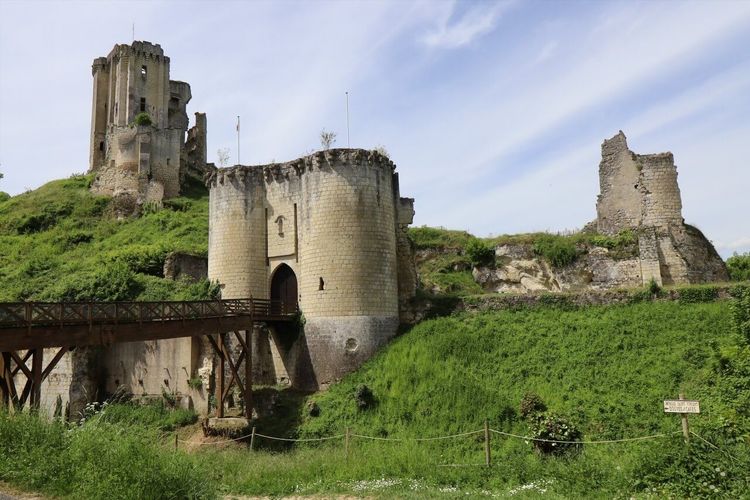
Lavardin stands apart in this selection: it lies not in the Loire or Indre valley but in that of the Loir (without an 'e'), 50 km northwest of Tours. This geographical detail changes the entire atmosphere of the village: the Loir is a slower, more wooded, less frequented river than the Loire, and Lavardin has preserved its secretive character accordingly.
The only village in Loir-et-Cher listed among the 'Most Beautiful Villages of France', Lavardin is distinguished by the ruins of its feudal château (Lavardin, 41800 Lavardin, rated 4.3/5 on Google from 688 reviews), one of the best-preserved in the region despite — or perhaps thanks to — its unabashedly ruined state. The château, built in the tenth to twelfth centuries, was dismantled on the orders of Henri IV in 1589 after withstanding several sieges. What remains standing — the towers, the successive enclosures, the square keep — is enough to convey the defensive power of the site, which controlled the road between Tours and Le Mans.
The village church of Saint-Genest houses one of the most important collections of Romanesque frescoes in the Val de Loire: dating from the eleventh to the sixteenth centuries, these murals cover almost the entire interior surface and are in themselves a reason to visit. The scenes of the Baptism of Christ and Christ in Glory are the most spectacular. Access is free, but the frescoes benefit from discreet artificial lighting — it is best to visit during daylight hours to appreciate the full range of colours.
The village borders the Loir along a grassy bank where it is pleasant to sit in the late afternoon. From Tours, allow 50 to 55 minutes via the A28 towards Le Mans. The stop pairs well with Vendôme, 15 km away, which also merits a half-day.
Artannes-sur-Indre and Beaulieu-lès-Loches: Two Discreet Villages Worth the Detour
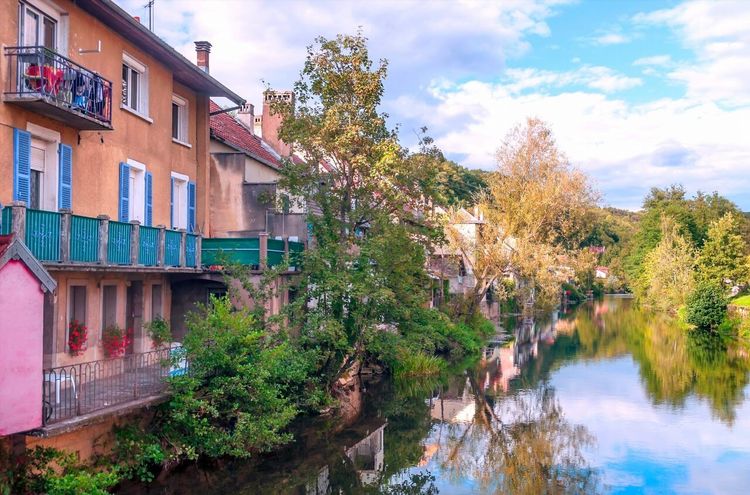
These two villages are less well known than the previous ones and carry no national label — which is precisely what makes them interesting for those looking to avoid overly frequented sites.
Artannes-sur-Indre lies 20 km south of Tours, in the Indre valley. The village is tiny — barely 700 inhabitants — but its setting is remarkable: the Indre makes a wide loop around a hillside on which the village spreads, giving the impression of an almost island-like settlement. Balzac described this landscape in Le Lys dans la vallée with a topographical precision that still allows today's visitors to find the exact viewpoints described in the novel.
Beaulieu-lès-Loches (Beaulieu-lès-Loches, 37600 Beaulieu-lès-Loches), 40 km southeast of Tours, is a commune that borders the town of Loches without being absorbed by it. Its main point of interest is the abbaye de Beaulieu, founded around 1004 by Foulques Nerra, Count of Anjou, in penance for his many war crimes. What remains of the abbey church, notably the Romanesque tower, displays an architectural sobriety that contrasts with the decorative exuberance of some Loire buildings. The village itself, with its tuffeau houses clustered against the abbey ruins, forms a coherent ensemble that can be explored in an hour.
These two stops combine naturally in a loop from Tours: Artannes in the morning, lunch in Loches, Beaulieu in the afternoon.
Planning Your Trip: Distances, Transport and Practical Tips
Setting out to discover the villages around Tours requires a minimum of planning — the distances are short, but most of these communes are not connected to one another by public transport in any practical way.
By car: this is the most convenient option. All the villages listed in this guide are reachable in under an hour from the centre of Tours. Roads are in good condition, and parking is free or nearly free in these small communes.
By bike: the villages close to the Loire — Vouvray, Rochecorbon, Villandry, Candes-Saint-Martin — are part of the Loire à Vélo greenway, an 800 km route that follows the river from the Ardèche to the Atlantic. The Touraine section is one of the most accessible: flat terrain, a path separated from the road for most of the route, clear signage. Allow a full day to chain Vouvray, Rochecorbon and Villandry from Tours.
By train: Tours station is connected to Loches (and therefore to Beaulieu-lès-Loches) by a direct line in 45 minutes. Some services run to Amboise, Chinon and Vendôme, which can serve as bases for reaching surrounding villages by bike or taxi.
Best time to visit: spring (April–June) and autumn (September–October) offer the most pleasant conditions — soft light, moderate crowds, caves and markets open. Chédigny is an exception: its rose flowering demands a visit between mid-May and the end of June, with the peak most often falling in the final weeks of spring.
The Ryo audio guide for Tours can serve as a starting point from the city before fanning out to the surrounding villages — its 23 audio tracks cover the historic centre in 2 hours and provide useful context on the history of the region.
FAQ
What are the most beautiful villages to visit near Tours?
Among the most remarkable villages within a 60 km radius of Tours, standouts include Candes-Saint-Martin, Montrésor, Crissay-sur-Manse and Lavardin for their 'Most Beautiful Villages of France' labels, as well as Rochecorbon for its troglodyte character and Chédigny for its rose bushes classified as a Remarkable Garden. Vouvray and Villandry round out the list for lovers of wine and historic gardens.
Can you visit several villages in a single day?
Yes, provided you choose geographically close villages. A good combination: Vouvray + Rochecorbon in the morning (both east of Tours, 3 km apart), then Villandry in the afternoon (to the southwest, 18 km from Tours). For the southeast, Chédigny + Montrésor pair well (20 km apart). Candes-Saint-Martin links naturally with Montsoreau, on the other side of the confluence.
Are some villages accessible without a car?
Vouvray is the best served from Tours via the Fil Bleu bus network. Loches (and by extension Beaulieu-lès-Loches) is accessible by train in 45 minutes. For other villages, a car or bicycle remains necessary. The Loire à Vélo route allows you to reach Vouvray, Rochecorbon and Villandry by bike from Tours along a continuous dedicated path.
What is the best time to visit Chédigny?
The window from mid-May to the end of June is ideal for seeing Chédigny's rose bushes in full bloom, with the peak typically falling in the second half of June. Out of season, the village remains charming but loses its most distinctive character. Access to the village is free all year round.
Are the villages around Tours suitable for children?
Most of these villages are suitable for a family outing, especially for children aged 6–8 and above. The gardens of Villandry offer specific trails for children. The ruins of Lavardin castle and the troglodyte caves of Rochecorbon and Vouvray generally appeal to children aged 8–10 and older. Comfortable shoes are recommended for cobbled lanes.
Is Montrésor really worth the trip from Tours?
At 55 km from Tours, Montrésor requires about 55 minutes by road. The detour is worthwhile if you have a half-day available and an interest in Renaissance architecture and historic interiors. The château, with its unique Polish collections found nowhere else in France, stands clearly apart from the classic Loire châteaux. The Friday morning market adds a lively dimension to the visit.
Conclusion
The villages around Tours form a discreet constellation that reveals itself only to those who take the trouble to stray from the tourist highways. From Rochecorbon to Montrésor, from Crissay to Lavardin, each village brings its own architectural logic, its own relationship to the river and to tuffeau stone. It is these accumulated details — a medieval lantern on a rocky spur, Romanesque frescoes beneath a limestone render, hundreds of roses climbing a village façade — that give Touraine its singular character.
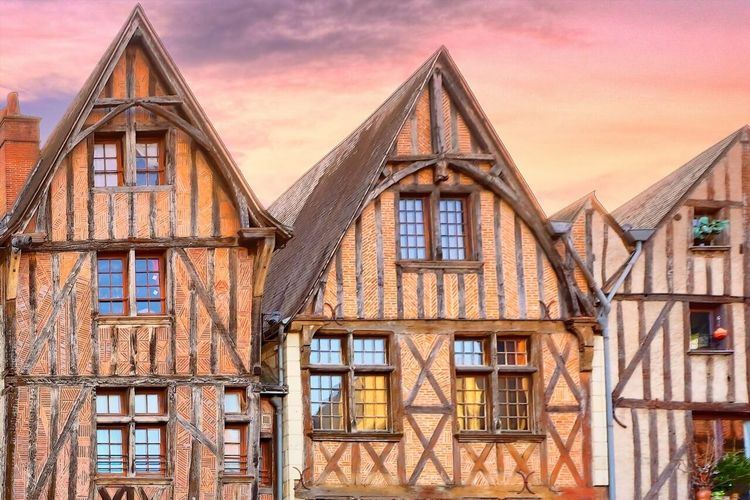
Before or after your exploration of the villages, take the time to discover Tours itself: the Ryo audio guide for Tours covers 22 points of interest in the historic centre in 2 hours, with audio tracks on the cathedral of Saint-Gatien, the half-timbered house quarter and the Loire riverbanks — a useful introduction to the history of the region.